
Design for Living
Una mujer para dos
1933 · United States · 88 min
- Director
- Ernst Lubitsch, Ben Hecht
- Screenplay
- Ben Hecht, Noël Coward
- Producer
- Ernst Lubitsch
- Music
- John Leipold
- Cinematography
- Victor Milner
- Editing
- Frances Marsh
- Production company
- Paramount Pictures
- Based on
- Design for Living
Cast
What it is about
Two Americans living in Paris, the painter George Curtis and the playwright Tom Chambers, meet Gilda Farrell on a train. She works as a commercial artist, and both men fall for her, straining their friendship. Unable to pick one, Gilda suggests the three live together as friends, with the understanding that they will not become lovers. Lubitsch's comedy turns this romantic tangle into a sly test of friendship and of the social conventions of its day.
How it was made
The film takes its starting point from Noël Coward's 1932 Broadway hit, but Lubitsch and screenwriter Ben Hecht treated it as a loose adaptation and rewrote most of the story. Where Coward's characters were sophisticated and cynical, Hecht's were naive and exuberant, living a carefree bohemian life in the middle of the Great Depression. Lubitsch had hoped for Ronald Colman and Leslie Howard, but Colman asked for too much money and Howard was wary of comparisons with the original stage cast. Douglas Fairbanks Jr. was first set for George but fell ill with pneumonia just before shooting, and Gary Cooper took the role. Fredric March played Tom and Miriam Hopkins played Gilda, with cinematography by Victor Milner.
Reception and legacy
Critics were divided. Mordaunt Hall of The New York Times praised the film's wit and pace while acknowledging that little of Coward's play survived, and Coward himself joked that only three of his original lines remained. Time Out London found the screen version heavy where the play was light. The film was a box office success, ranking among the year's top ten earners. Its risqué handling of the ménage à trois drew censorship trouble, including a Legion of Decency ban and a refused certificate for re-release in 1934. Today it is considered a minor but recognizable entry in Lubitsch's work.
Stills


Trivia
Only three original lines
Coward remarked that three of his original lines survived in the film, including the request 'Pass the mustard'.
A last-minute replacement
Douglas Fairbanks Jr., originally cast as George, came down with pneumonia just before filming and was replaced by Gary Cooper.
More films by Ernst Lubitsch
 Ninotchka
 To Be or Not to Be
 The Love Parade
 The Shop Around the Corner
 The Patriot
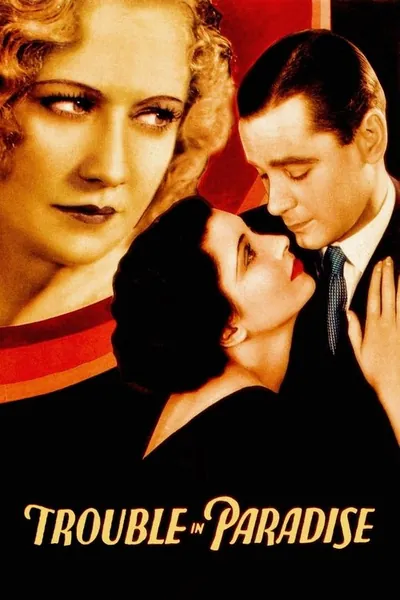 Trouble in Paradise
Original Cinematopedia text based on Wikipedia (es) and Wikipedia (en) and Wikidata.