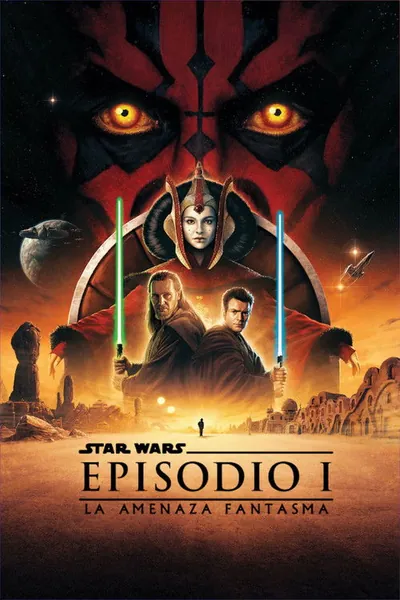
Star Wars: Episode I – The Phantom Menace
Star Wars: Episodio I - La amenaza fantasma
1999 · United States · 133 min
- Director
- George Lucas
- Screenplay
- George Lucas
- Producer
- Rick McCallum
- Music
- John Williams
- Cinematography
- David Tattersall
- Editing
- Ben Burtt
- Production company
- Lucasfilm
Awards: · 4 nominations
Cast
What it is about
The Trade Federation has imposed a blockade on Naboo, a planet ruled by a young queen, at a time when trade routes across the galaxy have become a source of growing tension. In an attempt to break the deadlock, the Republic's Supreme Chancellor sends two Jedi, Master Qui-Gon Jinn and his apprentice Obi-Wan Kenobi, to negotiate with the Federation's representatives. What begins as a diplomatic mission soon becomes an escape, once the two Jedi realise that their counterparts have no peaceful intentions. Sheltering in a forest on the planet, they meet a clumsy outcast from his own people, and together they set out on a journey that will take them deeper into a conflict affecting the whole system. The story also follows Queen Amidala, who tries to protect her people without fully revealing her identity, and a young slave on the desert world of Tatooine whose gift for machines catches Qui-Gon's attention. Hanging over all of it is a shadow the characters barely glimpse: the return of an order believed to have vanished. The film moves between political intrigue, space adventure and a coming-of-age story, and this summary stops short of the plot's resolution.
How it was made
George Lucas began shaping the fourth Star Wars film once he concluded that computer-generated effects had reached the level he needed to bring a story set before the original trilogy to the screen. The project's roots go back to the 1977 film, which Lucas conceived as part of a much larger story. After The Empire Strikes Back, he developed a backstory for Darth Vader that later fuelled the idea of a prequel trilogy. Lucas began writing the screenplay on 1 November 1994, working from a fifteen-page outline he had drafted in 1976 to keep track of the characters' histories. In early drafts Anakin was twelve, but Lucas lowered his age to nine, believing a younger child suited the separation from his mother, and that change forced him to rewrite much of the boy's role in the major scenes. The working title was The Beginning, and The Phantom Menace was chosen shortly before completion; Lucas linked it to Chancellor Palpatine, who hides his identity as a Sith Lord behind the image of a well-meaning public servant.
The cast mixed established performers with newcomers. Liam Neeson was cast as Qui-Gon even though Lucas had first considered an American actor, and Ewan McGregor was picked from a shortlist of fifty candidates who were compared with pictures of a young Alec Guinness; McGregor worked with a vocal coach to bring his voice closer to Guinness's. Natalie Portman was chosen from more than two hundred actresses, largely for her work in Léon and Beautiful Girls, while Jake Lloyd won the role of Anakin after hundreds of boys were tested. Ahmed Best, who was first hired to provide motion capture, also voiced Jar Jar Binks; on set he wore a foam and latex suit with a raised headpiece to give the actors a point of reference, and his filmed performance was later replaced by a computer-generated version. Frank Oz voiced Yoda, who was largely realised as a puppet manipulated by several performers, since Lucas's hope for a fully digital Yoda had not worked well enough at the time.
Principal photography began on 26 June 1997 at several locations, including Leavesden Film Studios in England and the Tunisian desert, where the Mos Espa set was built with inspiration from old local hotels and buildings. Industrial Light & Magic handled much of the visual effects, and designer Doug Chiang led a two-year review of thousands of designs. Lucas wanted the episode to feel richer and closer to a period piece, and the planets were built with some grounding in real-world references. Terryl Whitlatch designed creatures that often combined features of real animals and reflected their environments. Stunt coordinator Nick Gillard devised a new Jedi fighting style that blended swordsmanship with other movements, and he likened lightsaber duels to a game of chess. Costume designer Trisha Biggar and her team produced more than a thousand costumes, with colour palettes tailored to each world. Samuel L. Jackson accepted a role without knowing the character, since casting had been kept secret until his first day on set, when he learned he would play Mace Windu.
Reception and legacy
The film opened in cinemas on 19 May 1999, almost sixteen years after Return of the Jedi, and its release drew heavy media attention from an audience that had waited years for it. Critical opinion was divided. Visual effects and action sequences were widely praised, while many reviews objected to the heavy political exposition, the handling of several characters and, above all, Jar Jar Binks, who became the most frequent target of criticism. Commercially, however, the film was a major success. It grossed about 924 million dollars worldwide during its initial run, making it the highest-grossing film of 1999 and the most successful Star Wars film up to that point. A 2012 3D reissue pushed its overall worldwide gross past one billion dollars.
In awards terms, the film was nominated for a Razzie as Worst Film. Its reputation has shifted over time, and many fans now value its ambitious visual design and production scope, although it remains one of the most debated entries in the franchise. Its legacy is largely historical: it opened the prequel trilogy, followed by Attack of the Clones (2002) and Revenge of the Sith (2005), and it demonstrated how decisively computer-generated imagery could build entire worlds and characters. Today it is often discussed as an example of a large-scale production that provoked strong and divided responses, while marking a turning point for science fiction cinema in the late 1990s.
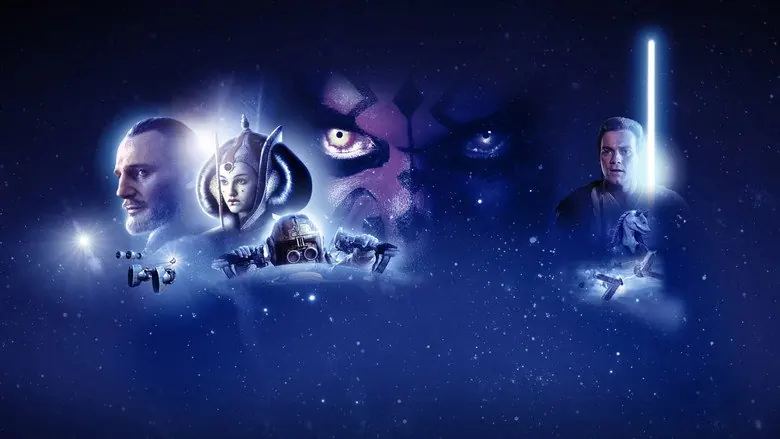
Stills


Trailer
Clicking loads the video from YouTube (privacy-enhanced mode). Open on YouTube
Trivia
A near-digital Jar Jar
Ahmed Best was initially hired only for motion capture, but he ended up voicing the character as well. On set he wore a foam and latex suit to give the actors a reference point, and his filmed performance was later replaced by the computer-generated character.
A younger Anakin
In early drafts of the script, Anakin was twelve years old. Lucas reduced his age to nine because he felt it suited the separation from his mother, and the change required rewriting much of his role in the major scenes.
A role revealed on set
Samuel L. Jackson agreed to appear without knowing his role. The casting was kept secret until his first day on set, when he discovered he would play Mace Windu.
More films by George Lucas
 Star Wars
 Star Wars: Episode III – Revenge of the Sith
 Star Wars: Episode II – Attack of the Clones
 American Graffiti
 THX 1138
Original Cinematopedia text based on Wikipedia (es) and Wikipedia (en) and Wikidata.