American Graffiti
1973 · United States · 108 min
- Director
- George Lucas
- Screenplay
- George Lucas, Gloria Katz, Willard Huyck
- Producer
- Francis Ford Coppola, Gary Kurtz
- Music
- Richard Rodgers
- Cinematography
- Jan D'Alquen, Ron Eveslage
- Editing
- Verna Fields
- Production company
- Lucasfilm, American Zoetrope
Awards: · 5 nominations
Cast
What it is about
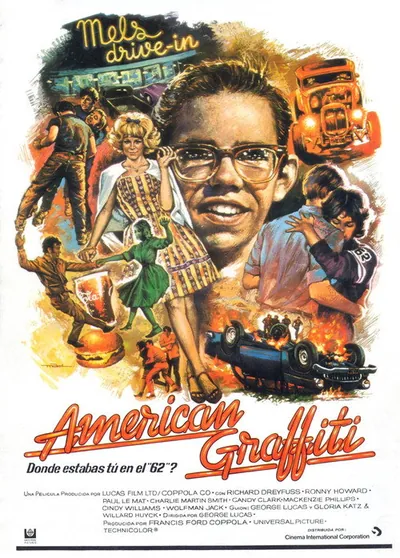
In Modesto, California, a group of friends who have just finished high school spend their last night together before going their separate ways. Between cruising the strip, dances, flirtations and street races, each character follows a storyline of their own, though all of them eventually intertwine. American Graffiti explores a friendship strained by distance, a hopeless crush and a radio disc jockey who has become something of an urban legend. It is a mosaic of the move from adolescence toward adulthood, told over a single summer night.
How it was made
The project began when Francis Ford Coppola suggested to George Lucas, then busy with THX 1138, that he write a coming-of-age story that could reach a mainstream audience. Lucas drew on his own teenage years in Modesto in the early 1960s and on cruising, the popular weekend habit of driving aimlessly around town. Some characters have real-life models: John Milner echoes the local street racers Lucas knew, while Terry reflects his own awkward years with dating. Lucas also acknowledged the influence of Federico Fellini's I Vitelloni. After other studios turned the idea down, Universal took it on. Filming started in San Rafael, but permission was limited to two days, so the crew moved to Petaluma, also in California. Made on a budget of $777,000, the film is built from interlocking vignettes over one night, scored with the rock and roll of the period.
Reception and legacy
The film premiered at the Locarno International Film Festival on August 2, 1973, and opened in US cinemas on August 11. Universal had modest hopes and initially planned a television release; Francis Ford Coppola, fresh from the success of The Godfather, lent his name to the project and helped secure a theatrical run. It was a commercial and critical success, earning five Academy Award nominations, including Best Picture, Best Director and Best Original Screenplay. It briefly became the highest-grossing film in Universal's history, a record The Sting overtook in 1974. It is widely credited with fuelling a wave of nostalgia for the 1950s and early 1960s in American pop culture and with shaping the teen comedy that followed. In 1995 it was selected for the National Film Registry by the Library of Congress.
Stills


Trailer
Clicking loads the video from YouTube (privacy-enhanced mode). Open on YouTube
Trivia
A film meant for television
Universal had little faith in the project and initially planned to release it as a television movie. Its theatrical run came thanks to Coppola's backing.
Universal's box office record
For a time it was the highest-grossing film in Universal's history, ahead of Airport, until The Sting surpassed it in 1974.
More films by George Lucas
 Star Wars
 Star Wars: Episode I – The Phantom Menace
 Star Wars: Episode III – Revenge of the Sith
 Star Wars: Episode II – Attack of the Clones
 THX 1138
Original Cinematopedia text based on Wikipedia (es) and Wikipedia (en) and Wikidata.