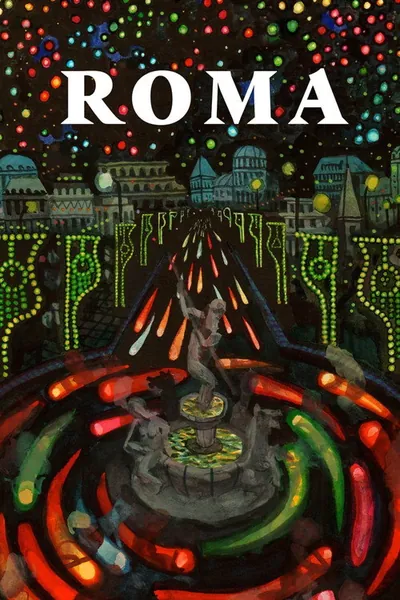
Fellini's Roma
Roma
1972 · Italy, France · 128 min
- Director
- Federico Fellini
- Screenplay
- Federico Fellini, Bernardino Zapponi
- Producer
- Turi Vasile
- Music
- Nino Rota
- Cinematography
- Giuseppe Rotunno
- Editing
- Ruggero Mastroianni
- Production company
- United Artists
Awards: · 1 nominations
What the critics say
63 % Rotten Tomatoes positive reviewsCast
What it is about
A young man arrives at Rome's Termini station from the provinces shortly before the Second World War, and the film unfolds as his recollections of the city. Through this memory-driven lens, Fellini assembles a fragmented portrait of Rome that moves between the Fascist past and the early 1970s. There is no conventional plot: scenes shift abruptly from a boarding house to brothels, from a cheap vaudeville theatre to an extravagant ecclesiastical fashion show, with no explicit narrative links. Rome itself acts as the main character, and the tone swings between lyricism, satire and the grotesque.
How it was made
Fellini wrote the screenplay with Bernardino Zapponi and shot the film with largely unknown performers alongside well-known figures playing versions of themselves, among them Anna Magnani, Marcello Mastroianni and Alberto Sordi. Turi Vasile produced, United Artists handled the distribution, and Giuseppe Rotunno was the cinematographer. Nino Rota's score was first released only in the United States. The version screened in Rome ran about 130 minutes, but for foreign markets Fellini trimmed it to roughly 115; that shorter cut is the one usually seen on home video and television, while the full version had only a single commercial release.
Reception and legacy
The film screened out of competition at Cannes in 1972, where it shared the Technical Grand Prize. Roger Ebert of the Chicago Sun-Times gave it four stars out of four, praising the way the city becomes the protagonist. The French critics' union SFCC named it best foreign film. Roma was submitted as Italy's entry for the Academy Award for Best Foreign Language Film but was not nominated, and it also received recognition in other categories from the Golden Globes and BAFTA. It is now regarded as one of the director's most personal works, an essay on urban memory.
Stills


Trailer
Clicking loads the video from YouTube (privacy-enhanced mode). Open on YouTube
Trivia
A deleted scene
During editing, a scene with Alberto Sordi was cut for being considered too immoral and cruel. In it, his character hurls insults at a blind man who blocks his view of children playing ball.
Anna Magnani in the street
The actress Anna Magnani, whom the crew met by chance in the street during shooting, appears near the end of the film; she died a few months later.
More films by Federico Fellini
 Amarcord
 8½
 La Dolce Vita
 La Strada
 Nights of Cabiria
 And the Ship Sails On
Original Cinematopedia text based on Wikipedia (es) and Wikipedia (en) and Wikidata.