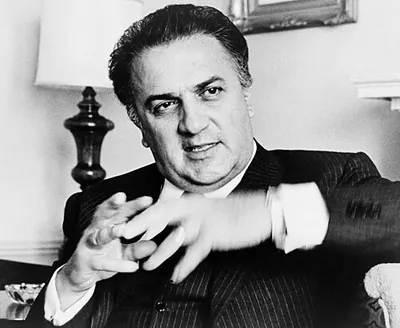
Federico Fellini
1920–1993 · Italian film director and screenwriter
Biography
Federico Fellini (Rimini, 1920 – Rome, 1993) was one of the most influential film directors of the twentieth century and the most internationally celebrated Italian filmmaker of the postwar period. He worked as a screenwriter, director, and, less often, as an actor and producer. His style blends fantasy and baroque imagery with a down-to-earth view of ordinary life, and the adjective "Felliniesque" has become a common way to describe extravagant characters and scenes. Four of his films won the Academy Award for Best Foreign Language Film, a record in that category, and in 1993 the Academy gave him an honorary Oscar for his career.
Fellini was born in Rimini into a middle-class family. His father, Urbano, was a traveling salesman of liquor, sweets, and groceries, and his mother, Ida Barbiani, came from a bourgeois Roman family. He had two younger siblings, Riccardo and Maddalena. As a boy he loved drawing and American comic strips, particularly the work of Winsor McCay and his character Little Nemo, and he admired Charlie Chaplin's films. He attended the Giulio Cesare classical lyceum and, while still a teenager, began publishing cartoons in magazines in Florence and Milan. At the University of Rome he enrolled in law, though biographers report no record of his ever attending a class. Instead he found work at the satirical magazine Marc'Aurelio, where between 1939 and 1942 he wrote humorous pieces and met writers and gagmen who opened doors to show business.
During those years he wrote gags and dialogue for radio and for popular comedians such as Aldo Fabrizi, and he contributed to screenplays for the Italian film industry. In 1942 he met Giulietta Masina, a radio performer who became his wife in October 1943 and his closest artistic partner for the rest of his life. The death of their infant son in 1945, only days after his birth, left a lasting mark on both of them. After Rome was liberated, Fellini ran a small shop that sold caricatures and portraits to American soldiers. In 1945 he joined Roberto Rossellini's team on Rome, Open City, one of the defining films of Italian neorealism, which he helped to write. He also worked on Rossellini's Paisan and on scripts for Alberto Lattuada and Pietro Germi, a practical education that gave him a broad command of filmmaking.
His directing debut came in 1950 with Variety Lights, which he co-directed with Lattuada. It was a commercial failure, and the debts it left took years to clear. His first solo feature, The White Sheik (1951), starring Alberto Sordi, was a gentle satire of the photo-romance magazines popular at the time. That same year he met the composer Nino Rota, who would score almost all of his subsequent films. I Vitelloni (1953) found critical favour and won the Silver Lion at Venice, securing his first international distribution. La Strada (1954), with Masina, Anthony Quinn and Richard Basehart, brought him worldwide recognition and his first Oscar. During its shoot he experienced the first signs of severe depression, and in those years he began to take an interest in psychoanalysis, an interest that would shape much of his later work.
Nights of Cabiria (1957), again with Masina, earned him a second Oscar and offered a more melancholy portrait of urban marginality. La Dolce Vita (1960), starring Marcello Mastroianni and Anita Ekberg, made him a global name. The film gave its name to the paparazzi, taking it from the character Paparazzo, provoked fierce controversy in Italy, and won the Palme d'Or at Cannes. From 1960 onward Fellini engaged with the work of Carl Jung through the psychoanalyst Ernst Bernhard, and that influence pushed his cinema toward the oneiric and the autobiographical. 8½ (1963) is the defining work of this period, a portrait of a director in creative crisis that won another Oscar and is regularly ranked among the greatest films ever made. Juliet of the Spirits (1965), his first colour feature, explored memory and guilt through the eyes of a married woman, again with Masina.
In the 1970s his films grew freer in form and less predictable for audiences. Fellini Satyricon (1969) and Fellini's Casanova (1976) reworked classical and eighteenth-century material with an elaborate visual style and a narrative freedom that not every viewer embraced. Roma (1972) and Amarcord (1973) returned to personal memory, the latter a nostalgic view of adolescence in a provincial town under Fascism. Amarcord won his fourth Oscar and became his second biggest commercial success after La Dolce Vita. Fellini gradually built a cinema that moved away from linear storytelling toward something closer to poetry, as he explained in interviews. In the 1980s he made Ginger and Fred (1986), with Mastroianni and Masina, and And the Ship Sails On (1983), a fable about the end of an era. In 1985 he received the Golden Lion at Venice for lifetime achievement, and in 1993 the honorary Oscar.
Fellini also had a notable career as a draughtsman outside cinema. A major exhibition of his drawings was held in Paris in 1982, and he later published a large collection of his sketches. Several of his projects, including the unfinished script Il viaggio di G. Mastorna, were never filmed, and that unrealised work has become part of his legend. He died in Rome on 31 October 1993, at the age of 73, from an acute myocardial infarction, after weeks in hospital following a stroke. His legacy is that of a filmmaker who turned memory, dream and spectacle into cinema, and his images remain widely recognised in film history and popular culture. His name is still linked to a way of looking at the world that mixes irony with nostalgia, and it continues to draw new generations of viewers.
Key films
- Rome, Open City (1945), co-written with Roberto Rossellini, a landmark of Italian neorealism.
- La Strada (1954), the story of a young woman sold to a travelling performer, starring Giulietta Masina and Anthony Quinn, and winner of an Oscar.
- Nights of Cabiria (1957), a portrait of a Roman prostitute played by Masina, which won the Oscar for Best Foreign Language Film.
- La Dolce Vita (1960), a panoramic look at high society in Rome with Marcello Mastroianni, and winner of the Palme d'Or at Cannes.
- 8½ (1963), a reflection on a director in creative crisis, which won an Oscar and is widely regarded as a masterpiece.
- Amarcord (1973), memories of adolescence in Rimini under Fascism, which won his last Oscar.
Trivia
The origin of the word paparazzi
The term for photographers who chase celebrities comes from Paparazzo, a character in La Dolce Vita, according to the sources.
A film that was never made
The Journey of G. Mastorna was a script written between 1965 and 1966 for producer Dino De Laurentiis. Fellini never filmed it, although he kept it among his plans until his death.
On Cinematopedia
 Amarcord1973
 8½1963
 La Dolce Vita1960
 La Strada1954
 Nights of Cabiria1957
 Rome, Open City1945
 And the Ship Sails On1983
 Fellini's Casanova1976
 I Vitelloni1953
 Fellini Satyricon1969
 Paisan1946
 Juliet of the Spirits1965
- There's Room Up Ahead 1942 · screenplay
- The Peddler and the Lady 1943 · screenplay
- Apparition 1943 · screenplay
- Rome, Open City 1945 · screenplay
- Tutta la città canta 1945 · screenplay
- Paisan 1946 · screenplay
- The Black Eagle 1946 · screenplay
- Flesh Will Surrender 1947 · screenplay
- L'Amore 1948 · screenplay, cast
- In the Name of the Law 1948 · screenplay
- Without Pity 1948 · screenplay
- City of Pain 1949 · screenplay
- Variety Lights 1950 · director, screenplay, producer
- The Flowers of St. Francis 1950 · screenplay
- Path of Hope 1950 · screenplay
- The Mill on the Po 1950 · screenplay
- Four Ways Out 1951 · screenplay
- Housemaid 1951 · screenplay
- The White Sheik 1952 · director, screenplay
- Europe '51 1952 · screenplay
- The Bandit of Tacca del Lupo 1952 · screenplay
- I Vitelloni 1953 · director, screenplay
- Love in the City 1953 · director, screenplay
- La Strada 1954 · director, screenplay
- Il bidone 1955 · director, screenplay
- Nights of Cabiria 1957 · director, screenplay
- Fortunella 1958 · screenplay
- La Dolce Vita 1960 · director, screenplay
- Boccaccio '70 1962 · director, screenplay
- 8½ 1963 · director, screenplay
- Juliet of the Spirits 1965 · director, screenplay
- Spirits of the Dead 1968 · director, screenplay
- Fellini Satyricon 1969 · director, screenplay
- Sweet Charity 1969 · screenplay
- The Clowns 1970 · director, screenplay, cast
- Alex in Wonderland 1970 · cast
- Fellini's Roma 1972 · director, screenplay, cast
- Amarcord 1973 · director, screenplay
- We All Loved Each Other So Much 1974 · cast
- Fellini's Casanova 1976 · director, screenplay
- Orchestra Rehearsal 1978 · director, screenplay, cast
- City of Women 1980 · director, screenplay
- And the Ship Sails On 1983 · director, screenplay
- Ginger and Fred 1985 · director, screenplay
- Intervista 1987 · director, screenplay, cast
- The Voice of the Moon 1990 · director, screenplay
- Long Live Freedom 2013 · cast
- How Strange to Be Named Federico 2013 · cast
Original Cinematopedia text based on Wikipedia (es) and Wikipedia (en) and Wikidata.