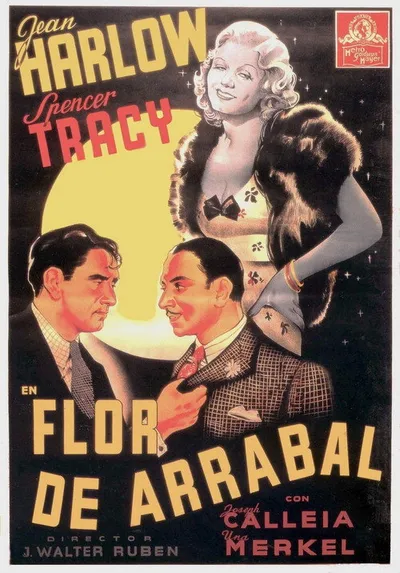
Riffraff
Flor de arrabal
1936 · United States · 94 min
- Director
- J. Walter Ruben
- Screenplay
- Anita Loos, Frances Marion
- Producer
- Irving Thalberg
- Music
- Edward Ward
- Cinematography
- Ray June
- Editing
- Frank Sullivan
- Production company
- Metro-Goldwyn-Mayer
Cast
What it is about
On the wharves of a coastal town, fisherman Dutch Muller leads a strike against the owners of a tuna cannery. He is joined by fellow fishery workers, among them Hattie Tuttle, a beautiful and tough-minded woman. They all share a cramped dwelling on the wharf, and a wealthy businessman's interest in Hattie adds tension to the story.
How it was made
The film grew out of an original story by Frances Marion, conceived as a dramatic showcase for Jean Harlow. David Lewis, newly arrived at MGM as associate producer, judged the dialogue insipid, and the script was then reworked by H. W. Hannaford and Anita Loos. Harlow darkened her hair to achieve a more natural look. During filming, a simulated rain sequence with forty female extras, many of them elderly or in frail health, left several with bruises, temporary blindness and pneumonia; the crew was short of staff and of the supplies needed to dry them between takes.
Reception and legacy
Critics were generally positive, praising the cast and the comic moments, though some reviewers regretted the melodramatic tone. Its portrayal of organized labor sparked controversy, and one union newspaper denounced it as propaganda against trade unions. According to MGM records, it earned 717,000 dollars in the United States and 330,000 elsewhere, resulting in a loss of 63,000 dollars. Lewis later felt it had shown that Harlow had an acceptable dramatic flair.
Stills


Trivia
A darker look
Before filming, Harlow darkened her hair, a change the press dubbed brownette.
A later realization
David Lewis admitted that at the time he did not notice the film's strongly anti-union stance, a fact that astonished him later.
Original Cinematopedia text based on Wikipedia (en) and Wikidata.