
Spencer Tracy
1900–1967 · American actor
Biography
Spencer Tracy (Milwaukee, 1900 - Los Angeles, 1967) was one of the great stars of Hollywood's Golden Age. His plain, natural style, with few obvious gestures, let him move easily between drama, comedy and adventure. He was the first actor to win two consecutive Academy Awards for Best Actor, and his understated approach remains a touchstone for later performers.
Raised in an Irish Catholic family, Tracy was a restless child whose parents sent him to a school run by Dominican nuns at the age of nine. His love of movies began early: he watched the same films again and again and acted out scenes for friends and neighbours. Near the end of the First World War he enlisted in the Navy with his friend Pat O'Brien, but never went to sea. At his father's urging he returned to his studies and discovered the stage at Ripon College. A scholarship took him to the American Academy of Dramatic Arts in New York, from which he graduated in 1923.
He spent seven years in the theatre, working with stock companies and taking small parts on Broadway, with several setbacks along the way. At one low point he considered giving up acting altogether. His fortunes turned in 1930 with The Last Mile, in which he played a condemned killer. The performance drew Hollywood's attention, and he soon signed with Fox, where he made many films that did little business, although his work in The Power and the Glory (1933) was much admired.
In 1935 he joined Metro-Goldwyn-Mayer, the most prestigious studio of the day, and his career took off with Fury (1936). That same year he starred in San Francisco, and in 1937 and 1938 he won consecutive Oscars for Captains Courageous and Boys Town. He became a successful screen partner of Clark Gable in several major box office hits. In 1942 he began with Katharine Hepburn in Woman of the Year a professional and personal partnership that lasted twenty-five years and produced nine films. His range ran from the comedy he made with Hepburn to the drama of Inherit the Wind.
In 1955 he won the Cannes Film Festival prize for Best Actor for Bad Day at Black Rock. That same year he left MGM and continued as a freelance star, despite health problems and a growing weariness and irritability as he aged. His personal life was troubled, marked by a lifelong struggle with alcoholism and by guilt over his son's deafness. His marriage to Louise had grown distant during the 1930s, although the couple never divorced. His relationship with Hepburn lasted twenty-five years and was an open secret.
Toward the end of his life he worked almost exclusively with director Stanley Kramer. His last film was Guess Who's Coming to Dinner (1967), which finished shooting just seventeen days before he died. Among his most admired films are Judgment at Nuremberg (1961) and The Old Man and the Sea (1958). Today he is remembered as a benchmark for screen acting, valued for his simplicity and the credibility of his characters.
Key films
- Fury (1936): one of the films that marked the start of his rise at MGM.
- Captains Courageous (1937): an Oscar-winning role as a fisherman in a coming-of-age drama at sea.
- Father of the Bride (1950): a family comedy in which he brought warmth and humour to a harried father.
- The Old Man and the Sea (1958): an adaptation of the Hemingway novella, in which he played an aging fisherman.
- Guess Who's Coming to Dinner (1967): his last film, a drama about racism in which he played a liberal father.
Trivia
Two Oscars in a row
Tracy was the first actor to win two consecutive Academy Awards for Best Actor, for Captains Courageous and Boys Town.
A sailor who never sailed
Tracy enlisted in the Navy with his friend Pat O'Brien but never went to sea. The war ended while they were still in training.
On Cinematopedia
 Judgment at Nuremberg1961
 How the West Was Won1962
 Guess Who's Coming to Dinner1967
 Captains Courageous1937
 It's a Mad, Mad, Mad, Mad World1963
 Bad Day at Black Rock1955
 Woman of the Year1942
 Boys Town1938
 San Francisco1936
 Father of the Bride1950
 The Old Man and the Sea1958
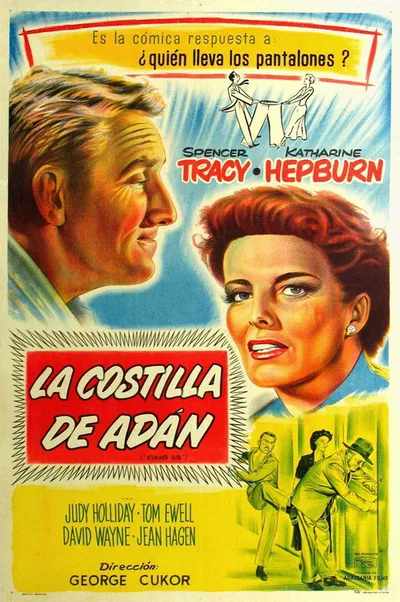 Adam's Rib1949
- Up the River 1930 · cast
- Quick Millions 1931 · cast
- Goldie 1931 · cast
- 20,000 Years in Sing Sing 1932 · cast
- Me and My Gal 1932 · cast
- Man's Castle 1933 · cast
- The Power and the Glory 1933 · cast
- Marie Galante 1934 · cast
- Dante's Inferno 1935 · cast
- Whipsaw 1935 · cast
- The Murder Man 1935 · cast
- San Francisco 1936 · cast
- Fury 1936 · cast
- Libeled Lady 1936 · cast
- Riffraff 1936 · cast
- Captains Courageous 1937 · cast
- Mannequin 1937 · cast
- Big City 1937 · cast
- They Gave Him a Gun 1937 · cast
- Boys Town 1938 · cast
- Test Pilot 1938 · cast
- Stanley and Livingstone 1939 · cast
- Boom Town 1940 · cast
- Northwest Passage 1940 · cast
- I Take This Woman 1940 · cast
- Edison, the Man 1940 · cast
- Young Tom Edison 1940 · cast
- Dr. Jekyll and Mr. Hyde 1941 · cast
- Men of Boys Town 1941 · cast
- Woman of the Year 1942 · cast
- Tortilla Flat 1942 · cast
- Keeper of the Flame 1942 · cast
- A Guy Named Joe 1943 · cast
- Thirty Seconds Over Tokyo 1944 · cast
- The Seventh Cross 1944 · cast
- Without Love 1945 · cast
- The Sea of Grass 1947 · cast
- Cass Timberlane 1947 · cast
- State of the Union 1948 · cast
- Adam's Rib 1949 · cast
- Father of the Bride 1950 · cast
- Edward, My Son 1950 · cast
- Malaya 1950 · cast
- Father's Little Dividend 1951 · cast
- Pat and Mike 1952 · cast
- Plymouth Adventure 1952 · cast
- The Actress 1953 · cast
- Broken Lance 1954 · cast
- Bad Day at Black Rock 1955 · cast
- The Mountain 1956 · cast
- Desk Set 1957 · cast
- The Old Man and the Sea 1958 · cast
- The Last Hurrah 1958 · cast
- Inherit the Wind 1960 · cast
- Judgment at Nuremberg 1961 · cast
- The Devil at 4 O'Clock 1961 · cast
- How the West Was Won 1962 · cast
- It's a Mad, Mad, Mad, Mad World 1963 · cast
- Guess Who's Coming to Dinner 1967 · cast
Original Cinematopedia text based on Wikipedia (es) and Wikipedia (en) and Wikidata.