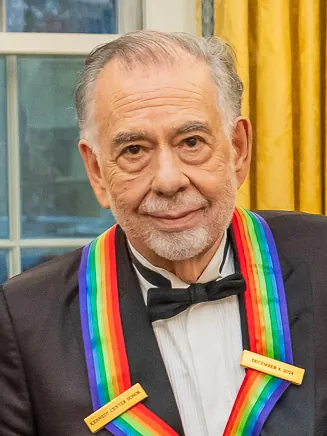
Francis Ford Coppola
b. 1939 · American screenwriter, producer and director
Biography
Francis Ford Coppola (born April 7, 1939, in Detroit, Michigan) is an American screenwriter, producer and director. He is one of the central figures of the New Hollywood of the 1970s, a generation that also included Martin Scorsese, Steven Spielberg, Brian De Palma and George Lucas. His name is tied to the The Godfather trilogy and to films that reshaped the gangster genre, the political thriller and the war epic. He has won five Academy Awards and two Palmes d'Or at Cannes, a distinction shared by very few filmmakers.
He was born at Henry Ford Hospital in Detroit. His father, Carmine Coppola, was a musician, and his mother, Italia Pennino, had been an actress; both came from families of Italian immigrants. His middle name honors The Ford Sunday Evening Hour, a radio concert series sponsored by the Ford Motor Company, where Carmine worked as an arranger and assistant musical director. Two years later the family moved to New York, when his father became principal flute of the NBC Symphony Orchestra under Arturo Toscanini. An uncle, Anton, who directed the orchestra at Radio City Music Hall, took the boy along to watch performances there. His younger sister, Talia, became known as an actress under the name Talia Shire.
At nine he contracted polio. He spent nearly a year in bed, with parts of his body paralyzed and no visitors allowed for fear of contagion. He passed the time with puppets, a tape recorder and a 16 mm projector given to him by his maternal grandfather, the composer Francesco Pennino. That long confinement fed an early attraction to images and theater. As a teenager he made 8 mm films by editing home movies. His teachers did not see him as a strong student, though his interest in machines earned him the childhood nickname «Science».
He studied theater arts at Hofstra University, where he staged productions that drew attention. There he met James Caan and Lainie Kazan, friends he would later cast in his films. He graduated in 1960 and that same year enrolled at UCLA, whose curriculum did not impress him, though it opened his first contacts in the industry.
His early work was modest. He took jobs on low-budget erotic films, known as nudies, and on the editing and dubbing of other people's pictures. In 1962 he met Roger Corman, the producer and director of cheap genre films, who took him on as an assistant and gave him tasks in editing, sound and second-unit direction. From that period comes Dementia 13 (1963), his first credited feature, a horror film shot in nine days in Ireland on a tight budget. His relationship with Corman ended after disagreements over the final cut of another film he had worked on.
His first personal work came in 1966 with You're a Big Boy Now, which began as his UCLA thesis. It followed a young man searching for independence and had autobiographical touches. Then came the assignment Finian's Rainbow (1968), a musical with Fred Astaire and Petula Clark, which asked him to adapt older material for an era that had little appetite for the genre. In 1969 he made The Rain People, an intimate drama that won the Golden Shell at San Sebastián. That same year he founded American Zoetrope, a company meant to offer an alternative to the studio system, with George Lucas as vice president. The name came from a gift of zoetropes he received in Europe.
In 1971 he won the Academy Award for Best Original Screenplay, shared with Edmund H. North, for Patton. That year he also began work on the adaptation of Mario Puzo's novel that became The Godfather (1972). He was reluctant at first, finding the book sensational, but he ended up rewriting it with Puzo and grounding it in his own Italian-American background. The shoot was tense. Paramount resisted several choices, above all the casting of Marlon Brando and Al Pacino. With cinematographer Gordon Willis and production designer Dean Tavoularis, he made a film that became a box-office hit and won the Academy Award for Best Picture.
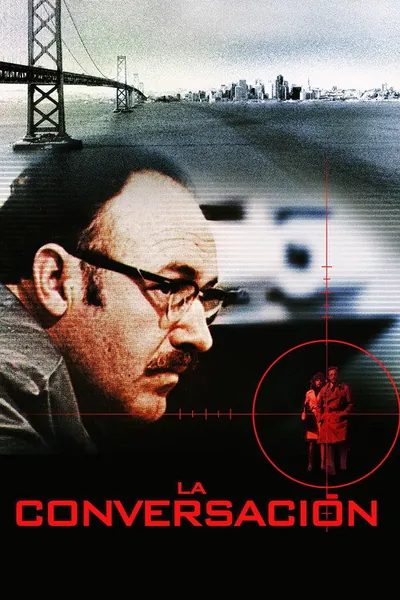
With The Conversation (1974), a thriller about a wiretapping expert played by Gene Hackman, he won his first Palme d'Or. The slow-paced film, with a remarkable sound design by Walter Murch, was later read as a comment on the Watergate scandal, although Coppola said the script predated it. That same year he released The Godfather Part II, which combined the rise of Vito Corleone with the fall of Michael. It won the Academy Award for Best Picture, making it the first sequel to take that prize, and it also earned awards for direction and adapted screenplay.
His next major project was Apocalypse Now (1979), a version of Joseph Conrad's Heart of Darkness moved to the Vietnam War. The Philippine shoot dragged on for months because of typhoons, the heart attack suffered by star Martin Sheen, Brando's erratic involvement and the withdrawal of military helicopters. The film was presented at Cannes before its final edit was complete and shared the Palme d'Or. Coppola defended it with a line that became famous: «My film is not about Vietnam. It is Vietnam». The making of the film was chronicled in Hearts of Darkness (1991), directed by George Hickenlooper and Fax Bahr, which used footage shot by his wife, Eleanor Coppola.
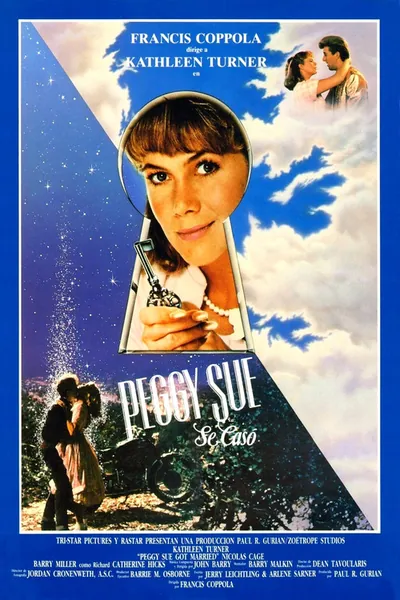
The 1980s were hard. The Las Vegas musical One from the Heart (1982) failed at the box office and forced him to sell the Zoetrope studios. To pay off his debts he took assignments. He directed The Outsiders (1983), based on the novel by S. E. Hinton, which launched a generation of young actors, and Rumble Fish, shot in black and white with echoes of German expressionism. Then came The Cotton Club (1984), which also failed to recoup its costs, and Peggy Sue Got Married (1986), a more personal and successful picture. That year he lost his eldest son, Gio, in a jet-ski accident while he was shooting Gardens of Stone. In 1988 he directed Tucker, produced by George Lucas, a portrait of an automobile inventor that critics often read as a mirror of Coppola's own career.
The 1990s brought financial recovery. The Godfather Part III (1990) closed the trilogy with a darker, elegiac tone that not all viewers welcomed, though it performed well at the box office. He then directed Bram Stoker's Dracula (1992), a stylized take on the novel that revived the spirit of silent cinema through handmade effects. It was a major commercial success and won three Academy Awards, for costume design, makeup and sound effects. With part of the earnings he bought a property in the Napa Valley, an activity he later developed into a winery.
Coppola remains one of the most frequently cited figures in film history for combining artistic ambition with industrial risk. His films of the 1970s still appear on lists of the greatest movies ever made, and the Godfather trilogy is studied as an example of studio filmmaking with a personal voice. His family is also tied to cinema: his daughter Sofia is a director, his son Roman has worked in effects and screenwriting, and his nephews Nicolas Cage and Jason Schwartzman are actors. His career shows that a filmmaker could move between commissioned work and personal projects, though not always with commercial success.
Key films
- The Godfather (1972): the film that changed his career and won the Academy Award for Best Picture, viewing the Corleone family as a metaphor for power.
- The Conversation (1974): a slow-burning thriller about surveillance and guilt, starring Gene Hackman, which earned him his first Palme d'Or.
- The Godfather Part II (1974): a sequel and prequel that alternates the rise of Vito Corleone with the fall of Michael, and won him the Academy Award for Best Director.
- Apocalypse Now (1979): an adaptation of Conrad moved to Vietnam, shot amid severe difficulties and awarded the Palme d'Or.
- Bram Stoker's Dracula (1992): a stylized version of the vampire myth, with handmade effects and three technical Academy Awards.
Trivia
A childhood nickname
As a child, because of his interest in technology and engineering, he was nicknamed «Science», even though his grades were not outstanding.
The name of his studio
His company American Zoetrope took its name from a gift of zoetropes that Coppola received from Mogens Scot-Hansen, founder of Lanterna Film, during a trip through Europe.
On Cinematopedia
 The Godfather1972
 The Godfather Part II1974
 Apocalypse Now1979
 Patton1970
 The Godfather Part III1990
 The Conversation1974
 Bram Stoker's Dracula1992
 Kagemusha1980
 Sleepy Hollow1999
 American Graffiti1973
 Peggy Sue Got Married1986
 Somewhere2010
- Dementia 13 1963 · director, screenplay
- The Terror 1963 · director
- The Haunted Palace 1963 · screenplay
- Is Paris Burning? 1966 · screenplay
- This Property Is Condemned 1966 · screenplay
- You're a Big Boy Now 1966 · director, screenplay
- Finian's Rainbow 1968 · director
- The Rain People 1969 · director, screenplay
- Patton 1970 · screenplay
- THX 1138 1971 · producer
- The Godfather 1972 · director, screenplay
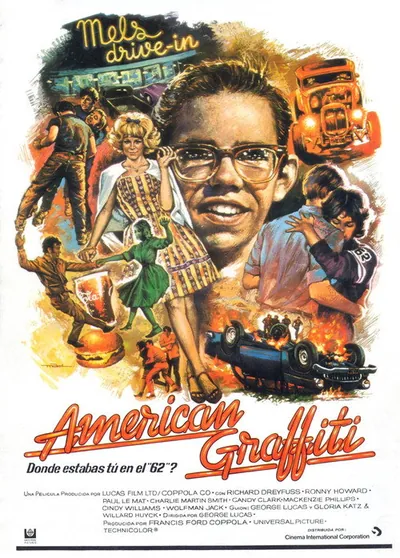
- American Graffiti 1973 · producer
- The Godfather Part II 1974 · director, screenplay, producer
- The Conversation 1974 · director, screenplay, producer
- The Great Gatsby 1974 · screenplay
- Apocalypse Now 1979 · director, screenplay, music, producer, cast
- Kagemusha 1980 · producer
- One from the Heart 1982 · director, screenplay
- Hammett 1982 · producer
- The Outsiders 1983 · director
- Rumble Fish 1983 · director, screenplay
- The Cotton Club 1984 · director, screenplay
- Mishima: A Life in Four Chapters 1985 · producer
- Peggy Sue Got Married 1986 · director
- Barfly 1987 · producer
- Gardens of Stone 1987 · director, producer
- Tucker: The Man and His Dream 1988 · director
- New York Stories 1989 · director, screenplay
- The Godfather Part III 1990 · director, screenplay, producer
- Bram Stoker's Dracula 1992 · director, producer
- Mary Shelley's Frankenstein 1994 · producer
- Don Juan DeMarco 1995 · producer
- Jack 1996 · director, producer
- The Rainmaker 1997 · director, screenplay
- Sleepy Hollow 1999 · producer
- The Virgin Suicides 1999 · producer
- Supernova 2000 · director
- Jeepers Creepers 2001 · producer
- Jeepers Creepers 2 2003 · producer
- Kinsey 2004 · producer
- Marie Antoinette 2006 · producer
- The Good Shepherd 2006 · producer
- Youth Without Youth 2007 · director, screenplay, producer
- Tetro 2009 · director, screenplay, producer
- Somewhere 2010 · producer
- Twixt 2011 · director, screenplay, producer
- On the Road 2012 · producer
- Palo Alto 2013 · cast
- Jeepers Creepers 3 2017 · producer
- Megalopolis 2024 · director, screenplay, producer
Original Cinematopedia text based on Wikipedia (es) and Wikipedia (en) and Wikidata.