
Pather Panchali
1955 · India · 120 min
- Director
- Satyajit Ray
- Screenplay
- Satyajit Ray
- Producer
- Government of West Bengal
- Music
- Ravi Shankar
- Cinematography
- Subrata Mitra
- Editing
- Dulal Dutta
- Production company
- Government of West Bengal
- Based on
- Pather Panchali
Awards: BAFTA Award for Best Film; National Board of Review Award for Best Foreign Language Film; National Film Award for Best Feature Film; National Film Award for Best Bengali Feature Film; Bodil Award for Best American Film · 1 nominations
Cast
What it is about
In a rural village in Bengal, in the early twentieth century, a poor Brahmin family gets by on very little. Harihar, the father, works as a priest without earning enough and dreams of a literary career. Sarbajaya, the mother, keeps the household running amid constant shortages and the presence of Indir, an elderly relative with a strong independent streak. Their children, Durga and Apu, spend their childhood in games, outings around the village and small wonders, such as a magic lantern show or the distant whistle of a train. The film watches everyday routine closely, letting the simplest moments carry their own weight.
How it was made
The project grew out of Pather Panchali, the Bengali novel by Bibhutibhushan Bandopadhyay, published in 1929 after a serial run the year before. Satyajit Ray, a graphic designer at a Calcutta publishing house, illustrated an abridged edition of the book in 1944 and, after reading the full text, became interested in adapting it. His directorial debut was shot mostly on location, with a tight budget, a cast of mostly amateur actors and an inexperienced crew. Money problems caused repeated stoppages, and the shoot stretched to nearly three years. Subrata Mitra handled the cinematography, Dulal Dutta the editing, and Ravi Shankar composed a score built on classical ragas. Ray favoured long, static shots, a deliberate pace and dissolves between scenes, with a approach that owes something to Italian neorealism.
Reception and legacy
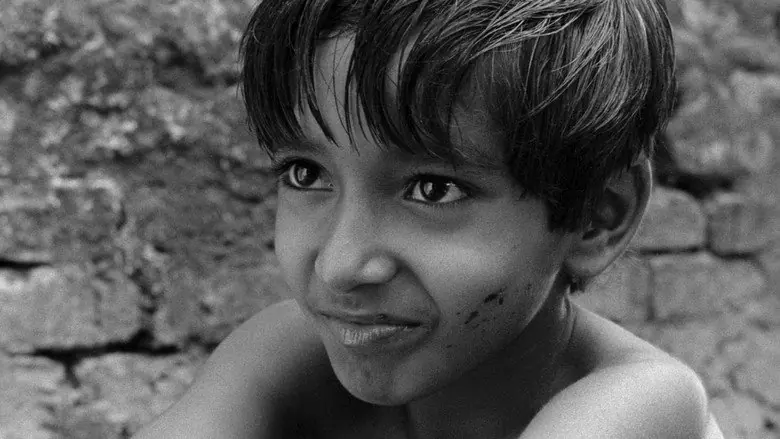
The film premiered on 3 May 1955 at New York's Museum of Modern Art and was released in Calcutta the same year to an enthusiastic response. It won India's National Film Award for Best Feature Film in 1955 and the Best Human Document award at Cannes in 1956. Its record also lists a BAFTA for best film and a National Board of Review award for best foreign language film. Critics praised its realism, its warmth and Subir Banerjee's performance as Apu, often cited among the finest child performances in cinema. Some detractors, however, found its slow pace a drawback. Over time it has come to be seen as a starting point for India's parallel cinema and one of the most influential films ever made, and it appears regularly on lists of the greatest films.
Stills


Trailer
Clicking loads the video from YouTube (privacy-enhanced mode). Open on YouTube
Trivia
An Apu with no experience
Subir Banerjee, who played Apu, had no acting training before the film, and his performance is often cited among the best child performances in film history.
An unexpected rescue
The West Bengal government bought the film for the equivalent of about 60,000 dollars, which pulled Ray out of debt. According to the sources, by 1980 it had turned a profit of around 700,000 dollars.
More films by Satyajit Ray
 Aparajito
 Distant Thunder
 The World of Apu
 The Lonely Wife
 Jalsaghar
 The Chess Players
Original Cinematopedia text based on Wikipedia (es) and Wikipedia (en) and Wikidata.