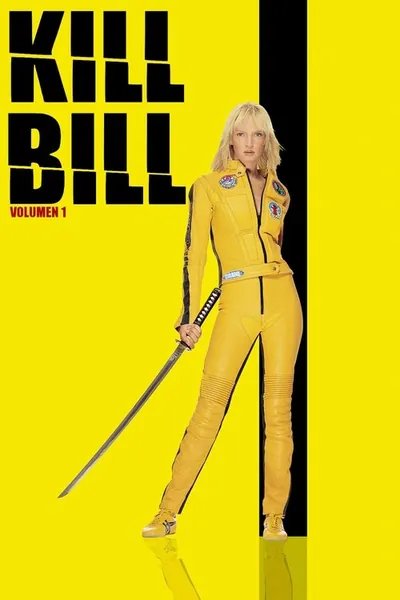
Kill Bill: Volume 1
Kill Bill: Volumen 1
2003 · United States · 110 min
- Director
- Quentin Tarantino
- Screenplay
- Quentin Tarantino
- Producer
- Lawrence Bender
- Music
- RZA
- Cinematography
- Robert Richardson
- Editing
- Sally Menke
- Production company
- A Band Apart, Miramax
Awards: MTV Movie Award for Best Villain; International Cinephile Society Award for Best Actress · 1 nominations
Cast
What it is about
A former hired killer, once part of a squad led by a man called Bill, is severely wounded during a massacre on the day of her wedding. After years in a coma, she wakes up in a world that has carried on without her and sets out on a list of revenges that will bring her face to face with her former colleagues. The film, the first part of a story split into two releases, mixes combat scenes with fragments of the past and a style that pays tribute to popular genres from different eras and countries.
How it was made
The character of the Bride grew out of a collaboration between Quentin Tarantino and Uma Thurman during the making of Pulp Fiction in 1994. Tarantino spent around a year and a half writing the script while living in New York, and some of the heroine's traits came from an earlier project, an assassin he had first devised for Inglourious Basterds. Bill was originally written for Warren Beatty, who turned the role down, and it eventually went to David Carradine. Shooting began in 2002 after a delay caused by Thurman's pregnancy, which Tarantino compared to Josef von Sternberg waiting for Marlene Dietrich. Although the edit presents events out of order, the shoot followed chronological order. Choreographer Yuen Woo-ping, known for The Matrix, advised on the fight scenes, and the animated sequence on O-Ren Ishii's past, directed by Kazuto Nakazawa, was produced by Production I.G. The footage ran over four hours, so the film was divided into two volumes.
Reception and legacy
The film opened in the United States on October 10, 2003, through Miramax, and received generally positive reviews. It grossed about 180.9 million dollars worldwide and posted the biggest opening weekend of any Tarantino film up to that point. It won the MTV Movie Award for best villain and the International Cinephile Society award for best actress, and it was nominated for the European Film Award for best non-European film. Its blend of homage and style made it a reference point for action cinema at the turn of the century, and its second part, released six months later, completed the story.
Stills


Trailer
Clicking loads the video from YouTube (privacy-enhanced mode). Open on YouTube
Trivia
A delay caused by pregnancy
When Uma Thurman became pregnant just before shooting, Tarantino postponed production, comparing his decision to Josef von Sternberg waiting for Marlene Dietrich to make Morocco.
A deleted chapter
An early draft included a clash with Yuki, Gogo Yubari's sister, which was cut for making the film longer and more expensive. Tarantino later reworked it into an animated short.
More films by Quentin Tarantino
 Pulp Fiction
 Inglourious Basterds
 Django Unchained
 Once Upon a Time... in Hollywood
 The Hateful Eight
 Reservoir Dogs
Original Cinematopedia text based on Wikipedia (es) and Wikipedia (en) and Wikidata.