
Django Unchained
Django desencadenado
2012 · United States · 165 min
- Director
- Quentin Tarantino
- Screenplay
- Quentin Tarantino
- Producer
- Stacey Sher, Reginald Hudlin, Pilar Savone
- Music
- Ennio Morricone
- Cinematography
- Robert Richardson
- Editing
- Fred Raskin
- Production company
- Columbia Pictures, A Band Apart, The Weinstein Company
Awards: Academy Award for Best Writing, Original Screenplay; Academy Award for Best Supporting Actor; National Board of Review: Top Ten Films · 5 nominations
Cast
What it is about
Texas, 1858, two years before the outbreak of the American Civil War. A group of enslaved men is being transported in chains under the custody of the Speck brothers when their path crosses that of a German bounty hunter, Dr. King Schultz. A former dentist turned manhunter, Schultz needs the help of one of the men, Django, to track down several outlaws whose faces he has never seen. In exchange, he offers something Django has never had: the chance to be free. Together they spend the winter collecting bounties, and Django discovers a natural talent with firearms. Their bond grows as they pursue the goal that gives the film its purpose: finding Broomhilda, Django's wife, from whom he was separated long ago. The search leads them to Mississippi, a place where the slave system shows its full cruelty and where every step demands pretending to be more than one feels. Tarantino frames the story as a journey of apprenticeship and settled scores, combining black humor, tension and a violence that is present from the start.
How it was made
The project dates back to 2007, when Quentin Tarantino told The Daily Telegraph about an idea for a spaghetti western set in the Deep South of the United States, which he called a « southern ». The starting point was the character created by Sergio Corbucci for his 1966 film Django, played by Franco Nero. Tarantino said he wanted to address the horror of slavery through the forms of the spaghetti western rather than those of socially conscious cinema, and to touch on subjects that, in his view, few people in the United States were willing to tackle. The title was confirmed on May 2, 2011, and the script was finished on April 26 of that year, when the final draft went to The Weinstein Company.
The film draws on many references. Beyond the Italian western, Tarantino took inspiration from Mandingo (1975), about a slave trained to fight other slaves, and paid homage to The Great Silence (1968) with an extended section set in the snow. The character of Dr. Schultz is credited to the heroes of the German Westerns of the 1960s based on Karl May, specifically Old Shatterhand. The title also alludes to Hercules Unchained and Angel Unchained.
The casting went through several changes. Michael K. Williams, Will Smith and Idris Elba were all mentioned for the title role before Jamie Foxx was cast. Kevin Costner could not join because of scheduling conflicts, and Kurt Russell, who replaced him, also left the project; the character of Ace Woody was later merged with Walton Goggins's role, Billy Crash. Jonah Hill turned down a role because of commitments to The Watch, although he later appeared in the film in a different part. Franco Nero made a brief appearance as a tribute to the original Django.
Principal photography began in California in November 2011, moved to Wyoming in February 2012, and concluded at the Evergreen Plantation in Louisiana in March of that year. The film was shot in anamorphic format on 35 mm and took 130 shooting days, wrapping in July 2012. It was the first Tarantino film not edited by Sally Menke, who died in 2010; the editing was handled by Fred Raskin, who had been an assistant editor on Kill Bill. The score mixes original compositions, including pieces by Ennio Morricone, with songs by artists such as John Legend and Rick Ross and with classical music. Kerry Washington insisted that the lashings really struck her, and spent time in the metal box that simulates her character's punishment so that the sense of confinement would feel real.
Reception and legacy
The film opened in the United States on December 25, 2012, after a premiere at the Ziegfeld Theatre in New York. It was a notable commercial success, grossing around 449 million dollars worldwide against a budget of 100 million. That made it Tarantino's highest-grossing film and the highest-grossing Western of all time, surpassing Dances with Wolves. On Rotten Tomatoes it holds an approval rating of 87 percent from 296 reviews, and on Metacritic it has a weighted average of 81 out of 100.
Critics praised the performances of Christoph Waltz, Leonardo DiCaprio and Samuel L. Jackson, as well as Tarantino's direction and screenplay. Peter Bradshaw, writing in The Guardian, gave it five stars, while A. O. Scott, in The New York Times, called it a troubling and important film about slavery and racism. Other voices were more reserved: Owen Gleiberman of Entertainment Weekly judged it less clever than Inglourious Basterds and too long, and several reviewers pointed to its graphic violence and frequent racial slurs as sources of controversy. The number of times the word « nigger » appears became a matter of debate, and the filmmaker Spike Lee said he would not see the film because he considered it disrespectful to his ancestors.
In awards terms, Waltz won the Academy Award for Best Supporting Actor, and Tarantino won the Oscar for Best Original Screenplay. The film earned five nominations at the 85th Academy Awards, including Best Picture. It received five Golden Globe nominations and two wins, and also won two prizes among its nominations at the BAFTA Awards. The American Film Institute named it one of the ten best films of the year, and the National Board of Review also honored it, naming DiCaprio best supporting actor. In 2021, the Writers Guild of America ranked its screenplay 74th among the 101 greatest screenplays of the 21st century.
Its legacy is tied to the so-called revisionist Western, which reinterprets the genre from the perspective of marginalized characters and uses violence as a stylistic element. For many viewers it represents the continuation of Tarantino's work after Inglourious Basterds, and an example of how genre cinema can address the history of slavery by combining entertainment with critique.
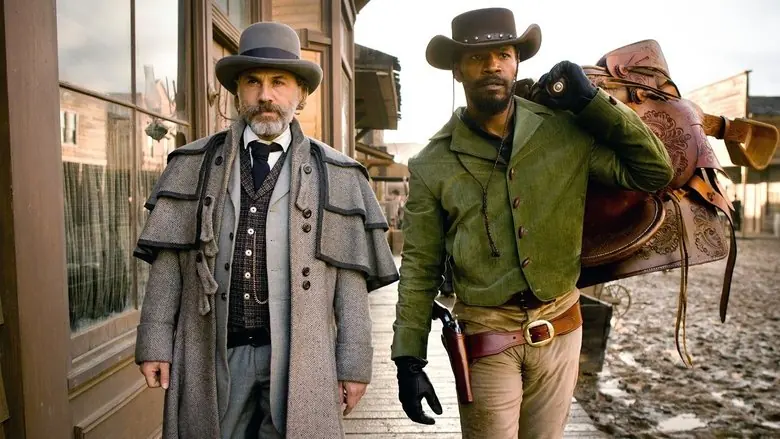
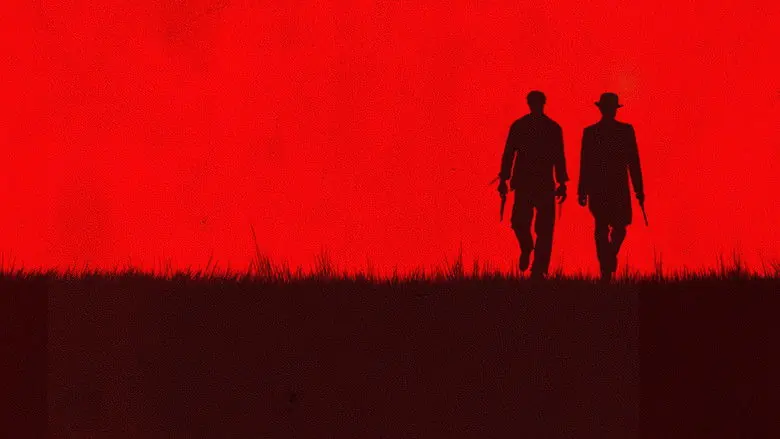
Stills

Trailer
Clicking loads the video from YouTube (privacy-enhanced mode). Open on YouTube
Trivia
DiCaprio's injured hand
During the scene in which his character explains phrenology, DiCaprio cut his left hand when he struck the table and broke a small glass. He stayed in character with barely a reaction, and Tarantino chose to keep the sequence in the final cut.
A tribute to Franco Nero
Tarantino wanted to honor the actor who played the original Django in 1966 by giving him a small role. His scene with Jamie Foxx is one of the most discussed moments in the film.
Without Sally Menke
It was the first Tarantino film not edited by Sally Menke, who died in 2010. Editing was handled by Fred Raskin, who had worked as an assistant editor on Kill Bill.
More films by Quentin Tarantino
 Pulp Fiction
 Inglourious Basterds
 Once Upon a Time... in Hollywood
 The Hateful Eight
 Reservoir Dogs
 Sin City
Original Cinematopedia text based on Wikipedia (es) and Wikipedia (en) and Wikidata.