
Bound for Glory
Esta tierra es mi tierra
1976 · United States · 145 min
- Director
- Hal Ashby
- Screenplay
- Robert Getchell
- Producer
- Harold Leventhal, Robert F. Blumofe
- Music
- Leonard Rosenman
- Cinematography
- Haskell Wexler
- Editing
- Robert C. Jones, Pembroke J. Herring
- Production company
- United Artists
- Based on
- Bound for Glory
Awards: Academy Award for Best Cinematography; Academy Award for Best Original Song Score · 6 nominations
What the critics say
81 % Rotten Tomatoes positive reviewsCast
What it is about
California, 1936, in the middle of the Great Depression. Woody Guthrie plays guitar and paints signs to make a living, but he would rather play music than hold a steady job, which strains his marriage to Mary. Determined to find work and an audience, he leaves home and sets out across the country, riding freight trains and sharing camps with other drifters. Along the way he meets people with nothing to lose and sees how the migrants arriving in California, fleeing drought, are treated. His protest songs draw him closer to union organizers, but they also put him at odds with those who want him to sing only for entertainment.
How it was made
United Artists agreed to finance the film on the strength of Hal Ashby's reputation, even before a star was attached. Dustin Hoffman and Jack Nicholson both turned down the role of Guthrie. Ashby first passed on David Carradine, partly because he felt the actor was too tall, but later came around to his rural look and musicianship. Robert Getchell's script loosely adapts Guthrie's partly fictionalized 1943 autobiography, and almost every character apart from Guthrie and his first wife is invented. The train scenes were shot on the Sierra Railroad, which assembled a freight train of 34 cars. It was the first film in which Garrett Brown used his Steadicam, and Haskell Wexler's cinematography won him the Academy Award.
Reception and legacy
The film was released in 1976 with six Academy Award nominations, including Best Picture and Best Adapted Screenplay, and it won two: Best Cinematography and Best Original Song. As of January 2024, according to the figures available, it held an 81% rating on Rotten Tomatoes from 26 reviews and a weighted average of 70 out of 100 on Metacritic. Its legacy rests mainly on its vivid recreation of the Dust Bowl era and its pioneering use of the Steadicam for moving shots, rather than on a clear influence on later biographical films.
Stills
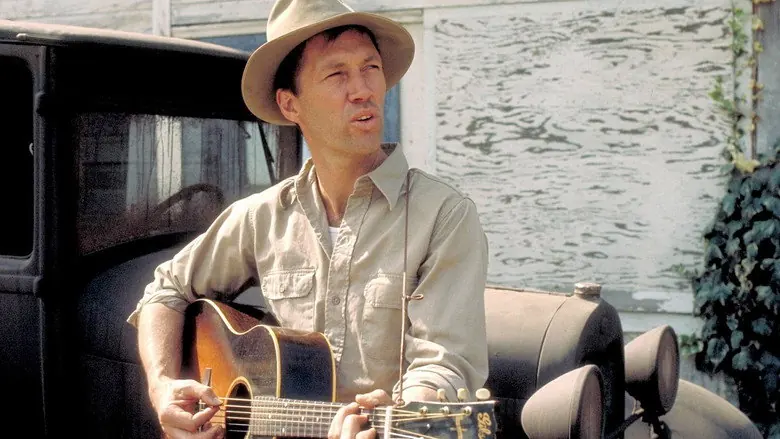

Trailer
Clicking loads the video from YouTube (privacy-enhanced mode). Open on YouTube
Trivia
A song written earlier
The song that closes the film, later known as This Land Is Your Land, was composed in New York in 1940, and Guthrie forgot it for about five years.
A 34-car train
Because Ashby wanted a large freight train rather than the shorter ones usually used in films, the Sierra Railroad assembled a 34-car convoy for the railway scenes.
More films by Hal Ashby
 Coming Home
 Being There
 The Last Detail
 Shampoo
 Harold and Maude
 Lookin' to Get Out
Original Cinematopedia text based on Wikipedia (es) and Wikipedia (en) and Wikidata.