
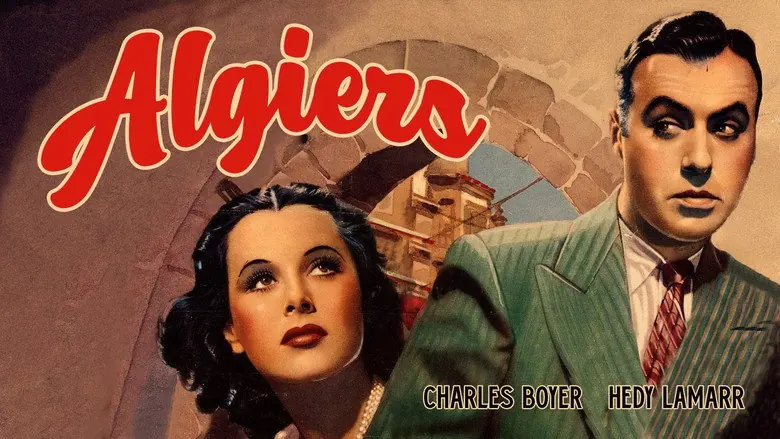
Algiers
1938 · United States · 96 min
- Director
- John Cromwell
- Screenplay
- Hedy Lamarr, James M. Cain, Charles Boyer, John Howard Lawson, Sigrid Gurie
- Producer
- Walter Wanger
- Cinematography
- James Wong Howe
- Editing
- Otho Lovering
- Production company
- United Artists
- Based on
- Pépé le Moko
Awards: · 4 nominations
Cast
What it is about
Pepe le Moko, a notorious jewel thief who fled France, has spent two years hiding in the Casbah, the native quarter of Algiers, where he has become a respected and well-protected leader. French police still want him, and local detectives are waiting for their chance. Pepe's sense of confinement deepens when he meets Gaby, a French tourist who reminds him of Paris. Their growing attraction stirs jealousy in Ines, the Algerian woman who shares his life, and the story turns on the tension between longing for freedom and the impossibility of leaving the only refuge he has.
How it was made
The film remakes the successful 1937 French picture Pépé le Moko. Producer Walter Wanger bought the rights and also purchased the prints so the original could not compete with his version in the United States, reusing much of its music and background footage. The first script was rejected by the Production Code office over the portrayal of the leading women and the suicide ending, so the finale was changed to a police shooting. James M. Cain rewrote the opening twenty minutes, and John Howard Lawson sharpened the romance. Hedy Lamarr, making her Hollywood debut, was suggested by Charles Boyer; director John Cromwell later judged her acting limited, though he felt it improved. Location footage shot in Algiers was integrated by cinematographer James Wong Howe.
Reception and legacy
The film was a box-office success, largely on the strength of Lamarr's appeal, and earned four Academy Award nominations, including Best Actor for Boyer and Best Cinematography for Wong Howe. Joseph Calleia won the National Board of Review award for his portrayal of Inspector Slimane. Its influence is visible in Casablanca (1942), whose screenwriters had Lamarr in mind for the lead female role, and Boyer's characterization inspired the cartoon character Pepé Le Pew. It was also adapted several times for radio and produced a musical remake, Casbah (1948). It entered the US public domain in 1966 after its copyright was not renewed.
Stills

Trailer
Clicking loads the video from YouTube (privacy-enhanced mode). Open on YouTube
Full film
Trivia
Buying the prints
Walter Wanger bought all copies of the French film to keep it from competing with his version in the United States.
A changed ending
The Breen Office demanded that Pepe not commit suicide, so in the final film police shoot him as he tries to escape.
More films by John Cromwell
 Since You Went Away
 Of Human Bondage
 Anna and the King of Siam
 Caged
 The Prisoner of Zenda
 Dead Reckoning
Original Cinematopedia text based on Wikipedia (es) and Wikipedia (en) and Wikidata.