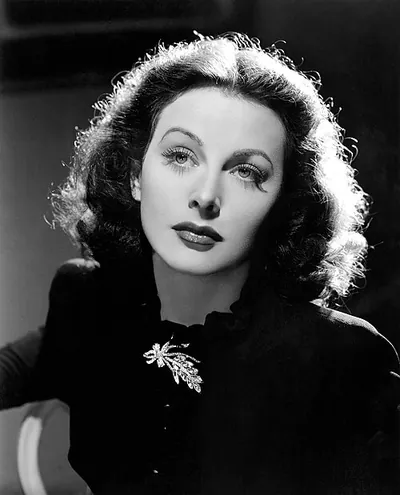
Hedy Lamarr
1914–2000 · Austrian-American actress and inventor
Biography
Hedy Lamarr, born Hedwig Eva Maria Kiesler in Vienna in 1914 and died in Florida in 2000, was an Austrian-born American actress who became a major film star in Hollywood during the 1940s. She is also remembered as an inventor, which makes her career unusual: a studio star whose ideas about wireless communication anticipated later technology. Her story interests film lovers both for her movies and for the way the studio system shaped her public image.
She trained in performing arts in Berlin, at a school linked to Max Reinhardt, and began working in theatre and film in Austria and Czechoslovakia. Her name became linked to Ecstasy (1933), directed by Gustav Machatý, which showed her nude and her face during orgasm, something unseen in mainstream commercial cinema at the time. The film won recognition in Europe, but it was banned in the United States and Germany and condemned by religious and moral groups, turning it into an international scandal that shadowed the actress for years.
In 1933 she married Friedrich Mandl, a wealthy Austrian arms manufacturer with ties to Mussolini and Hitler. By her own account, the marriage was suffocating: her husband controlled her movements, stopped her from working and kept her under close watch at home. Some accounts suggest that during these years she used his business meetings to pursue her interest in engineering and to collect technical information. In 1937 she managed to flee to Paris. There are two versions of the escape: the one she gives in her autobiography, in which she disguised herself as her maid, and another in which she left after a dinner party where she was wearing all her jewellery.
From Paris she went to London, where she met Louis B. Mayer of Metro-Goldwyn-Mayer. Mayer first offered her a modest contract, which she turned down, but she impressed him enough to secure one paying $500 a week. He asked her to change her name to distance herself from her past, and she chose Lamarr in homage to the silent star Barbara La Marr. In 1938 he brought her to Hollywood and promoted her as the world's most beautiful woman. Her breakthrough was Algiers (1938), opposite Charles Boyer, a success that placed her among the leading names of the moment. She then played exotic seductresses in Boom Town (1940), H.M. Pulham, Esq. (1941) and White Cargo (1942). Her greatest commercial success came with Samson and Delilah (1949), directed by Cecil B. DeMille, in which she played the title character's betrayer. After a period on television, she made her last film, The Female Animal, in 1958, and in 1960 she received a star on the Hollywood Walk of Fame.
At the start of the Second World War, Lamarr and the composer George Antheil developed a radio guidance system for Allied torpedoes based on frequency hopping, designed to resist jamming by the Axis powers. The patent was filed in both their names. The US Navy did not adopt the technology until the 1960s, and the invention received little recognition at the time. Over the following decades its principles were linked to Bluetooth and to early versions of Wi-Fi, and in 2014 she was inducted into the National Inventors Hall of Fame. It is worth noting that frequency hopping existed before their patent and that her role is more complicated than popular retellings suggest.
Lamarr became an American citizen in 1953. In 1966 she published the autobiography Ecstasy and Me, whose authorship she later disputed: she acknowledged on television that much of it was fiction and that a ghostwriter had been involved, which led to legal disputes. She faced other legal problems, including arrests for shoplifting in 1966 and 1991. In 1974 she sued Warner Bros. over the parody of her name in Blazing Saddles, and the case ended in an out-of-court settlement. After a period of retirement in Miami Beach, she spent many hours on the telephone in her final years. She died in 2000, and her ashes were taken to Vienna. Her legacy combines an uneven film career with a late but genuine recognition for her work in technology.
Key films
- Ecstasy (1933): her most famous film, which brought her international attention and marked her early reputation.
- Algiers (1938): her Hollywood breakthrough, opposite Charles Boyer.
- Boom Town (1940): a Western with Clark Gable and Spencer Tracy in which she played a glamorous figure typical of the period.
- Samson and Delilah (1949): her greatest commercial success, directed by Cecil B. DeMille, in which she played Delilah.
Trivia
An invention with a composer
At the start of the Second World War, Lamarr developed a frequency-hopping radio guidance system for torpedoes together with the composer George Antheil. The patent was registered in both names.
A name taken from a silent star
Mayer suggested she change her name to distance herself from her past, and the surname Lamarr paid homage to the silent film actress Barbara La Marr, whom Mayer's wife admired.
A lawsuit over a parody
In 1974 she sued Warner Bros. over the parody of her name in Blazing Saddles, arguing that it violated her right to privacy. The case ended in an out-of-court settlement and an apology.
On Cinematopedia
 Algiers1938
 Samson and Delilah1950
 Ziegfeld Girl1941
 Boom Town1940
 Comrade X1940
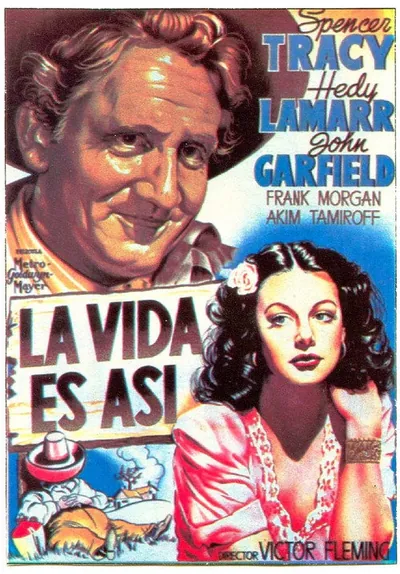 Tortilla Flat1942
 Ecstasy1933
 Experiment Perilous1944
 Come Live with Me1941
 Dishonored Lady1947
 I Take This Woman1940
 Lady of the Tropics1939
- Money on the Street 1930 · cast
- The Trunks of Mr. O.F. 1931 · cast
- No Money Needed 1932 · cast
- Ecstasy 1933 · cast
- Algiers 1938 · screenplay, cast
- Lady of the Tropics 1939 · cast
- Boom Town 1940 · cast
- Comrade X 1940 · cast
- I Take This Woman 1940 · cast
- Ziegfeld Girl 1941 · cast
- Come Live with Me 1941 · screenplay, cast
- H. M. Pulham, Esq. 1941 · cast
- Tortilla Flat 1942 · cast
- White Cargo 1942 · cast
- Experiment Perilous 1944 · cast
- The Conspirators 1944 · cast
- The Heavenly Body 1944 · cast
- Her Highness and the Bellboy 1945 · cast
- The Strange Woman 1946 · cast
- Dishonored Lady 1947 · cast
- Samson and Delilah 1950 · cast
- Copper Canyon 1950 · cast
- A Lady Without Passport 1950 · screenplay, cast
- Loves of Three Queens 1954 · cast
- The Story of Mankind 1957 · cast
Original Cinematopedia text based on Wikipedia (es) and Wikipedia (en) and Wikidata.