
Annie Hall
1977 · United States · 91 min
- Director
- Woody Allen
- Screenplay
- Woody Allen, Marshall Brickman
- Producer
- Charles H. Joffe, Jack Rollins
- Music
- Carmen Lombardo
- Cinematography
- Gordon Willis
- Editing
- Ralph Rosenblum
- Production company
- Jack Rollins & Charles H. Joffe Productions
Awards: Academy Award for Best Writing, Original Screenplay; Academy Award for Best Picture; Academy Award for Best Director; Academy Award for Best Actress; Golden Globes; National Board of Review: Top Ten Films · 5 nominations
Cast
What it is about
Alvy Singer, a New York comedian of Jewish background, is trying to understand why his relationship with Annie Hall ended a year ago. The film does not follow a strict chronology. Memories of the couple sit alongside the protagonist's recollections of a Brooklyn childhood, his previous marriages and his anxious view of love, sex and death. Annie, a singer from the Midwest who has settled in New York, comes across as spontaneous and quietly insecure, while Alvy is a hypochondriac, obsessive and painfully aware of his own contradictions. The tone is that of a sharp comedy of manners, with fast dialogue, but it also makes room for melancholy and self-examination. Characters sometimes speak straight to the audience, and some scenes show what people think as opposed to what they say. The result is a fragmented, personal structure centred on a couple whose differences in temperament, background and expectations slowly wear away a relationship that once seemed simple.
How it was made
Annie Hall grew out of the long walks Woody Allen took through New York with his co-writer Marshall Brickman. The two talked about the project often, sometimes in frustration, and at one point they nearly dropped it. Allen wrote a first draft in about four days, which Brickman then revised. That early version followed a man in his forties whose life had several strands: a relationship with a younger woman, a preoccupation with the banality of everyday life and a need to test himself. Allen turned forty in 1975, and Brickman suggests that his age and his thoughts about death pushed the material towards a more philosophical, personal approach. Allen has described the decision to sacrifice some laughs for a story about human beings. The script changed a great deal. The first version was a drama built around a murder mystery, with a comic and romantic subplot. The mystery was dropped, although Allen and Brickman returned to the genre years later with Manhattan Murder Mystery (1993), again starring Diane Keaton. The working title was Anhedonia, a word for the inability to feel pleasure, and Brickman proposed alternatives such as Rollercoaster Named Desire. After several test screenings, Allen settled on Annie Hall. The role of Annie was written specifically for Keaton, who had already worked with Allen in Play It Again, Sam, Sleeper and Love and Death. She saw the character as an affable version of herself, and she has said that the couple's dynamic drew partly on her own relationship with the director, although Allen has insisted the film is not autobiographical. The cinematographer was Gordon Willis, a specialist in darker dramas such as The Godfather, a pairing that many found unexpected at the time. The two became friends and went on to work together on several later films. Principal photography began on May 19, 1976, on the South Fork of Long Island, with the lobster-cooking scene, and continued on and off for about ten months. Willis varied his approach by location: warm golden light for California, grey overcast for Manhattan and a polished Hollywood look for the dream sequences, most of which were cut. It was his idea to shoot the two therapy sessions in a single set divided by a wall rather than with split screen. Allen uses long takes in which conversations run without cuts. One study cited in the sources puts the film's average shot length at about 14.5 seconds, while many films of 1977 averaged between 4 and 7 seconds. Breaking the fourth wall, an animated sequence based on the comic strip Inside Woody Allen and the use of mental subtitles are occasional but very visible devices. Editor Ralph Rosenblum's first assembly ran two hours and twenty minutes. Brickman found it scattered, a film that could have been several films, and the edit was reorganised around the relationship, which became the dramatic spine. The music is sparse, mostly songs such as Carmen Lombardo's «Seems Like Old Times», sung by Keaton. The budget was about four million dollars, modest for a film of its profile.
Reception and legacy
The film premiered at the Los Angeles Film Festival on March 27, 1977, and opened commercially in the United States on April 20 of that year. Critics received it with widespread acclaim, especially praising the script and the performances of Allen and Keaton. Tim Radford of The Guardian called it Allen's most closely focused and daring work to that point. Vincent Canby of The New York Times preferred it to Take the Money and Run, finding it more humane. There were dissenting voices as well. Peter Cowie noted its profusion of cultural references, and John Simon, writing for New York magazine, dismissed it as unfunny and embarrassingly self-revealing. Over time the reputation grew. Roger Ebert included it among his Great Movies and, in 2002, remarked with surprise on how familiar it still felt. Peter Bradshaw, writing later for The Guardian, named it the best comedy of all time. At the Academy Awards, Annie Hall won four Oscars: Best Picture, Best Director, Best Original Screenplay and Best Actress for Keaton. Allen was nominated for Best Actor but did not attend the ceremony, a stance he kept in later years until 2002. The film also won four BAFTA Awards and Keaton received the Golden Globe for Best Actress in a comedy or musical. Christopher Walken, who has a supporting role, won the Oscar the following year for The Deer Hunter. In 1992 the Library of Congress selected the film for the National Film Registry as culturally, historically and aesthetically significant. Its influence can be seen in later romantic comedies, and Rob Reiner openly paid homage to it in When Harry Met Sally.... Critics also regard it as a transitional film in Allen's career, moving from the absurd humour of his early work towards a more naturalistic, author-driven cinema. Its screenplay is among the most admired in the genre, and the film is a regular fixture on lists of essential comedies.
Stills


Trailer
Clicking loads the video from YouTube (privacy-enhanced mode). Open on YouTube
Trivia
A rejected title
Before becoming Annie Hall, the film was working under Anhedonia, a psychological term for the inability to enjoy life. The studio would not allow such an unappealing name.
A cameo that fell through
Allen first wanted Federico Fellini for the cinema queue scene, but Fellini declined, as did Luis Buñuel. Marshall McLuhan appeared instead.
A later tribute
Rob Reiner openly paid tribute to the film in When Harry Met Sally..., made years later.
More films by Woody Allen
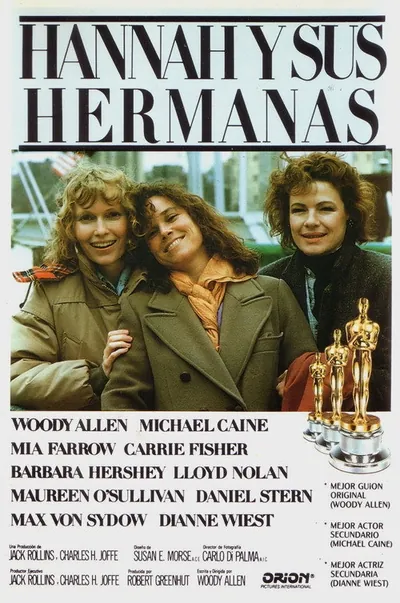 Hannah and Her Sisters
 Midnight in Paris
 The Purple Rose of Cairo
 Blue Jasmine
 Vicky Cristina Barcelona
 Bullets Over Broadway
Original Cinematopedia text based on Wikipedia (es) and Wikipedia (en) and Wikidata.