
Toshirō Mifune
1920–1997 · Japanese actor and producer
Biography
Toshiro Mifune (Seito, China, 1920 - Mitaka, Tokyo, 1997) was a Japanese actor and producer whose screen presence made him one of the central figures of postwar Japanese cinema. He is best known for his sixteen films with Akira Kurosawa, many of them samurai dramas. His rough, sometimes comic warriors, often masterless ronin, helped shape the wandering-warrior archetype that Western cinema would later borrow.
Born on 1 April 1920 in Seito, in Japanese-occupied Shandong, he was the eldest son of Tokuzo and Sen Mifune, both of Japanese origin. His father was a merchant and photographer who ran a photography business, and young Mifune worked in his studio. During the Second World War he served in the Imperial Japanese Army's aerial photography unit, a posting that came from his knowledge of cameras. After the war he worked as a camera assistant at Toho.
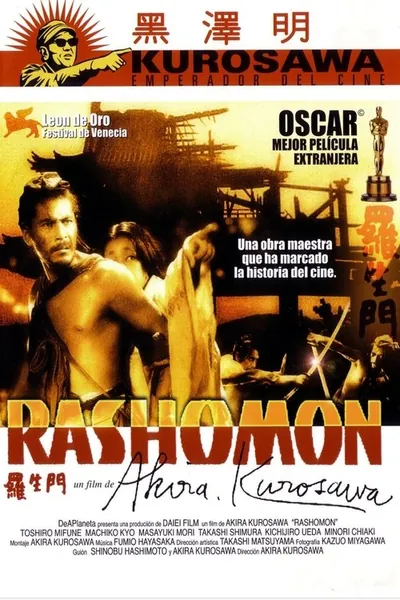
His move into acting was almost accidental. A friend submitted his photograph to a new-faces audition without his knowledge, and although he did not win the competition, the director Kajiro Yamamoto noticed him and recommended him to Senkichi Taniguchi, who cast him in the comedy Shin Baka Jidai (1947). The following year he met Kurosawa during another talent search at Toho. Kurosawa was struck by the young man's intensity, and their partnership produced Rashomon (1950), Seven Samurai (1954), Throne of Blood (1957) and Yojimbo (1961). Mifune's characters were often coarse and wry, and Kurosawa reportedly said he could convey in three feet of film an emotion that an average Japanese actor needed ten feet to express.
In the early 1960s the partnership cooled, strained by Kurosawa's demanding shoots and by the money problems that followed Mifune's decision to set up his own production company. Red Beard (1965) became their last film together. That same year Mifune won the Volpi Cup at Venice for Yojimbo and again for Red Beard. He also worked with Hiroshi Inagaki on the Samurai Trilogy (1954-1956) and on twenty films in total with the director.
His international reach came with Animas Trujano (1961), directed in Mexico by Ismael Rodriguez after the death of Pedro Infante. Mifune learned his lines in Spanish, but his heavy accent led to his voice being dubbed by Narciso Busquets in the final cut. The film became the second Mexican production nominated for an Academy Award, and it also received a Golden Globe nomination. He later starred in Grand Prix (1966), his Hollywood debut, and appeared in Hell in the Pacific (1968), Red Sun (1971) and Steven Spielberg's 1941 (1979). On television he played Lord Toranaga in the miniseries Shogun (1980).
He retired in 1992 for health reasons and died on 24 December 1997, aged 77, in a hospital in Mitaka. His legacy lives on through his influence on action and Western cinema, his star on the Hollywood Walk of Fame in 2016, and the documentary Mifune: The Last Samurai (2015), which covers his life and films.
Key films
- Rashomon (1950), a bandit caught up in the conflicting accounts of a murder.
- Seven Samurai (1954), a rough, wry warrior who helps defend a village.
- Yojimbo (1961), a nameless ronin who plays two rival clans against each other.
- Throne of Blood (1957), Kurosawa's version of Macbeth, with Mifune as an ambitious feudal lord.
- Red Beard (1965), a doctor at a charity clinic and his last film with Kurosawa.
Trivia
A dubbed voice
Mifune learned his lines for Animas Trujano in Spanish, but his accent was so strong that Narciso Busquets provided his voice in the final cut.
Three feet of film
Kurosawa remarked that Mifune could convey in three feet of film an emotion that an average Japanese actor needed ten feet to show.
On Cinematopedia
 Rashomon1950
 Seven Samurai1954
 Yojimbo1961
 Grand Prix1966
 19411979
 Throne of Blood1957
 The Hidden Fortress1958
 Stray Dog1949
 Rickshaw Man1958
 High and Low1963
 Drunken Angel1948
 The Idiot1951
- Snow Trail 1947 · cast
- Drunken Angel 1948 · cast
- Stray Dog 1949 · cast
- The Quiet Duel 1949 · cast
- Rashomon 1950 · cast
- Scandal 1950 · cast
- The Idiot 1951 · cast
- The Life of Oharu 1952 · cast
- Eagle of the Pacific 1953 · cast
- Seven Samurai 1954 · cast
- Samurai I: Musashi Miyamoto 1954 · cast
- I Live in Fear 1955 · cast
- Samurai II: Duel at Ichijoji Temple 1955 · cast
- Samurai III: Duel at Ganryu Island 1956 · cast
- A Wife's Heart 1956 · cast
- Throne of Blood 1957 · cast
- The Lower Depths 1957 · cast
- The Hidden Fortress 1958 · cast
- Rickshaw Man 1958 · cast
- The Birth of Japan 1959 · cast
- Life of an Expert Swordsman 1959 · cast
- The Bad Sleep Well 1960 · cast
- Yojimbo 1961 · cast
- The Story of Osaka Castle 1961 · cast
- Sanjuro 1962 · cast
- The Important Man 1962 · cast
- Chushingura 1962 · cast
- High and Low 1963 · cast
- The Lost World of Sinbad 1963 · cast
- Red Beard 1965 · cast
- Samurai Assassin 1965 · producer, cast
- Grand Prix 1966 · cast
- The Sword of Doom 1966 · cast
- Samurai Rebellion 1967 · producer, cast
- Japan's Longest Day 1967 · cast
- Hell in the Pacific 1968 · cast
- The Sands of Kurobe 1968 · cast
- Battle of the Japan Sea 1969 · cast
- Samurai Banners 1969 · cast
- Red Lion 1969 · producer, cast
- Shinsengumi: Assassins of Honor 1969 · cast
- Zatoichi Meets Yojimbo 1970 · cast
- Red Sun 1971 · cast
- Paper Tiger 1975 · cast
- Midway 1976 · cast
- Proof of the Man 1977 · cast
- Shogun's Samurai 1978 · cast
- The Fall of Ako Castle 1978 · cast
- 1941 1979 · cast
- The Battle of Port Arthur 1980 · cast
- Inchon 1981 · cast
- The Challenge 1982 · cast
- Princess from the Moon 1987 · cast
- Tora-san Goes North 1987 · cast
- Death of a Tea Master 1989 · cast
- Shogun Mayeda 1991 · cast
- Shadow of the Wolf 1992 · cast
Original Cinematopedia text based on Wikipedia (es) and Wikipedia (en) and Wikidata.