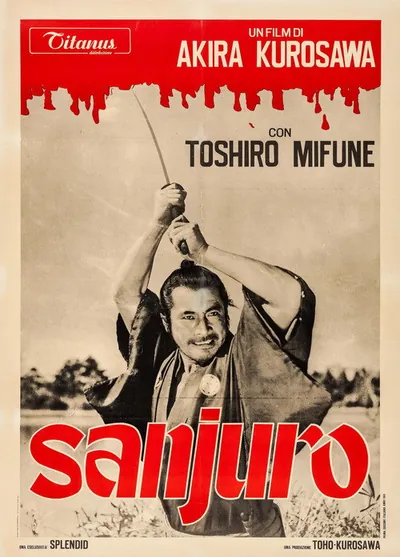
Sanjuro
1962 · Japan · 96 min
- Director
- Akira Kurosawa
- Screenplay
- Akira Kurosawa, Hideo Oguni
- Producer
- Ryūzō Kikushima
- Music
- Masaru Sato
- Editing
- Akira Kurosawa
- Production company
- Toho
What the critics say
100 % Rotten Tomatoes positive reviewsCast
What it is about
In Tokugawa-era Japan, nine young samurai decide to confront the corruption that has taken hold of their clan. They secure the support of a police inspector, but their plan collapses when they are ambushed by the very forces they meant to challenge. A wandering ronin, bitter and pragmatic, rescues them and gradually becomes involved in their cause. When asked his name, the nameless drifter gives an alias drawn from the camellias around him, Tsubaki Sanjuro, which the group greets with laughter. The film follows his improvised schemes, his clashes with the corrupt officials, and a growing tension with an opponent who, though on the other side, shares his life outside society.
How it was made
The story draws loosely on Shūgorō Yamamoto's short story Hibi Heian, originally meant as a straight adaptation. The success of Yojimbo (1961) led Toho to turn it into a sequel starring the same antihero, and Akira Kurosawa rewrote the script with Hideo Oguni. Toshirō Mifune leads the cast, with Tatsuya Nakadai as the principal antagonist. Unlike the border town of Yojimbo, the action unfolds in a clan fortress town, giving the film a lighter, socially comic edge. One production anecdote concerns a single petal falling onto a turbulent stream, achieved with nylon stocking filament. The climactic spray of blood was unusually graphic for its era.
Reception and legacy
It opened in Japan in January 1962 and became Toho's biggest hit that year, and the second most successful Japanese release of its season. Critics have received it very warmly; in 2020 it held a 9.5 out of 10 average on Rotten Tomatoes with 100% positive reviews. Its final duel is often remembered as one of the great moments of samurai cinema. A new version directed by Yoshimitsu Morita appeared in 2007, a sign of the story's lasting appeal.
Stills


Trailer
Clicking loads the video from YouTube (privacy-enhanced mode). Open on YouTube
Trivia
A petal on the stream
The shot of a petal falling into the water proved hard to film. The crew rejected a piano wire and used a nylon stocking filament instead.
A hose that burst
During the climax, the hose producing the blood spray burst with far more force than planned. Nakadai said the pressure almost lifted him off the ground.
More films by Akira Kurosawa
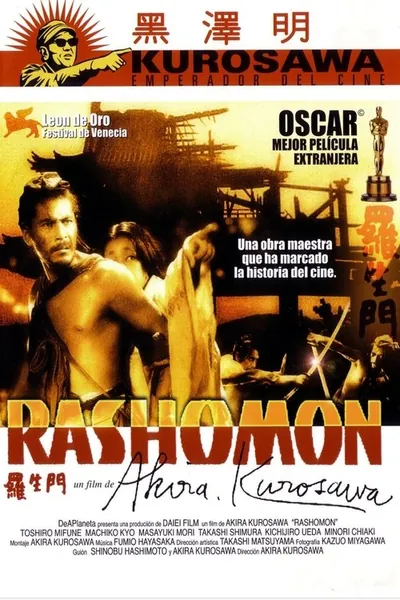 Rashomon
 Dersu Uzala
 Seven Samurai
 Ran
 Kagemusha
 Yojimbo
Original Cinematopedia text based on Wikipedia (es) and Wikipedia (en) and Wikidata.