
Pier Paolo Pasolini
1922–1975 · Italian poet, novelist and film director
Biography
Pier Paolo Pasolini (Bologna, 1922 - Ostia, 1975) was an Italian poet, novelist, essayist and film director, and one of the most influential intellectuals of twentieth-century Italy. He also worked as an actor, journalist, playwright and political activist. His films combined social critique with a blunt look at sexuality, religion and power. His murder in November 1975 shocked Italy and the wider world, and the circumstances and the identity of the killer remain a matter of debate.
Born in Bologna in 1922, he was the son of Susanna Colussi, an elementary school teacher, and Carlo Alberto Pasolini, a lieutenant in the Italian army. Because of the father's postings, the family moved often across northern Italy. After his father's arrest over gambling debts, his mother took the children back to Casarsa della Delizia in Friuli. There, around the age of seven, the young Pasolini began writing poems inspired by the surrounding countryside. Reading Rimbaud, Dostoevsky, Tolstoy and Shakespeare shaped him as he drifted away from the religious fervour of his childhood.
As a teenager he settled in Bologna, where he studied literature, philology and the figurative arts. In the early 1940s he published his first collection of poems in Friulan, a language he did not speak fluently but studied as an act of devotion to a regional tradition. Critics such as Gianfranco Contini and Alfonso Gatto took notice. He also painted, and he briefly edited the magazine Il Setaccio, from which he was dismissed after clashes with a director aligned with the Fascist regime. That experience pushed him gradually towards communism.
The war shaped his early adulthood. Called up after the 1943 armistice, he escaped capture by the Germans and returned to Casarsa, where he took part in efforts to promote Friulan and helped found an academy for the language. In 1945 his brother Guido was killed in an ambush set by Yugoslav guerrillas, an event that devastated him. That same year he graduated with a thesis on Giovanni Pascoli. He belonged to the Communist Party until 1949, when he was expelled for what the party called moral indignity, a reference to his well-known homosexuality.
In 1950 he moved to Rome with his mother and settled in the rundown Rebibbia suburb, while also finding work at the Cinecittà studios. His first novel, Ragazzi di vita (1955), about the Roman underclass, brought an obscenity complaint from which he was cleared. That year he helped launch the poetry journal Officina with other writers. The Ashes of Gramsci (1957), which won the Viareggio Prize, confirmed his standing as a poet. His move into film came step by step, first as a screenwriter and then as a director, with Accattone (1961), about a pimp on the Roman outskirts, and Mamma Roma (1962), starring Anna Magnani.
His films consistently looked closely at the marginalised, often using non-professional actors and a style that mixed the sacred with the popular. The Gospel According to St. Matthew (1964), shot with a cast of amateurs, remains his best-known work. Teorema (1968) turned a parable about the bourgeois family into a stark allegory. Then came The Decameron (1971), The Canterbury Tales (1972) and Arabian Nights (1974), the so-called Trilogy of Life, with their earthy, festive and erotic tone.
Salò, or the 120 Days of Sodom (1975), loosely based on Sade and set in the Salò Republic, was his most controversial film. Pasolini was murdered at Ostia on 2 November 1975. His work is still read as a critique of consumerism, mass culture and authoritarian power, and his figure continues to provoke debate in Italy and beyond.
Key films
- Accattone (1961)
- Mamma Roma (1962)
- The Gospel According to St. Matthew (1964)
- Teorema (1968)
- The Decameron (1971)
- Salò, or the 120 Days of Sodom (1975)
Trivia
Expulsion from the Communist Party
In 1949 he was expelled from the Italian Communist Party for what the party called moral unworthiness, a charge tied to his homosexuality, which the party regarded as bourgeois degeneration.
Obscenity complaint
The publication of Ragazzi di vita in 1955 led to an obscenity complaint against Pasolini and his publisher, Garzanti. He was cleared, but the controversy made him a target of insinuation in the tabloid press.
On Cinematopedia
 La Dolce Vita1960
 Nights of Cabiria1957
 The Canterbury Tales1972
 Salò, or the 120 Days of Sodom1975
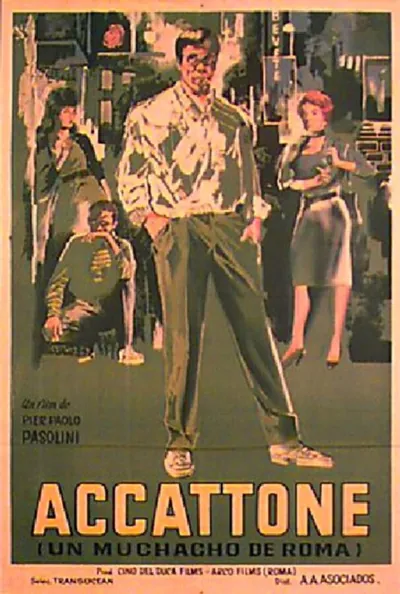 Accattone1961
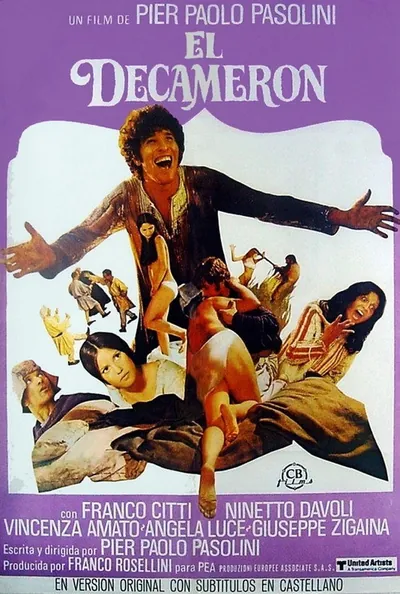 The Decameron1971
 The Gospel According to St. Matthew1964
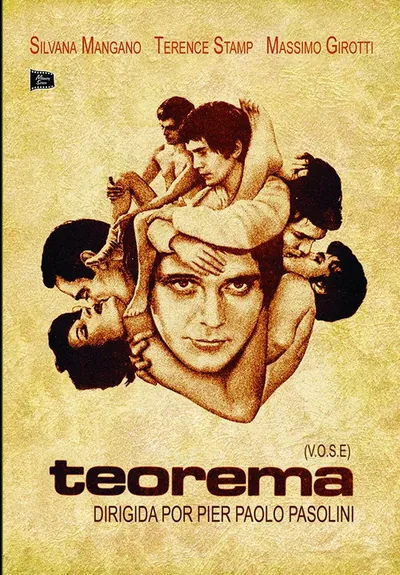 Theorem1968
 Mamma Roma1962
 Arabian Nights1974
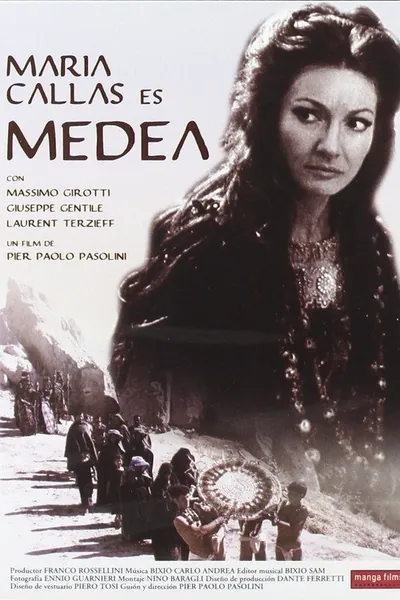 Medea1969
 The Hawks and the Sparrows1966
- The River Girl 1955 · screenplay
- Escape to the Dolomites 1955 · screenplay
- Nights of Cabiria 1957 · screenplay
- Young Husbands 1958 · screenplay
- Bad Girls Don't Cry 1959 · screenplay
- La Dolce Vita 1960 · screenplay
- Handsome Antonio 1960 · screenplay
- Long Night in '43 1960 · screenplay
- From a Roman Balcony 1960 · screenplay
- The Hunchback of Rome 1960 · cast
- Il carro armato dell'8 settembre 1960 · screenplay
- Accattone 1961 · director, screenplay
- Girl in the Window 1961 · screenplay
- Mamma Roma 1962 · director, screenplay
- The Grim Reaper 1962 · screenplay
- Ro.Go.Pa.G. 1963 · director, screenplay
- Anger 1963 · director, screenplay, cast
- La Ricotta 1963 · director, screenplay
- The Gospel According to St. Matthew 1964 · director, screenplay
- Love Meetings 1964 · director, screenplay, cast
- Location Hunting in Palestine 1965 · director, screenplay
- The Hawks and the Sparrows 1966 · director, screenplay
- Oedipus Rex 1967 · director, screenplay, cast
- The Witches 1967 · director, screenplay
- Caprice Italian Style 1967 · director, screenplay
- Requiescant 1967 · screenplay, cast
- Theorem 1968 · director, screenplay
- Notes for a Film on India 1968 · director, screenplay, cast
- Medea 1969 · director, screenplay
- Pigsty 1969 · director, screenplay
- Love and Anger 1969 · director, screenplay
- The Decameron 1971 · director, screenplay, cast
- The Canterbury Tales 1972 · director, screenplay, cast
- December 12th 1972 · director, screenplay
- Bawdy Tales 1973 · screenplay
- Arabian Nights 1974 · director, screenplay
- Salò, or the 120 Days of Sodom 1975 · director, screenplay
- Who Killed Pasolini? 1995 · cast
Original Cinematopedia text based on Wikipedia (es) and Wikipedia (en) and Wikidata.