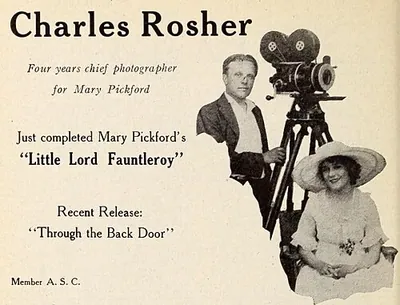
Charles Rosher
1885–1974 · British-born American cinematographer
Biography
Charles Gladdish Rosher (London, 17 November 1885 – Lisbon, 15 January 1974) was a British-born cinematographer who worked in Hollywood from the early silent era into the 1950s. He is remembered for his long partnership with Mary Pickford and for sharing the first Academy Award for cinematography, with Karl Struss, for Sunrise.
Rosher came to filmmaking through photography, which he had first pursued as a hobby while studying naval architecture. He trained at a London school of photography and worked as an assistant to the official photographer of the British royal family. After a conference in Rochester, New York, in 1908, he chose to stay in the United States, drawn by better pay and by the absence of formal dress requirements. He began as a newsreel cameraman and in 1910 joined David Horsley's New Jersey company, which moved to Hollywood in 1911 and took him along, making him the city's first full-time cameraman. In 1913 he went to Mexico to film Pancho Villa's rebellion.
In 1919 he helped found the American Society of Cinematographers and became its first vice-president. Through the 1920s he was among the most sought-after cameramen in Hollywood. He shot Pickford's films from A Little Princess (1917) through My Best Girl (1927), before their working relationship broke down during Coquette (1929), her first talkie, over restrictions the sound department wanted to impose. His collaboration with F. W. Murnau on Sunrise is regarded as a landmark of silent-era cinematography. He also shot five films for David O. Selznick and spent the last twelve years of his career at Metro-Goldwyn-Mayer, on titles such as Annie Get Your Gun and Show Boat.
Rosher won a second Oscar for The Yearling (1946), shared with Leonard Smith and Arthur Arling, and received four further nominations. He was also honoured with Photoplay's Gold Medal and a fellowship from the Society of Motion Picture Engineers. His legacy rests on his craft through the shift from silent to sound and on his work in the early years of colour photography.
Key films
- Sunrise (1927), directed by F. W. Murnau, which earned the first Academy Award for cinematography, shared with Karl Struss.
- Coquette (1929), Mary Pickford's first talkie, whose production ended his work with her.
- The Taming of the West...
On Cinematopedia
 Sunrise: A Song of Two Humans1927
 The Yearling1946
 Coquette1929
 Tempest1928
 The Affairs of Cellini1934
 Annie Get Your Gun1950
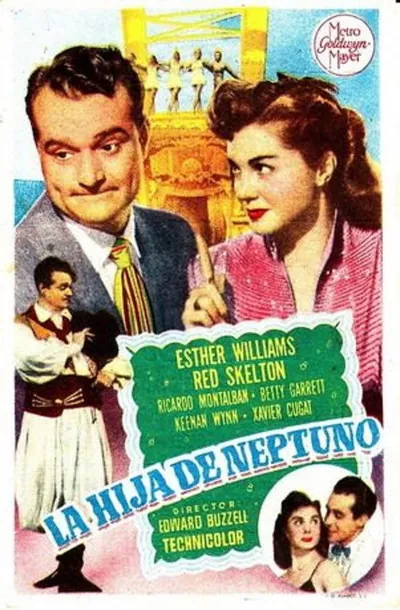 Neptune's Daughter1950
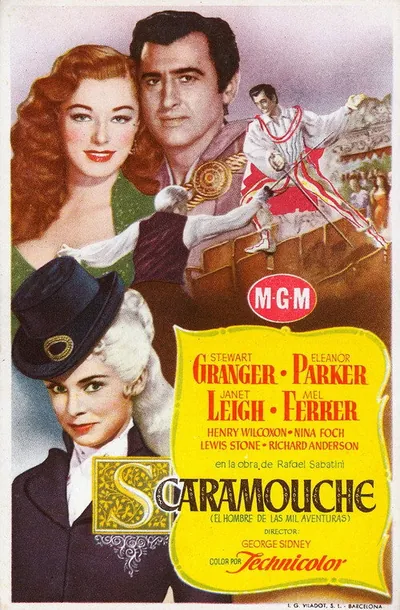 Scaramouche1952
 What Price Hollywood?1932
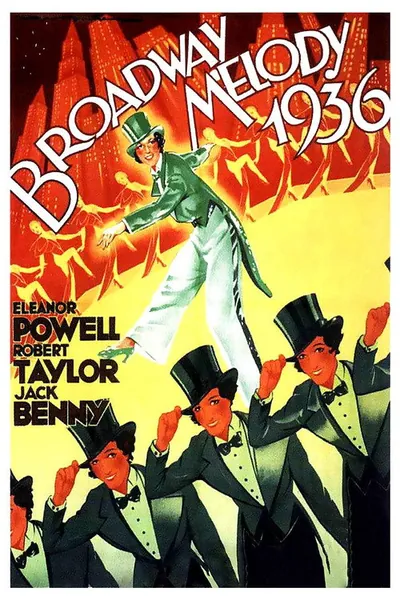 Broadway Melody of 19361935
 Daddy-Long-Legs1919
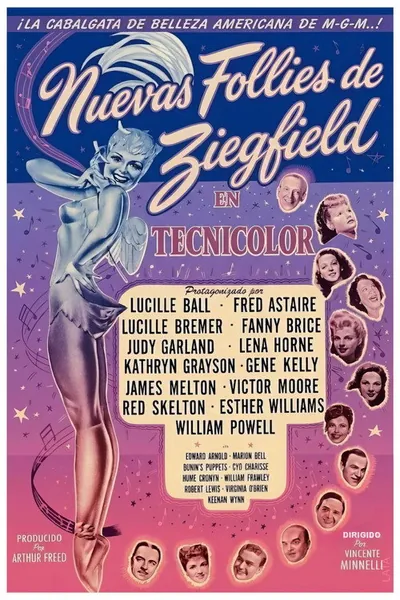 Ziegfeld Follies1945
- Blackbirds 1915 · cinematography
- The Voice in the Fog 1915 · cinematography
- The Blacklist 1916 · cinematography
- The Clown 1916 · cinematography
- A Little Princess 1917 · cinematography
- The Primrose Ring 1917 · cinematography
- A Mormon Maid 1917 · cinematography
- How Could You, Jean? 1918 · cinematography
- Johanna Enlists 1918 · cinematography
- Daddy-Long-Legs 1919 · cinematography
- Heart o' the Hills 1919 · cinematography
- The Hoodlum 1919 · cinematography
- Captain Kidd, Jr. 1919 · cinematography
- Pollyanna 1920 · cinematography
- Suds 1920 · cinematography
- The White Circle 1920 · cinematography
- Little Lord Fauntleroy 1921 · cinematography
- Through the Back Door 1921 · cinematography
- The Love Light 1921 · cinematography
- Smilin' Through 1922 · cinematography
- Tess of the Storm Country 1922 · cinematography
- Rosita 1923 · cinematography
- Three Women 1924 · cinematography
- Dorothy Vernon of Haddon Hall 1924 · cinematography
- Sparrows 1926 · cinematography
- Sunrise: A Song of Two Humans 1927 · cinematography
- My Best Girl 1927 · cinematography
- Tempest 1928 · cinematography
- Coquette 1929 · cinematography
- Atlantic 1929 · cinematography
- Eternal Love 1929 · cinematography
- Paid 1930 · cinematography
- Dance, Fools, Dance 1931 · cinematography
- Laughing Sinners 1931 · cinematography
- This Modern Age 1931 · cinematography
- What Price Hollywood? 1932 · cinematography
- Rockabye 1932 · cinematography
- The Silver Cord 1933 · cinematography
- The Affairs of Cellini 1934 · cinematography
- Broadway Melody of 1936 1935 · cinematography
- The Call of the Wild 1935 · cinematography
- After Office Hours 1935 · cinematography
- Little Lord Fauntleroy 1936 · cinematography
- Small Town Girl 1936 · cinematography
- Hollywood Hotel 1937 · cinematography
- The Perfect Specimen 1937 · cinematography
- White Banners 1938 · cinematography
- Brother Rat and a Baby 1940 · cinematography
- One Foot in Heaven 1941 · cinematography
- Stand By for Action 1942 · cinematography
- I Dood It 1943 · cinematography
- Kismet 1944 · cinematography
- Ziegfeld Follies 1945 · cinematography
- Yolanda and the Thief 1945 · cinematography
- The Yearling 1946 · cinematography
- Song of the Thin Man 1947 · cinematography
- Fiesta 1947 · cinematography
- On an Island with You 1948 · cinematography
- Words and Music 1948 · cinematography
- Annie Get Your Gun 1950 · cinematography
- Neptune's Daughter 1950 · cinematography
- The Red Danube 1950 · cinematography
- Pagan Love Song 1950 · cinematography
- Show Boat 1951 · cinematography
- Scaramouche 1952 · cinematography
- Young Bess 1953 · cinematography
- Kiss Me Kate 1953 · cinematography
- The Story of Three Loves 1953 · cinematography
- Jupiter's Darling 1955 · cinematography
Original Cinematopedia text based on Wikipedia (en) and Wikidata.