
Of These Thousand Pleasures
Sandra
1965 · Italy · 105 min
- Director
- Luchino Visconti
- Screenplay
- Luchino Visconti, Suso Cecchi d'Amico, Enrico Medioli
- Producer
- Franco Cristaldi
- Music
- César Franck
- Cinematography
- Armando Nannuzzi
- Editing
- Mario Serandrei
Awards: Golden Lion
What the critics say
100 % Rotten Tomatoes positive reviewsCast
What it is about
After years away, Sandra returns to Volterra, her hometown, for a ceremony in which the family garden is donated to the town in memory of her father. Her husband Andrew, deeply in love with her, accompanies her and wants to see where she spent her youth. In the large family house, Sandra is overwhelmed by memories. She reunites with her brother Gianni, an aspiring writer with whom she shares an ambiguous bond, and with her mother, a pianist with serious psychiatric problems. Gradually Andrew realises the family is haunted by the death of the father, a Jewish intellectual deported by the Nazis. The film turns on the pull between an unresolved past and the choices of the present.
How it was made
The film was shot on location in Volterra, a Tuscan town, and two local palazzos stood in for the family mansion. The screenplay was written by Visconti with Suso Cecchi D'Amico and Enrico Medioli. The Italian title comes from a line of Giacomo Leopardi's poem "Le ricordanze", a reference that resonates with the story. It was the third of four films Claudia Cardinale made with Visconti, after Rocco and His Brothers (1960) and The Leopard (1963). César Franck provided the music, Armando Nannuzzi shot the film and Mario Serandrei edited it. Drawing on Electra, Orestes and the Oedipus myth, Visconti transposes Greek tragedy into contemporary Italy with a measured treatment of memory and of time that seems suspended in the house.
Reception and legacy
A drama with a deliberate pace, the film is less known than Visconti's other works, though its direction and performances are often praised for their sensitivity. It premiered at the Venice International Film Festival, where it won the Golden Lion. Its reworking of Greek tragedy and its meditation on memory make it a distinctive entry in Visconti's filmography.
Stills


Trivia
Dubbing
It was first reported that the lead actors would voice their own parts in the English-language version, but they were ultimately dubbed by others.
Locations
Casa Inghirami and the Palazzo Viti were both used as settings for the family mansion.
More films by Luchino Visconti
 The Leopard
 Ludwig
 Death in Venice
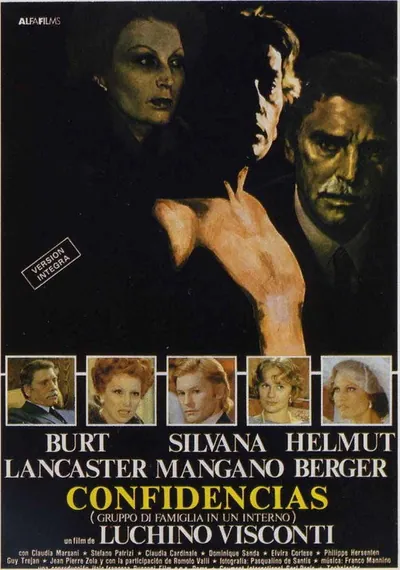 Conversation Piece
 Rocco and His Brothers
 The Damned
Original Cinematopedia text based on Wikipedia (es) and Wikipedia (en) and Wikidata.