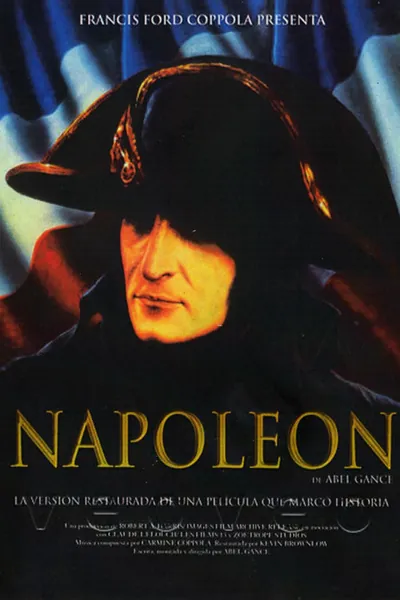
Napoléon
Napoleón
1927 · Italy, France, Germany · 330 min
- Director
- Abel Gance
- Screenplay
- Abel Gance
- Producer
- Abel Gance
- Music
- Arthur Honegger
- Cinematography
- Léonce-Henri Burel, Georges Meyer, Jules Kruger
- Editing
- Abel Gance
What the critics say
88 % Rotten Tomatoes positive reviewsCast
What it is about
The film follows the early life of Napoleon Bonaparte, from his schooldays at the military academy in Brienne in 1781 to 1796, when he has been made a general and launches the Montenotte campaign. Abel Gance structures the story in several blocks: the boyhood of a future soldier who is mocked for his Corsican origins, a return to Corsica where local politics turns against him, and his rise during the French Revolution, including the siege of Toulon, his imprisonment, his marriage to Joséphine de Beauharnais and his command of the army guarding the Italian border. It is a chronicle of youth and ambition rather than an intimate portrait, built on crowd scenes and on a Napoleon defined by fervour and strategic instinct.
How it was made
Gance conceived the work as the first of six films covering Napoleon's entire career, up to his death in exile on Saint Helena. The difficulties of the first film made the full project unfeasible. The shoot relied on a wide range of techniques: extensive close-ups, fast cutting, hand-held camera, location filming, point-of-view shots, multiple cameras, multiple exposure, underwater camera and multi-screen projection. For the finale he devised Polyvision, a triptych projected by three machines at once, forming a central image flanked by two side images. The process was costly and hard to exhibit, and in many cinemas the film was shown on a single reel, with the images appearing very small.
Reception and legacy
The film premiered at a gala at the Palais Garnier in Paris on 7 April 1927. Metro-Goldwyn-Mayer acquired its rights, cut it drastically and kept only the central panel of the Polyvision sequence for a limited American release, where it was received with little enthusiasm just as talkies were arriving. For decades it circulated in incomplete versions. The 1980 restoration, led by silent film historian Kevin Brownlow after twenty years of work, restored much of its reputation. Its editing and camera mobility are regarded as landmarks, and its mid-1950s revival influenced the filmmakers of the French New Wave.
Stills


Trailer
Clicking loads the video from YouTube (privacy-enhanced mode). Open on YouTube
Trivia
A one-off format
Polyvision was used only for the closing sequence, and the film is cited as the only production to employ this system.
Colour in some scenes
The film used Keller-Dorian cinematography for its colour sequences.
More films by Abel Gance
 The Wheel
 Austerlitz
 J'accuse
 End of the World
Original Cinematopedia text based on Wikipedia (es) and Wikipedia (en) and Wikidata.