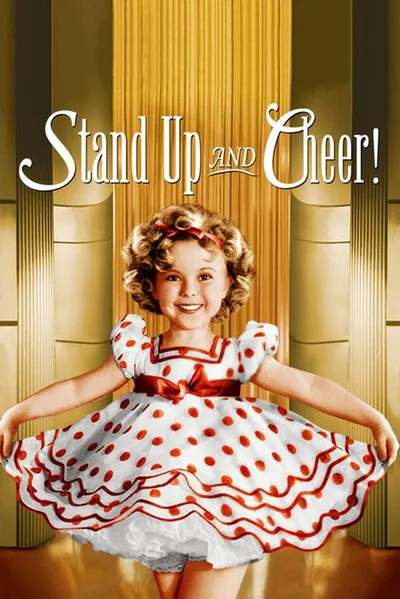
Stand Up and Cheer!
¡Levántate y aplaude!
1934 · United States
- Director
- Hamilton MacFadden
- Producer
- Winfield Sheehan
- Music
- Lew Brown
- Cinematography
- Ernest Palmer
- Production company
- Fox Film Corporation
Cast
What it is about
After consulting his advisers, the President of the United States concludes that the Great Depression stems from a loss of national optimism, fueled by financiers who profit from the crisis. To counter it, he appoints Lawrence Cromwell secretary of a newly created Department of Amusement, which assembles a large body of entertainers and sends them across the country. Much of the action takes place in Cromwell's office, where he holds auditions amid constant interruptions, and it ends with a musical number that becomes a fantasy of overcoming the crisis.
How it was made
The film, known during shooting as "Fox Follies", was conceived as a vehicle for a string of vaudeville acts and variety numbers, with a thin storyline, based on a story idea by Will Rogers and Philip Klein and a screenplay by Lew Brown and Ralph Spence. The most remembered moment is the James Dunn and Shirley Temple number "Baby Take a Bow". Temple had been signed to a two-week contract at first and did not have time to learn the choreography, so she performed a routine she had learned from Meglin; Dunn then learned it from her. During the recording, her voice cracked on the last note, but the producers kept it. Her talent became evident while filming the number, and the studio extended her contract to one year with a seven-year option.
Reception and legacy
Critics were divided. The New York Times praised its resemblance to a modern Gilbert and Sullivan-style comic opera, while The New Yorker called it mediocre. Several outlets praised Shirley Temple, whom Variety called the film's unofficial star. The film was a box office disappointment for Fox, and eleven minutes were cut for home video, most of them of racial content. Today scholars cite it as a typical example of Great Depression entertainment, and the number's popularity gave its title to Temple's next film.
Stills


Trivia
A polka-dot dress
The polka-dot dress Shirley Temple wore in her number with Dunn was used as the model for the first Shirley Temple dolls, made by Ideal in 1934.
A hidden cut
Before filming the dance routine, Temple slipped and cut her head; her mother covered the wound with a spit curl.
More films by Hamilton MacFadden
 The Black Camel
Original Cinematopedia text based on Wikipedia (es) and Wikipedia (en) and Wikidata.