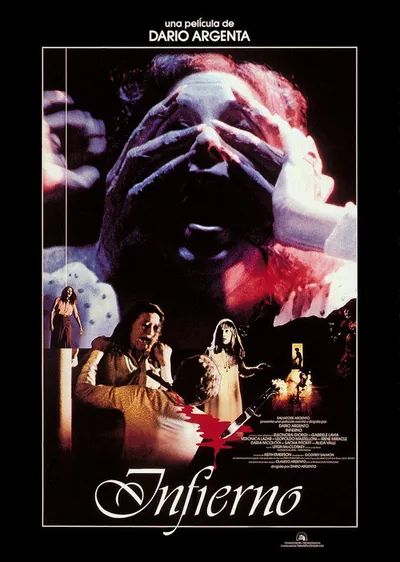
Inferno
1980 · Italy · 107 min
- Director
- Dario Argento
- Screenplay
- Dario Argento
- Producer
- Claudio Argento
- Music
- Keith Emerson
- Cinematography
- Romano Albani
- Editing
- Franco Fraticelli
What the critics say
63 % Rotten Tomatoes positive reviewsCast
What it is about
Rose Elliot, a poet living alone in an old, run-down apartment building in New York City, comes across a strange Latin book that unsettles her. Its pages describe three powerful witches who rule the world through sorrow, tears and darkness, and Rose becomes convinced that one of their houses is the building where she lives. Worried, she writes to her brother Mark, a music student in Rome, asking him to help her make sense of it. Mark travels to New York and begins his own inquiry, sensing that something hidden surrounds his sister and the people who live in the building.
How it was made
Inferno is the second part of Dario Argento's Three Mothers trilogy and a thematic follow-up to Suspiria (1977). Argento wrote and directed it, and his brother Claudio produced. Its main literary source is Thomas de Quincey's Suspiria de Profundis (1845), from which the names of the three witches and many of the alchemist's quotations are taken. While writing the script, Argento became interested in alchemy and Jungian archetypes, which gave the film a strongly esoteric tone. Principal photography took place largely on studio sets at the Elios studios in Rome, with only a small part, some exteriors in Central Park, shot in New York. Mario Bava handled the special effects and reportedly stood in for Argento on some scenes while he was recovering from hepatitis. The score was composed by the first-time film composer Keith Emerson, with a classical, atmospheric style far removed from the sound of Goblin. Romano Albani was the cinematographer.
Reception and legacy
The film opened in Italy in February 1980, distributed by 20th Century-Fox, but its American release was shelved for unspecified reasons and it received only a one-week limited run in New York in 1986. That restricted distribution helped keep it from matching the box office of Suspiria. Initial critical response was mostly negative, largely due to its confusing plot, but its reputation has grown considerably over the years for its atmosphere and surreal imagery. Kim Newman called it perhaps the most underrated horror movie of the 1980s, and in 2005 Total Film named it one of the 50 greatest horror films of all time. Argento has said it is his favourite of his films. The trilogy was completed with The Mother of Tears in 2007.
Stills


Trailer
Clicking loads the video from YouTube (privacy-enhanced mode). Open on YouTube
Trivia
An unexpected stand-in
Mario Bava, in charge of the special effects, reportedly filmed some scenes in place of Argento, who was ill with hepatitis during shooting.
An unusual film debut
Keith Emerson, making his film debut, composed the score, choosing a classical, atmospheric style very different from the sound of Goblin.
More films by Dario Argento
 Suspiria
 Deep Red
 The Bird with the Crystal Plumage
 Phenomena
 Tenebrae
 The Cat o' Nine Tails
Original Cinematopedia text based on Wikipedia (es) and Wikipedia (en) and Wikidata.