
The Shawshank Redemption
1994 · United States · 142 min
- Director
- Frank Darabont
- Screenplay
- Frank Darabont
- Producer
- Niki Marvin
- Music
- Thomas Newman
- Cinematography
- Roger Deakins
- Editing
- Richard Francis-Bruce
- Production company
- Columbia Pictures, Castle Rock Entertainment
- Based on
- Rita Hayworth and Shawshank Redemption
Awards: National Board of Review: Top Ten Films; American Society of Cinematographers Award for Outstanding Achievement in Cinematography in Theatrical Releases · 7 nominations
Cast
What it is about
In 1947, Andy Dufresne, a vice president at a major bank in Portland, Maine, goes on trial for the murder of his wife and of the man she was seeing. He insists he is innocent, but the evidence is enough to sentence him to two consecutive life terms at Shawshank State Prison. On arrival he finds a place governed by brutality, where guards punish inmates with cruel methods and Warden Samuel Norton presides over a regime that presents itself as order and discipline. There he befriends Ellis «Red» Redding, a long-serving inmate who knows how to get contraband, and the two men watch the prison routine for years from different angles. Andy, reserved and methodical, looks for a way to survive without losing himself; Red, more skeptical, describes the passing years with the dry irony of someone who no longer expects much. The story unfolds in episodes spanning more than two decades: the pressure of a gang of prisoners, Andy's uneasy relationship with the staff, his work running the library and the letters he keeps sending to the authorities. It is a story about patience, hope, and how a man keeps his integrity in a place built to break it.
How it was made
The film grew out of Rita Hayworth and Shawshank Redemption, a novella Stephen King published in 1982 as part of the collection Different Seasons. Frank Darabont had already worked with the writer on a short film based on one of his stories, and in 1987 he bought the adaptation rights for $5,000. King never cashed that check. Years later he returned it framed, with a note suggesting it might come in handy for bail money. When writing the screenplay, Darabont expanded certain elements of the source. Brooks, a minor figure in the novella, became a character with far more dramatic weight, and the warden, who in the book is split among several characters, became a single antagonist. He wrote the script in about eight weeks. Among his influences he listed the films of Frank Capra, especially Mr. Smith Goes to Washington and It's a Wonderful Life, and he cited Martin Scorsese's Goodfellas as a model for using dialogue to convey the passage of time.
Castle Rock Entertainment backed the project even though prison films had a reputation for disappointing at the box office. Castle Rock co-founder Rob Reiner wanted to direct it himself, but the studio ultimately let Darabont keep the job, with a budget of $25 million. Pre-production began in January 1993, and principal photography ran from June to August of that year, often with workdays of up to eighteen hours.
The casting went through several rounds of rejections. Darabont first approached actors he admired, such as Gene Hackman and Robert Duvall, for Andy, but they were unavailable, and Tom Cruise, Tom Hanks and Kevin Costner all turned the role down. Tim Robbins, whom the director had admired in Jacob's Ladder, was cast instead. To prepare, Robbins spent an afternoon in solitary confinement and had his arms and legs shackled for a few hours. Morgan Freeman was chosen on the suggestion of producer Liz Glotzer, even though the novella describes Red as a white Irishman. Brad Pitt was considered for the young inmate Tommy but left the project because of scheduling conflicts. Bob Gunton, who was shooting Demolition Man at the time, tested for Norton wearing a wig, since his head had been shaved for that other role.
Roger Deakins served as cinematographer, at Robbins's insistence. Deakins preferred to keep the prison exteriors out of frame to heighten the sense of confinement, while Darabont wanted more sweeping scenic shots. Most of the film was shot in Mansfield, Ohio, where the Ohio State Reformatory, closed in 1990, stood in for the fictional Shawshank in Maine. The cellblock interiors were built on a set inside a shuttered Westinghouse factory so that the cells could face one another. The final beach scene was filmed on Saint Croix in the U.S. Virgin Islands. The sewage-pipe escape required practical work too: Robbins crawls through a mixture of water, chocolate syrup and sawdust, and the stream was dammed and chlorinated to make it workable.
Reception and legacy
Critics responded warmly to the film, particularly to its story and to the performances of Robbins and Freeman. Its theatrical release in the United States in September 1994 was nonetheless a box-office disappointment, earning around $16 million during its initial run. At the time, observers pointed to several causes: competition from Pulp Fiction and Forrest Gump, the general unpopularity of prison films, the absence of significant female characters, and a title considered confusing for audiences. Despite that modest start, the film found its audience over the following years, helped by a theatrical re-release, strong home video rentals and frequent television broadcasts.
It fared better with awards voters. It received seven Academy Award nominations, including Best Picture, Best Actor, Best Adapted Screenplay, Best Cinematography, Best Film Editing, Best Original Score and Best Sound, along with two Golden Globe nominations.
Over time it became one of the most beloved films of the 1990s. It has held first place on IMDb's user-voted top 250 list since 2008, when it overtook The Godfather. In 2015 the United States Library of Congress selected it for preservation in the National Film Registry, citing its cultural, historical and aesthetic significance. Its thematic richness, read in religious terms or as a meditation on freedom and friendship, has kept critical discussion of it alive.
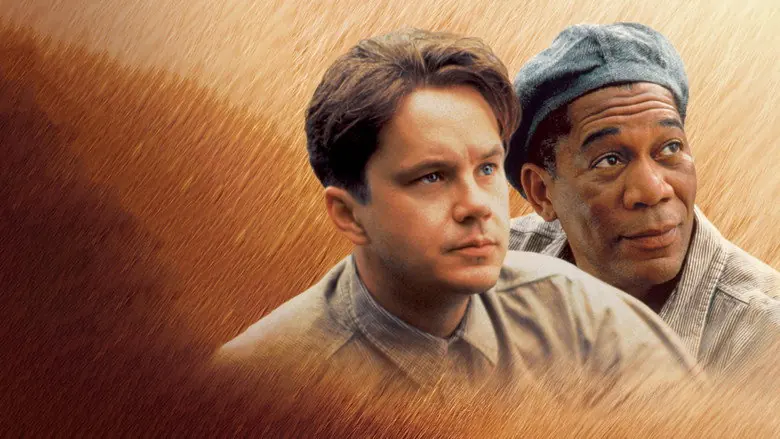
Stills


Trailer
Clicking loads the video from YouTube (privacy-enhanced mode). Open on YouTube
Trivia
A check that was never cashed
Stephen King never cashed the $5,000 check Darabont paid for the rights. Years later he returned it framed, with a note suggesting it might come in handy for bail money.
A tree felled by wind
The oak tree under which Andy buries his letter to Red stood near Malabar Farm State Park in Ohio. Winds destroyed it in 2016.
More films by Frank Darabont
 The Green Mile
 The Mist
 The Majestic
Original Cinematopedia text based on Wikipedia (es) and Wikipedia (en) and Wikidata.