
Rita Hayworth
1918–1987 · American actress, dancer and pin-up girl
Biography
Rita Hayworth, born Margarita Carmen Cansino (Brooklyn, October 17, 1918 – Manhattan, May 14, 1987), was an American actress, dancer and pin-up girl and one of the leading stars of Hollywood's Golden Age. Her screen career spanned around 38 years and some 61 films, and her name became closely tied to the 1940s and to the femme fatale image she embodied in several of her best-known titles.
She was born into a family with a long tradition in dance. Her father, Eduardo Cansino, was a Spanish dancer from Castilleja de la Cuesta, near Seville, and her mother, Volga Hayworth, was an American chorus performer of English and Irish descent. As a child she took dance lessons almost every day and, before she was a teenager, had already appeared on Broadway and in a short film for Warner Bros. The family moved to Hollywood in 1927, and soon her father made her his dance partner in an act that played casinos and nightclubs along the California coast and across the Mexican border. Her childhood was marked by demanding routines, constant touring and a patchy education, and she never finished high school.
In 1935 Fox signed her to a six-month contract as Rita Cansino, and she mostly took small parts as exotic foreigners. Her career changed direction when the salesman Edward Judson, whom she married in 1937, helped secure a deal with Columbia Pictures and its chief, Harry Cohn, who offered her a seven-year contract. Cohn felt her looks were too Mediterranean, and on his advice she took her mother's maiden name, dyed her hair a coppery red and had electrolysis to change her hairline. Rita Hayworth was born in that moment.
Her breakthrough came in 1939, when Howard Hawks cast her in Only Angels Have Wings, opposite Cary Grant and Jean Arthur. In 1941 she worked on Blood and Sand and The Strawberry Blonde, and that same year and the next she partnered Fred Astaire in You'll Never Get Rich and You Were Never Lovelier, two big-budget musicals that Columbia made with unusual ambition. In August 1941 she appeared on the cover of Life, and during the Second World War she became one of the most admired pin-ups among American servicemen.
Her best-known role came in Gilda (1946), opposite Glenn Ford, in which she played a femme fatale who became a sex symbol of the period. The film was a box-office success, and the name was given to an atomic bomb tested in 1946 at Bikini Atoll, a nod to the way the actress was seen as a kind of bombshell. She then starred in The Lady from Shanghai (1947), directed by her second husband, Orson Welles, playing against type with platinum-blonde hair. Her marriage to Prince Aly Khan in 1949, along with long disputes with Columbia, kept her away from Hollywood for several years. She returned with Affair in Trinidad (1952), but her marriage to the singer Dick Haymes again damaged her career and reputation.
After her return, struggling with money and legal troubles, she took strong supporting roles in Fire Down Below and Pal Joey, both from 1957, and in Separate Tables (1958). She kept working until 1972, when difficulties remembering scripts and her dependence on alcohol made it impossible to continue. In 1960 she received a star on the Hollywood Walk of Fame in recognition of her contribution to film. In 1980 she was diagnosed with early-onset Alzheimer's disease, and she died in 1987 at the age of 68. The public discussion of her illness drew attention to the disease and helped increase public and private funding for research.
Today she is remembered above all for her image in Gilda, which has become a touchstone for the glamour of mid-century cinema, and for a career in which acting and dancing combined in memorable ways.
Key films
- Only Angels Have Wings (1939): her first major role, as a woman who unsettles a group of pilots, directed by Howard Hawks.
- Blood and Sand (1941): one of her early dramatic performances, opposite Tyrone Power.
- Gilda (1946): the role that made her the defining screen femme fatale of the classic era.
- The Lady from Shanghai (1947): a departure from her usual image, directed by Orson Welles.
- Pal Joey (1957): her return to a major film role after years away, alongside Frank Sinatra.
Trivia
A bomb with her film's name
In 1946 an atomic bomb tested at Bikini Atoll was named Gilda after the film, a nod to the bombshell reputation the press had given the actress.
Astaire's praise
Fred Astaire, who had made ten films with Ginger Rogers, eventually admitted that Hayworth was his favorite dance partner, after first trying to avoid naming anyone.
On Cinematopedia
 Separate Tables1958
 Gilda1946
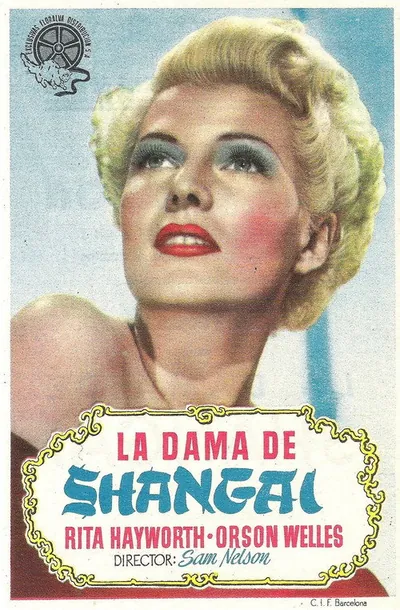 The Lady from Shanghai1947
 Only Angels Have Wings1939
 Pal Joey1957
 Cover Girl1944
 Blood and Sand1941
 Affair in Trinidad1952
 You Were Never Lovelier1942
 The Loves of Carmen1948
 Tales of Manhattan1942
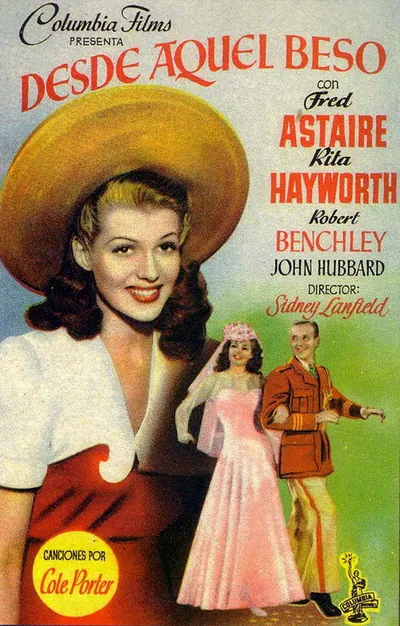 You'll Never Get Rich1941
- Charlie Chan in Egypt 1935 · cast
- Dante's Inferno 1935 · cast
- In Caliente 1935 · cast
- Under the Pampas Moon 1935 · cast
- Dancing Pirate 1936 · cast
- Human Cargo 1936 · cast
- Rebellion 1936 · cast
- Criminals of the Air 1937 · cast
- The Shadow 1937 · cast
- Hit the Saddle 1937 · cast
- There's Always a Woman 1938 · cast
- The Renegade Ranger 1938 · cast
- Only Angels Have Wings 1939 · cast
- The Lone Wolf Spy Hunt 1939 · cast
- Susan and God 1940 · cast
- Angels Over Broadway 1940 · cast
- The Lady in Question 1940 · cast
- Music in My Heart 1940 · cast
- Blood and Sand 1941 · cast
- You'll Never Get Rich 1941 · cast
- The Strawberry Blonde 1941 · cast
- Affectionately Yours 1941 · cast
- You Were Never Lovelier 1942 · cast
- Tales of Manhattan 1942 · cast
- My Gal Sal 1942 · cast
- Cover Girl 1944 · cast
- Tonight and Every Night 1945 · cast
- Gilda 1946 · cast
- The Lady from Shanghai 1947 · cast
- Down to Earth 1947 · cast
- The Loves of Carmen 1948 · cast
- Affair in Trinidad 1952 · producer, cast
- Salome 1953 · cast
- Miss Sadie Thompson 1953 · cast
- Pal Joey 1957 · cast
- Fire Down Below 1957 · cast
- Separate Tables 1958 · cast
- They Came to Cordura 1959 · cast
- The Happy Thieves 1961 · cast
- Circus World 1964 · cast
- The Rover 1967 · cast
- Sons of Satan 1968 · cast
- Road to Salina 1970 · cast
- The Wrath of God 1972 · cast
Original Cinematopedia text based on Wikipedia (es) and Wikipedia (en) and Wikidata.