
Jean Cocteau
1889–1963 · French poet, playwright, novelist and filmmaker
Biography
Jean Cocteau (Maisons-Laffitte, 1889 - Milly-la-Forêt, 1963) was a French poet, playwright, novelist, draughtsman and film director whose work spans much of the avant-garde of the first half of the twentieth century. In cinema he worked as a screenwriter, director and, occasionally, an actor, though he always insisted that poet was the title that mattered most to him. His name is tied to the Ballets Russes, to the Surrealist circle and to the renewal of French theatre, and his small but influential filmography gave rise to what is known as the Orphic Trilogy.
He was born to Georges Cocteau and Eugénie Lecomte and grew up in a comfortable Parisian family. His father took his own life in 1898, when Jean was still a child, an event that marked his early years and encouraged his mother's protectiveness. He discovered theatre and cinema young, through the programmes his mother brought home from her outings. He attended the Lycée Condorcet and the Lycée Fénelon without much interest in discipline. Édouard de Max presented him as a young prodigy in 1908, and the following year he published his first collection of poems, La lampe d'Aladin. His friendship with Sergei Diaghilev drew him into ballet, and from that connection came the scenario for Parade (1917), with music by Erik Satie and sets by Pablo Picasso. During the First World War he served as an ambulance driver for the Red Cross.
In 1918 he met the poet Raymond Radiguet, with whom he worked on literary projects and whose writing he promoted with determination. Radiguet's sudden death in December 1923 hit him hard, and his dependence on opium, which had already begun, worsened during this period. His attempts at recovery left a mark on his style: Les Enfants terribles, published in 1929, is one of his best-known books and was reportedly written in about a week during a difficult withdrawal.
His first film, The Blood of a Poet, was made in 1930 and shown publicly in 1932. Although it is now generally regarded as a Surrealist work, the Surrealists themselves did not accept it as one. Beauty and the Beast (1946), Orpheus (1950) and Testament of Orpheus (1960) followed. His visual language, rooted in the economical line of his drawings, carried over into his films and gave them a recognisable identity. In these years he worked closely with Jean Marais, his most enduring companion, for whom he wrote roles and whom he defended against criticism of their relationship, while he spoke out against homophobia in his essays. The painter Christian Bérard was his key collaborator on stage design until Bérard's death in 1949. Cocteau was elected to the Académie française in 1955, and in 1960 he designed the staging of Francis Poulenc's opera La Voix humaine for the Teatro Colón in Buenos Aires.
Cocteau died on 11 October 1963 in Milly-la-Forêt, of an acute heart attack, hours after learning of the death of his friend Édith Piaf. His legacy spans poetry, theatre, fiction, drawing and film, and these fields are hard to separate. The house where he lived is open to the public and holds a substantial collection of his works and memorabilia, and his films remain part of the standard study of cinema.
Key films
- The Blood of a Poet (1930): his first feature, an experimental, dreamlike work and the first part of the Orphic Trilogy.
- Beauty and the Beast (1946): a fairy-tale adaptation with Jean Marais as the Beast and a carefully crafted visual design.
- Orpheus (1950): a modern reworking of the Orpheus myth, with Marais in the lead.
- Testament of Orpheus (1960): the closing part of the trilogy, in which Cocteau reflects on his own work and plays himself.
- Les Dames du Bois de Boulogne (1945): a drama of passion adapted from Diderot, with dialogue written by Cocteau.
Trivia
A remark after Radiguet's death
After Raymond Radiguet died in 1923, Cocteau declared «Ya no escribiré» (I will write no more), although he went on publishing for decades.
Died hours after Édith Piaf
Cocteau died within hours of learning of the death of his friend Édith Piaf, in the same year, 1963.
On Cinematopedia
 Beauty and the Beast1946
 Orpheus1950
 Testament of Orpheus1960
 The Blood of a Poet1932
 Les Dames du Bois de Boulogne1945
 The Eternal Return1943
 Les Enfants Terribles1950
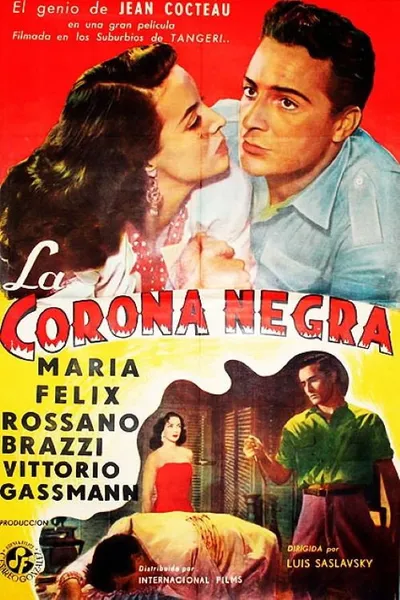 The Black Crown1951La Princesse de Clèves1961La Princesse de Clèves1961Thomas the Impostor1964Thomas the Impostor1964Ruy Blas1948Ruy Blas1948
 The Eagle with Two Heads1948
- The Blood of a Poet 1932 · director, screenplay
- The Comedy of Happiness 1940 · screenplay
- The Eternal Return 1943 · screenplay
- Les Dames du Bois de Boulogne 1945 · screenplay
- Beauty and the Beast 1946 · director, screenplay
- Ruy Blas 1948 · screenplay
- The Eagle with Two Heads 1948 · director, screenplay
- Les Parents terribles 1948 · director, screenplay, cast
- Orpheus 1950 · director, screenplay
- Les Enfants Terribles 1950 · screenplay, cast
- The Black Crown 1951 · screenplay
- Testament of Orpheus 1960 · director, screenplay, cast
- La Princesse de Clèves 1961 · screenplay
- Thomas the Impostor 1964 · screenplay
Original Cinematopedia text based on Wikipedia (es) and Wikipedia (en) and Wikidata.