
Faye Wong
b. 1969 · Chinese singer and actress, best known in Hong Kong, Taiwan and mainland China
Biography
Faye Wong, born Wang Fei in Beijing in 1969, is a singer and actress whose career was built largely in Hong Kong, though her following extends to Taiwan, mainland China and Japan. Outside Asia she is best known for her work with Wong Kar-wai, but her main legacy lies in music, where she became one of the central names in Mandopop and Chinese-language pop.
She grew up in Beijing during the Cultural Revolution, in a household shaped by mining and music: her father was a mining engineer and her mother a soprano who sang revolutionary songs. Her mother was wary of a performing career, so the teenager quietly recorded several low-budget albums between 1985 and 1987, mostly covers of Teresa Teng, whom she idolised. In 1987 she moved to Hong Kong to join her father, unable to speak Cantonese, and endured a lonely period before starting singing lessons with Tai See-chung, a teacher who had trained other local stars.
She signed with Cinepoly Records in 1988. Her first album, released in 1989 under the name Shirley Wong, received only a modest response. After a spell of training in New York she returned with a more personal approach and went back to the name Faye Wong. The breakthrough came in 1992 with Fragile Woman, a Cantonese version of a Japanese song, which made her a star across much of Asia. From the mid-1990s she sang mainly in Mandarin, absorbed alternative rock influences such as the Cocteau Twins, and drew closer to the rock scene emerging in Beijing.
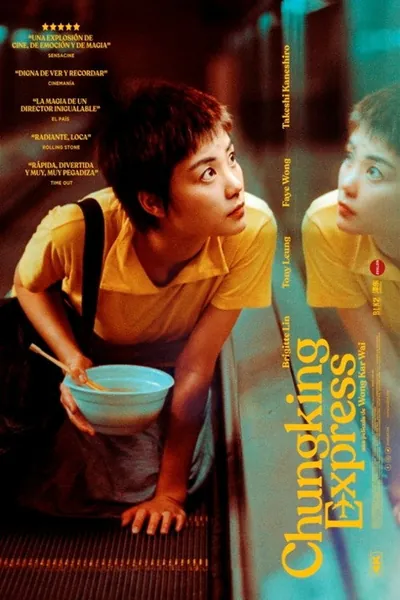
Her best-known film role is in Chungking Express (1994), directed by Wong Kar-wai, where her Cantonese cover of The Cranberries' Dreams is heard. She worked with the director again on 2046 (2004) and appeared in international productions such as Cold Fever. Her film career has been far less continuous than her music, and the press has often described her as a figure of deliberate public reserve.
In 1997 she moved back to Beijing and switched to EMI, the label she has stayed with since. In 1998 she made her first appearance on China's state broadcaster, which helped cement her popularity on the mainland. After her second marriage in 2005 she withdrew from the spotlight and limited herself to occasional stage appearances. Her legacy lies in bringing Chinese-language pop to very large audiences while keeping a distinct artistic identity and a notably distant relationship with fame.
Key films
- Chungking Express (1994): lead role in Wong Kar-wai's film, which also features her Cantonese cover of Dreams.
- 2046 (2004): a second collaboration with Wong Kar-wai and one of her best-known films outside Asia.
- Cold Fever (1996): another of her notable titles, in an international production far removed from Hong Kong cinema.
Trivia
A song for a video game
Her performance of the main theme of the Final Fantasy VIII soundtrack, Eyes On Me, brought her wider recognition outside Japan. According to the reference text, she was paid one million US dollars for the recording.
Sales record
In 2000, Guinness World Records recognised her as the best-selling female Cantopop artist, with an estimated 9.7 million albums sold by March of that year.
On Cinematopedia
 Chungking Express
 2046
 Beyond Hypothermia
 Chinese Odyssey 2002
Original Cinematopedia text based on Wikipedia (es) and Wikipedia (en) and Wikidata.