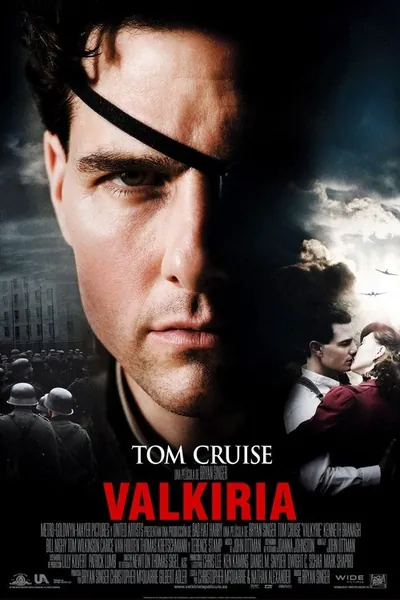
Valkyrie
2008 · United States, Germany · 120 min
- Director
- Bryan Singer
- Screenplay
- Christopher McQuarrie
- Producer
- Bryan Singer, Christopher McQuarrie, Chris Lee, Gilbert Adler
- Music
- John Ottman
- Cinematography
- Newton Thomas Sigel
- Editing
- John Ottman
- Production company
- United Artists, Cruise/Wagner Productions
- Based on
- 20 July plot
Cast
What it is about
During the Second World War, Wehrmacht colonel Claus von Stauffenberg is serving in Tunisia when an air raid leaves him badly wounded. Recovering in Germany, he is recruited by a group of soldiers and civilians determined to bring down Adolf Hitler's regime. Their plan relies on Operation Valkyrie, an emergency measure that would mobilise the Reserve Army and allow the conspirators to seize control of the country once the dictator was gone. The film follows the secret meetings, the doubts among the plotters, the pressure from officers loyal to the regime and the watchful eye of the Gestapo, as the group tries to hold together a scheme that depends on many people and leaves very little room for error.
How it was made
Bryan Singer directed the film from a screenplay by Christopher McQuarrie, with Nathan Alexander also credited as a writer. Singer, McQuarrie, Chris Lee and Gilbert Adler produced it for United Artists and Cruise/Wagner Productions, the company linked to Tom Cruise, who plays Stauffenberg. The cast mixes British and German actors: Kenneth Branagh is Henning von Tresckow, Bill Nighy plays Friedrich Olbricht, Tom Wilkinson is Friedrich Fromm and Terence Stamp plays Ludwig Beck. Cruise spent eight months preparing, reading history, hiring a researcher and speaking with members of the colonel's family. To mirror Stauffenberg's injuries, he practised dressing, handling objects and writing with one hand, and he found the eyepatch especially uncomfortable. Singer, who had previously made Superman Returns, compared the colonel's double life, loyal officer by day and conspirator in secret, to Superman and his alter ego Clark Kent. Newton Thomas Sigel shot the film, while John Ottman handled both the score and the editing. Shooting in Germany was difficult at first, because Cruise's links to Scientology are viewed with suspicion there, but the filmmakers were later allowed to film at locations such as Berlin's historic Bendlerblock.
Reception and legacy
Critics gave the film mixed reviews. German newspapers and filmmakers backed its aim of spreading awareness of the 20 July plot abroad, although controversy over the lead actor lingered. The release date moved several times, from June 2008 to February 2009, and the film finally opened in North America on 25 December 2008 and in Germany on 22 January 2009. After a weak response to its first marketing campaign, United Artists rebuilt the promotion to play down Cruise and highlight Singer's credentials. Worldwide box office takings exceeded 200 million dollars. Over the years the film is remembered mainly as a way of introducing international audiences to Stauffenberg and the plot against Hitler, one of the many attempts on the dictator's life.
Stills


Trailer
Clicking loads the video from YouTube (privacy-enhanced mode). Open on YouTube
Trivia
Physical preparation
During filming Cruise imitated Stauffenberg's limitations, practising dressing, handling objects and writing with one hand.
Superman as a comparison
Singer likened the colonel's double life, loyal on the surface and secretly a conspirator, to Superman and Clark Kent.
More films by Bryan Singer
 The Usual Suspects
 Bohemian Rhapsody
 X-Men
 X-Men: Days of Future Past
 X2
 X-Men: Apocalypse
Original Cinematopedia text based on Wikipedia (es) and Wikipedia (en) and Wikidata.