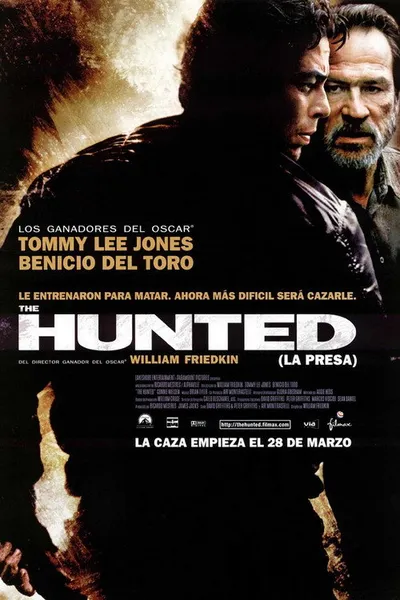
The Hunted
2003 · United States · 91 min
- Director
- William Friedkin
- Screenplay
- Art Monterastelli
- Producer
- James Jacks
- Music
- Brian Tyler
- Cinematography
- Caleb Deschanel
- Production company
- Lakeshore Entertainment
Cast
What it is about
Four hunters are found brutally killed in the forests of Oregon, and the FBI turns to L.T. Bonham, a retired survival instructor living in seclusion in British Columbia. Special Agent Abby Durrell needs someone who can track a man who knows the wilderness as well as he does. Bonham recognizes the prime suspect as Aaron Hallam, a former student, and reluctantly takes on the job. Going into the woods alone and unarmed forces him to confront his past and the consequences of what he taught. The film becomes a manhunt in which two men pursue each other with a mix of respect, suspicion and personal debt.
How it was made
The project began with an original script by Peter and David Griffiths, which William Friedkin felt resembled the life of Tom Brown Jr., an American outdoorsman and wilderness survival expert. Friedkin had long wanted to adapt Brown's life for the screen, so the writers met Brown and produced a new draft with his input. Art Monterastelli then completed the final screenplay. The story is partly inspired by a real case in which Brown was asked to find a former pupil, a Special Forces sergeant who had evaded the authorities, an episode he recounts in his book Case Files of the Tracker (2003). Shooting took place in Oregon and Washington, including Portland and Silver Falls State Park. The hand-to-hand and knife fights draw on Filipino martial arts, with choreography by Thomas Kier and Rafael Kayanan, brought in by Benicio del Toro. Johnny Cash recites the opening of Bob Dylan's "Highway 61 Revisited" at the start, and closes the film with his own song "The Man Comes Around".
Reception and legacy
Critics were largely unfavourable. Many reviewers pointed to striking similarities with First Blood, and the thin plot, underdeveloped characters and general implausibility drew most of the criticism. Rolling Stone dismissed it as "just a Rambo rehash". Some praise went to the cinematography and action scenes, particularly for the restrained use of special effects and stunts, and Roger Ebert was among the critics who responded favourably. At the box office it fell well short of its reported $55 million budget, grossing roughly $45.5 million worldwide. It is now remembered as a minor entry in William Friedkin's filmography, though it retains interest for its treatment of war trauma.
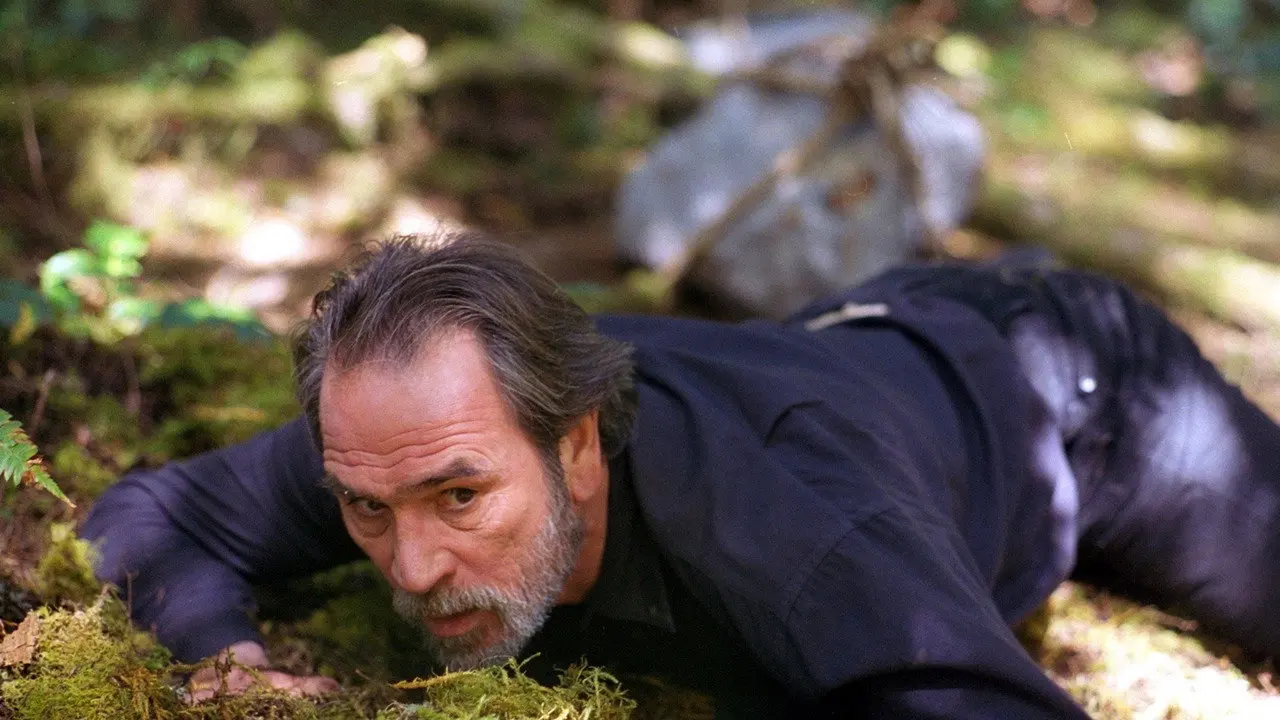
Stills


Trailer
Clicking loads the video from YouTube (privacy-enhanced mode). Open on YouTube
Trivia
Real-life inspiration
The plot is partly inspired by a real case involving Tom Brown Jr., which he recounted in his book Case Files of the Tracker.
Cash and Dylan
Johnny Cash recites the opening of Bob Dylan's "Highway 61 Revisited" at the start and performs his own song "The Man Comes Around" at the end.
More films by William Friedkin
 The French Connection
 The Exorcist
 Sorcerer
 To Live and Die in L.A.
 Rules of Engagement
 Cruising
Original Cinematopedia text based on Wikipedia (es) and Wikipedia (en) and Wikidata.