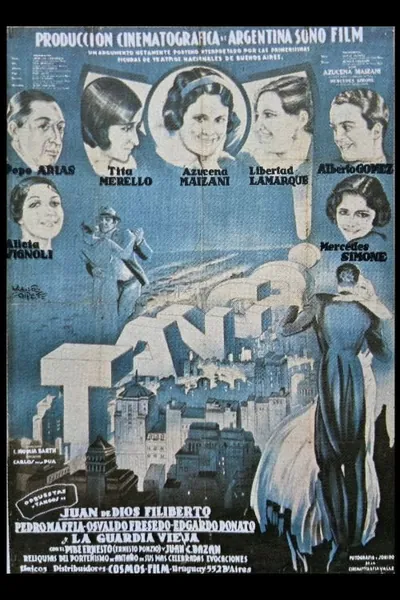
¡Tango!
1933 · Argentina · 80 min
- Director
- Luis Moglia Barth
- Screenplay
- Luis Moglia Barth
- Music
- Roberto Firpo
- Cinematography
- Alberto Etchebehere
Cast
What it is about
A 1933 Argentine musical romance that follows the formula Carlos Gardel had established in films such as Luces de Buenos Aires: a melodramatic story interrupted by tango numbers, with less dialogue and more music, closer to a musical revue. Its plot draws on tango lyrics about a poor young woman seduced by a wealthy man who promises her a glamorous life and then abandons her. The core story follows a young man heartbroken when his girlfriend leaves him for an older, rich suitor, and tracks his misfortunes from there.
How it was made
Directed and co-written by Luis Moglia Barth with Carlos de la Púa, it was the first production of Argentina Sono Film and the first Argentine feature made with optical sound, at the studio's new facility. Roberto Firpo composed the music and Alberto Etchebehere shot the black-and-white image. The cast brought together stage, radio and tango figures such as Libertad Lamarque, Tita Merello, Pepe Arias, Azucena Maizani and Luis Sandrini, alongside the orchestras of Juan D'Arienzo, Osvaldo Fresedo, Pedro Maffia and Juan de Dios Filiberto. Its technical approach showed strong Hollywood influence.
Reception and legacy
It premiered in Buenos Aires on 27 April 1933, but its success was limited by poor sound quality and uneven acting. Even so, it established a formula that many later tango films would reuse, and together with Los tres berretines it is regarded as the start of the Golden Age of Argentine cinema. Luis Sandrini became one of the first Argentine film stars, and Libertad Lamarque began a sound-film career here that later took her to Mexico.
Stills

Trivia
First Argentine optical sound feature
It was the first Argentine feature film with optical sound, produced at Argentina Sono Film's new optical sound studio.
Musicians recruited from theatres
According to one source, co-writer Carlos de la Púa had to look for musicians in several Buenos Aires theatres to play during filming.
Original Cinematopedia text based on Wikipedia (es) and Wikipedia (en) and Wikidata.