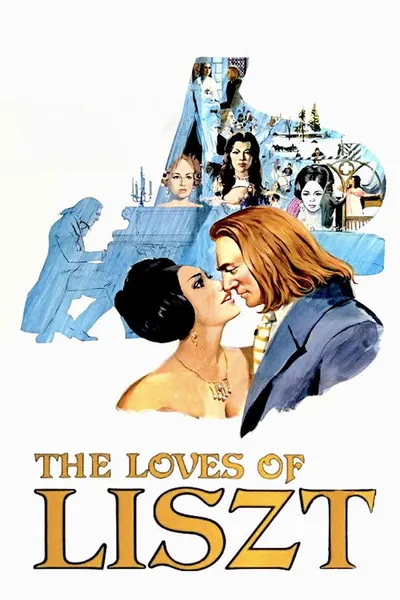
The Loves of Liszt
Sueños de amor
1970 · Hungary, Soviet Union · 171 min
- Director
- Márton Keleti
- Screenplay
- Imre Keszi, Leonid Lyubashevsky
- Music
- Ferenc Farkas
- Cinematography
- István Hildebrand
- Editing
- Mihály Morell
- Production company
- Lenfilm
Cast
What it is about
An epic musical drama tracing the life of Hungarian pianist and composer Franz Liszt. After a concert tour brings him to St. Petersburg, he dazzles the Russian aristocracy and forms a friendship with composer Mikhail Glinka. His tangled romantic life takes up much of the story, especially his bond with Princess Carolyne zu Sayn-Wittgenstein, who stays with him for years while religious and family obstacles keep the couple from marrying. The film alternates bravura piano performances with the protagonist's personal struggles.
How it was made
A Hungarian-Soviet co-production between MAFILM and Lenfilm, shot between 1968 and 1970 in the Soviet Union, East Germany and Hungary. Directed by Márton Keleti from a screenplay by Imre Keszi and Leonid Lyubashevsky, with music by Ferenc Farkas. Imre Sinkovits plays Liszt. The piano performances were credited to Sviatoslav Richter and György Cziffra, and Liszt's historic St. Petersburg concert was filmed at the Bolshoi Philharmonic Hall there. Several versions exist: the Hungarian cut runs about 174 minutes, the Soviet one was reduced to 150 and the American to 130.
Reception and legacy
The film was criticized for its historical liberties, yet its epic scope and virtuoso piano sequences won wide praise. It premiered in 1970 in Hungary and the Soviet Union, reaching Finland in 1972 and the United States in 1975. It is regarded as a notable work in the cultural landscape of 1970s Eastern Europe.
Stills

Trivia
Richter at the keyboard
Sviatoslav Richter played the piano pieces heard in the film, including the études and the famous Liebestraum, although Sinkovits plays Liszt on screen.
Three cuts
The film circulated in several versions: the Hungarian cut of about 174 minutes, the Soviet one of 150, and the American one of 130, with many scenes removed.
Original Cinematopedia text based on Wikipedia (en) and Wikidata.