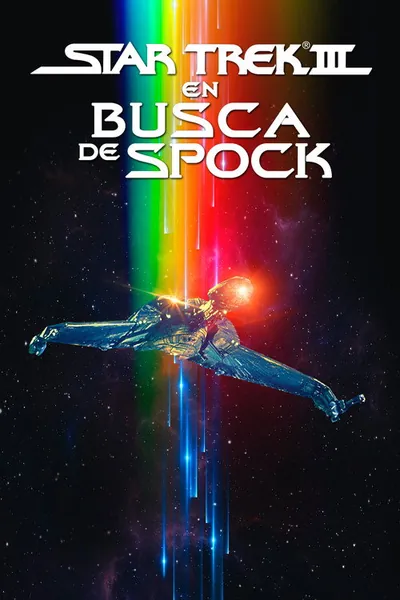
Star Trek III: The Search for Spock
Star Trek III: en busca de Spock
1984 · United States · 103 min
- Director
- Leonard Nimoy
- Screenplay
- Leonard Nimoy, Harve Bennett
- Producer
- Harve Bennett
- Music
- James Horner
- Cinematography
- Charles Correll
- Editing
- Robert F. Shugrue
- Production company
- Paramount Pictures
- Based on
- Star Trek: The Original Series
Cast
What it is about
After Spock's death at the end of Star Trek II: The Wrath of Khan, the Enterprise limps back to Earth for repairs. Soon afterward, Doctor Leonard McCoy begins to behave strangely, haunted by dreams tied to the Vulcan. While Starfleet keeps the situation around the Genesis planet under wraps, a politically sensitive matter, Admiral James Kirk learns something that changes his plans. He decides to defy orders and take the ship that was due to be decommissioned, with a small group of loyal officers at his side. Their journey brings them into conflict with the Klingons, led by Kruge, who are eager to get their hands on the secrets of the Genesis device.
How it was made
Leonard Nimoy agreed to return as Spock on the condition that he could direct, after fan protests over the character's death in the previous film. Producer Harve Bennett wrote the script by starting from the ending and working backwards, and he wanted the destruction of the Enterprise to come as a genuine shock. Bennett and Nimoy worked with Industrial Light & Magic on storyboards and new ship designs, and ILM handled most of the effects sequences. Apart from a single day of location shooting, the film was made entirely on Paramount and ILM soundstages. Composer James Horner returned to develop the themes he had written for the previous film. Production was halted after a 1983 fire destroyed several Paramount studios, one of them next to the Genesis planet set. The fire was first thought to have started from the set's pyrotechnics, but it was eventually concluded that it had been set deliberately. Edward James Olmos auditioned for the role of Kruge, but Christopher Lloyd was cast after the producer persuaded Nimoy to hire him.
Reception and legacy
The film received mostly positive reviews, though notably less enthusiastic than its predecessor. Critics praised the cast, Nimoy's direction and the characterisation, while the objections focused mainly on the plot; the special effects received a mixed response. Roger Ebert regarded it as a compromise between the tones of the first two Star Trek films. In the United States it grossed around 76 million dollars. It forms the middle part of a three-film story arc that concludes with Star Trek IV: The Voyage Home, and its 2009 Blu-ray release bundled it with the other films starring the original series cast.
Stills


Trailer
Clicking loads the video from YouTube (privacy-enhanced mode). Open on YouTube
Trivia
A credit under a pseudonym
Nimoy was credited as «Franke Force», a name used to keep his acting role in the film secret.
The computer voice
Nimoy provided the voice of the Excelsior's computer in the turbolift scene with Scotty.
A dispute over one line
George Takei objected when a guard called his character «Tiny» and argued with the producer to have the line cut. After seeing the first screening he changed his mind and apologised.
More films by Leonard Nimoy
 Star Trek IV: The Voyage Home
 Three Men and a Baby
 The Good Mother
Original Cinematopedia text based on Wikipedia (es) and Wikipedia (en) and Wikidata.