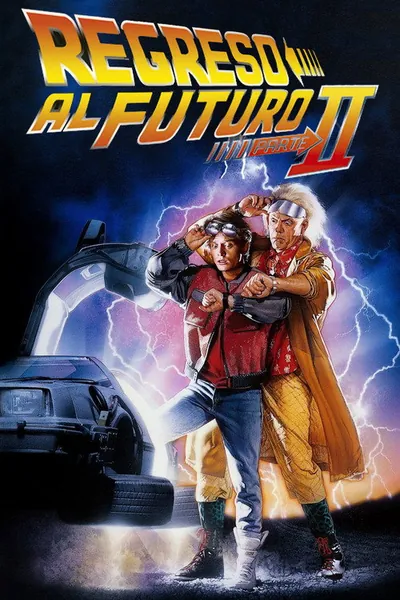
Back to the Future Part II
Back to the Future II
1989 · United States · 108 min
- Director
- Robert Zemeckis
- Screenplay
- Robert Zemeckis, Bob Gale
- Producer
- Bob Gale, Neil Canton
- Music
- Alan Silvestri
- Cinematography
- Dean Cundey
- Editing
- Arthur Schmidt, Harry Keramidas
- Production company
- Amblin Entertainment
Awards: BAFTA Award for Best Special Visual Effects · 4 nominations
Cast
What it is about
A year after the events of the first film, Doc Brown persuades Marty McFly and Jennifer Parker to travel with him to 2015. The aim is to prevent trouble for Marty's children, but the visit quickly shows that the future is far from simple. As the protagonists try to fix a course that keeps slipping away, the DeLorean ends up in the hands of someone with plans of his own for the timeline, and Marty and Doc must travel back to 1955 to set things right. The film mixes situational comedy with a slightly dystopian view of the future and brings back the characters of the first part, including the old rival Biff Tannen. Watching the first film beforehand is strongly recommended, since the story continually builds on it.
How it was made
The sequel was not planned when the first film was shot, as director Robert Zemeckis has recalled. Its box-office success led to a follow-up, and the story had to be built around choices made in the original, such as Jennifer riding in the DeLorean, which had been a joke. Zemeckis and Bob Gale wrote the screenplay, Gale co-produced with Neil Canton, and Amblin Entertainment was the production company. It was shot back-to-back with Part III on a budget of about 40 million dollars. Filming began in February 1989, after two years spent building sets and writing scripts. Elisabeth Shue replaced Claudia Wells, and Jeffrey Weissman replaced Crispin Glover, who appears in archive footage. Industrial Light & Magic used digital compositing and the VistaGlide motion control camera system, which let one actor play several characters on screen without restricting camera movement. The score is by Alan Silvestri and the cinematography by Dean Cundey.
Reception and legacy
It was released on November 22, 1989 by Universal Pictures. Critics gave it mostly positive reviews, though many at the time considered it inferior to its predecessor. It grossed around 333 million dollars worldwide in its initial run, making it the third-highest-grossing film of 1989. It earned an Academy Award nomination for Best Visual Effects and won the BAFTA in the same category. Its lasting importance lies in how it expanded the saga's universe and in its visual effects work, which served as a reference for adventure cinema of the period. It set up the third installment, released in May 1990, which completed the trilogy.
Stills


Trailer
Clicking loads the video from YouTube (privacy-enhanced mode). Open on YouTube
Trivia
A joke turned into a plot point
Zemeckis has said the DeLorean's flight in the first film was only a comic gag. When planning the sequel, the team had to invent a storyline involving Jennifer.
Filmed back to back
This film and the third installment were shot simultaneously, an uncommon practice for commercial cinema of the period.
More films by Robert Zemeckis
 Forrest Gump
 Back to the Future
 Who Framed Roger Rabbit
 Cast Away
 Back to the Future Part III
 Contact
Original Cinematopedia text based on Wikipedia (es) and Wikipedia (en) and Wikidata.