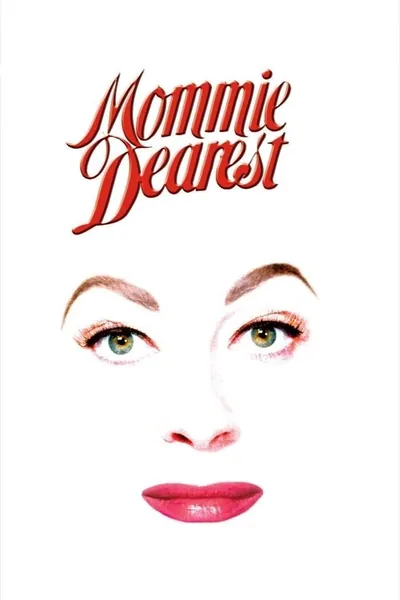
Mommie Dearest
Queridísima mamá
1981 · United States · 129 min
- Director
- Frank Perry
- Screenplay
- Frank Perry, Robert Getchell, Frank Yablans, Tracy Hotchner
- Producer
- Terry O'Neill, Frank Yablans
- Music
- Henry Mancini
- Cinematography
- Paul Lohmann
- Editing
- Peter E. Berger
- Based on
- Mommie Dearest
Awards: Golden Raspberry Award for Worst Actress; Golden Raspberry Award for Worst Supporting Actor - Razzie Award; Golden Raspberry Award for Worst Supporting Actress; Golden Raspberry Award for Worst Screenplay; Golden Raspberry Award for Worst Picture · 7 nominations
Cast
What it is about
Joan Crawford is a Hollywood actress who is driven and obsessed with order, trying to control the people around her with the same rigor she applies to herself. Her career is fading, and her wish for a child, frustrated by repeated miscarriages, leads her to adoption. The film follows the upbringing of Christina and Christopher, her adopted daughter and son, in a household where affection and luxury coexist with strict discipline, and where clashes grow increasingly violent. It traces the relationship between mother and daughter over the years, based on the memoir Christina wrote.
How it was made
The project grew out of Christina Crawford's 1978 memoir, whose film rights were bought by Paramount Pictures. The screenplay went through several writers, among them Robert Getchell and Tracy Hotchner. Anne Bancroft was first cast as Joan, but Faye Dunaway replaced her in January 1981. Frank Perry took over direction in September 1980, after Franco Zeffirelli left the project. Christina's involvement in the production was later limited after disagreements over how her mother should be portrayed. Henry Mancini composed the score and Paul Lohmann shot the film. Filming began in late January 1981, and the result is an intense melodrama driven largely by Dunaway's performance.
Reception and legacy
The film opened in September 1981 and received mostly negative reviews, with praise for Dunaway's performance and criticism of its editing and screenplay. It was a commercial success, grossing well above its budget of about 10 million dollars. Crawford's family condemned the portrayal of the actress as harsher than the book described, and some relatives disputed that abuse occurred at all. Over time it became a cult favorite, largely for its heightened tone. It received nine Razzie nominations at the 2nd Golden Raspberry Awards and won five, including Worst Picture and Worst Actress for Dunaway.
Stills


Trailer
Clicking loads the video from YouTube (privacy-enhanced mode). Open on YouTube
Trivia
A cult title
Paramount retooled the marketing campaign to present the film as an unintentional comedy, despite its dark subject matter.
A studio without Crawford
Paramount was the only one of the major studios for which Crawford had never appeared in a feature film.
More films by Frank Perry
 Diary of a Mad Housewife
 The Swimmer
 Last Summer
 David and Lisa
 Doc
Original Cinematopedia text based on Wikipedia (es) and Wikipedia (en) and Wikidata.