
Querelle
1982 · France, Germany · 108 min
- Director
- Rainer Werner Fassbinder
- Screenplay
- Rainer Werner Fassbinder, Kurt Raab, Burkhard Driest, Jean Genet
- Producer
- Dieter Schidor
- Music
- Peer Raben
- Cinematography
- Xaver Schwarzenberger
- Editing
- Rainer Werner Fassbinder, Juliane Lorenz
- Production company
- Gaumont
- Based on
- Querelle of Brest
Awards: · 2 nominations
What the critics say
65 % Rotten Tomatoes positive reviewsCast
What it is about
Adapted from Jean Genet's novel Querelle de Brest, the film follows Georges Querelle, a strikingly handsome sailor who is also a thief and a killer. When his ship, the Vengeur, docks at Brest, Querelle visits the brothel La Feria, run by Lysiane, and becomes entangled with his brother Robert. He deals in opium with the club's owners and a corrupt policeman, while his path crosses that of Gil, a construction worker hiding from the law after a killing. An intense attraction develops between the two, as Querelle manipulates everyone around him with a mixture of desire and violence. Meanwhile, his superior, Lieutenant Seblon, watches him with an obsessive fascination.
How it was made
The project was first conceived for Werner Schroeter, with a script by Burkhard Driest and production by Dieter Schidor, but funding problems led the producers to other directors before they settled on Rainer Werner Fassbinder. Driest wrote a script far removed from the novel, which Fassbinder reshaped into a fragmented narrative that focused on meditating on Genet's words rather than on plot. Shot entirely on studio sets at CCC-Spandau in Berlin, the film uses stylised designs by Rolf Zehetbauer, saturated colour and artificial lighting for a deliberately expressionist look. Its visual codes borrow heavily from the erotic drawings of Tom of Finland, in poses, silhouettes and costumes. Brad Davis stars, and the film was shot in English as a West German and French co-production.
Reception and legacy
The film premiered at the Montreal World Film Festival in August 1982, two months after Fassbinder's death. It performed well at the French box office, selling over 100,000 tickets in its first three weeks in Paris, an unusual result for a gay-themed film. Critics were divided: Vincent Canby of The New York Times called it a dead end, while Marcel Carné, head of the Venice jury, argued for it to win the Golden Lion, the film having been nominated for that prize. Its soundtrack earned Razzie nominations. Over time it has become a landmark of queer cinema and a testament to its director's final work.
Stills


Trailer
Clicking loads the video from YouTube (privacy-enhanced mode). Open on YouTube
Trivia
A studio-bound shoot
The entire film was shot on sets at CCC-Spandau Studios in Berlin, with no real location shooting.
Tom of Finland influence
The visual style borrows costumes and poses from the erotic artist Tom of Finland.
More films by Rainer Werner Fassbinder
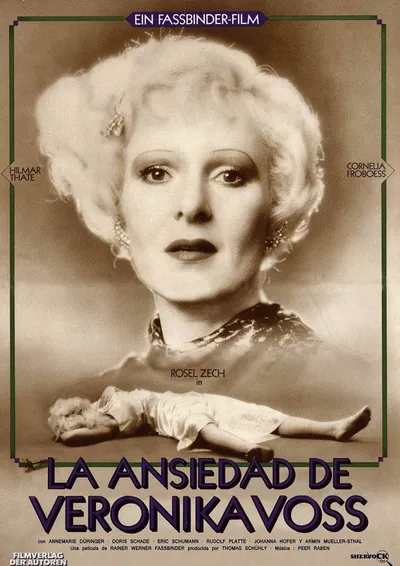 Veronika Voss
 Ali: Fear Eats the Soul
 The Marriage of Maria Braun
 The Bitter Tears of Petra von Kant
 Lili Marleen
 The Merchant of Four Seasons
Original Cinematopedia text based on Wikipedia (es) and Wikipedia (en) and Wikidata.