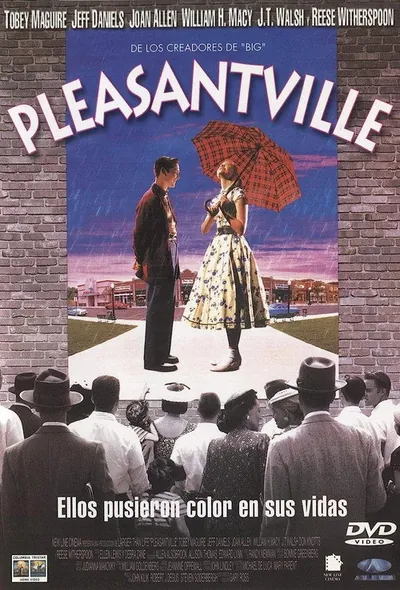
Pleasantville
1998 · United States · 120 min
- Director
- Gary Ross
- Screenplay
- Gary Ross
- Producer
- Steven Soderbergh, Gary Ross, Bob Degus
- Music
- Randy Newman
- Cinematography
- John Lindley
- Editing
- William Goldenberg
- Production company
- New Line Cinema
Awards: · 3 nominations
Cast
What it is about
Twins David and Jennifer share a home but lead very different lives. She is popular and shallow; he escapes into Pleasantville, a black-and-white 1950s sitcom about the idealized Parker family. After a fight over the television leaves the remote control broken, a mysterious repairman hands them an odd replacement. When they use it, both are pulled into the show's world, where they must pass as Bud and Mary Sue and discover a town where nothing ever goes wrong. Their arrival begins to upset that calm, and unexpected changes start spreading color through the town.
How it was made
It marked the directing debut of Gary Ross, who also wrote the script. To create the contrast between black-and-white and color, the entire film was shot in color, and roughly 163,000 frames of 35 mm footage were scanned and digitally manipulated to selectively desaturate and adjust contrast. The scanning took place in Los Angeles, handled by Cinesite. Principal photography ran from March to July 1997 and was overshadowed by the death of camera operator Brent Hershman, who fell asleep at the wheel after a workday of about 19 hours. His death led to a wrongful death suit and a failed petition for a fourteen-hour daily limit. Randy Newman composed the score, and New Line Cinema produced the film.
Reception and legacy
Pleasantville was released in October 1998 and was a box-office disappointment, taking in about 49.8 million dollars against a 60 million budget. Critics generally responded positively. It earned three Academy Award nominations, for costume design, production design and original dramatic score. Over time it has been read as a fable about personal repression and fear of change, and as a commentary on suburban American values. It was also one of the last screen appearances of Don Knotts and of J. T. Walsh, to whom the film is dedicated.
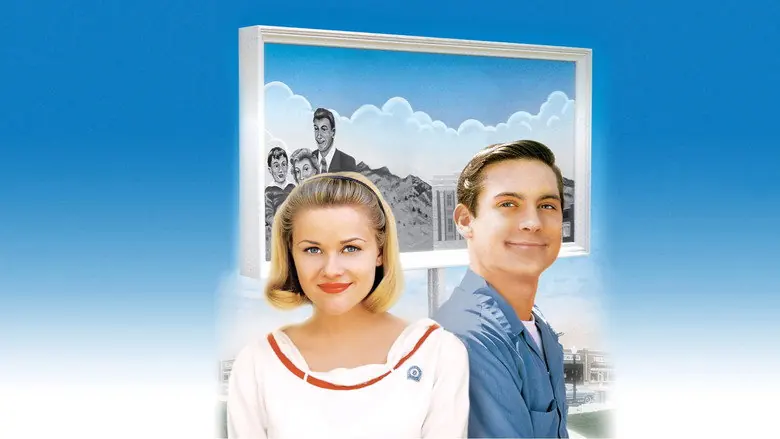
Stills


Trailer
Clicking loads the video from YouTube (privacy-enhanced mode). Open on YouTube
Trivia
Frame scanning
It was the first feature film made by scanning and digitizing recorded footage to remove or manipulate its colors.
A final screen role
It was the final on-screen film appearance of Don Knotts, who later worked in voice acting until his death.
More films by Gary Ross
 The Hunger Games
 Seabiscuit
 Ocean's 8
 Free State of Jones
Original Cinematopedia text based on Wikipedia (es) and Wikipedia (en) and Wikidata.