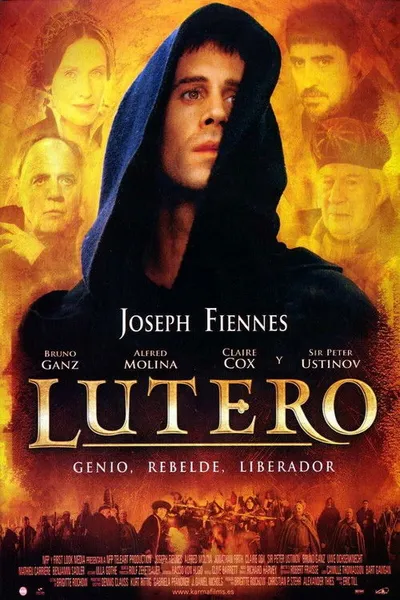
Luther
Lutero
2003 · United States, United Kingdom, Germany · 118 min
- Director
- Eric Till, Hans Kyser
- Music
- Richard Harvey
- Cinematography
- Robert Fraisse
- Production company
- Metro-Goldwyn-Mayer
Cast
What it is about
The film follows the life of Martin Luther from 1505, when a thunderstorm leads him to become a monk, to the Diet of Augsburg in 1530. It focuses on his spiritual doubts inside the Erfurt monastery, his relationship with his mentor Johann von Staupitz, and the conflicts that lead him to question the sale of indulgences. The story alternates between the character's inner life and the wider political and church settings of the period.
How it was made
Directed by Eric Till from a screenplay by Hans Kyser, it is a co-production between the United States, the United Kingdom and Germany, with Metro-Goldwyn-Mayer as the studio. Part of its funding came from Thrivent Financial for Lutherans, a Christian financial services company. Filming took place in several locations in Germany, Italy and the Czech Republic. Joseph Fiennes plays Luther, alongside Alfred Molina as Johann Tetzel, and Peter Ustinov and Bruno Ganz. The score is by Richard Harvey and the cinematography by Robert Fraisse. Like many historical dramas, it takes liberties, such as benches in churches and bible verse numbering, which did not exist in Luther's time.
Reception and legacy
The available sources offer limited information on its commercial and critical reception, and they do not list major awards. Its main appeal lies in offering an accessible portrait of Luther and of the years leading to the Reformation. Its historical accuracy has been qualified by the liberties noted. The ending stresses that what happened at Augsburg opened the door to religious freedom, and it highlights the lasting influence of Luther's German Bible on the language.
Stills


Trailer
Clicking loads the video from YouTube (privacy-enhanced mode). Open on YouTube
Trivia
One of Ustinov's last films
Peter Ustinov took one of his final roles here, as he died the year after the film's release.
Faith-based funding
Part of the budget came from Thrivent Financial for Lutherans, a Christian financial services company.
Anachronistic verses
Luther cites Bible passages by chapter and verse, although the verse division was not introduced until 1551.
Original Cinematopedia text based on Wikipedia (es) and Wikipedia (en) and Wikidata.