
La La Land
2016 · United States · 128 min
- Director
- Damien Chazelle
- Screenplay
- Damien Chazelle
- Producer
- Gary Gilbert, Marc Platt, Fred Berger, Jordan Horowitz
- Music
- Justin Hurwitz
- Cinematography
- Linus Sandgren
- Editing
- Tom Cross
- Production company
- Starz Entertainment, Summit Entertainment
Awards: Academy Award for Best Director; Academy Award for Best Actress; Academy Award for Best Original Song; Academy Award for Best Cinematography; Golden Globe Award for Best Actor – Motion Picture Musical or Comedy; Academy Award for Best Production Design… · 13 nominations
Cast
What it is about
Los Angeles, in the middle of rush hour. Mia Dolan is an aspiring actress who works as a barista near the big Hollywood studios and keeps going to auditions that never quite go her way. Sebastian Wilder is a jazz pianist who scrapes by playing in restaurants and parties, convinced that his music deserves a place of its own. A chance meeting, sparked by a traffic incident and an unfortunate gesture, leads to a relationship that starts with friction and gradually settles as the two get to know each other. The film follows their attempts to make a name in a city that promises a lot and asks even more, and how their professional ambitions and romantic lives shape one another. The story moves through parties, auditions, performances and short trips, with musical numbers that grow out of the narrative rather than halting it. Without getting into what comes later, the film asks a simple but hard question: what do dreams cost, and what are you willing to leave behind to chase them? Its tone moves between light comedy and a more wistful drama, and the protagonists' journey invites reflection on how expectations change once everyday life takes over.
How it was made
The project grew out of the friendship between Damien Chazelle and Justin Hurwitz, who were classmates at Harvard University, where they explored the idea in a senior thesis: a low-budget musical about a Boston jazz musician called Guy and Madeline on a Park Bench. Chazelle, a former drummer and a longtime fan of musicals, wanted to revive the classic form by grounding it in realistic situations where things do not always go as planned. After moving to Los Angeles in 2010, he wrote the screenplay and set it there, drawn to the city's traffic, sprawl and skylines rather than to its postcard romance. For years, however, he could not find financing. Studios were wary of an original musical without familiar songs, and of a jazz musical in a genre many considered all but extinct. One studio asked for changes, including turning the lead into a rock musician and dropping the bittersweet ending, and Chazelle refused. After Whiplash was well received in 2014, the project found backing from Summit Entertainment and Black Label Media, with Marc Platt among the producers.
Miles Teller and Emma Watson were first attached to the leads, but neither stayed on, Watson because of commitments to the live-action Beauty and the Beast. Chazelle chose to make his characters somewhat older, people with some experience of struggling to make their dreams work, and cast Ryan Gosling and Emma Stone, who had already worked together on earlier films. Stone had loved musicals since childhood and had moved to Hollywood at fifteen. Gosling had no previous training and had to learn the piano, and both worked on singing and dancing for the film's six original songs. Justin Hurwitz composed the score, while Benj Pasek and Justin Paul wrote the lyrics, except for "Start a Fire." Mandy Moore choreographed the numbers, emphasizing emotion over technique.
Principal photography began in Los Angeles on August 10, 2015, and lasted about forty days, finishing in mid-September, across more than sixty locations. Chazelle wanted the musical numbers filmed in long, uninterrupted takes, in the spirit of Fred Astaire and Ginger Rogers, and the image to have the widescreen look of 1950s musicals. The film was shot on 35mm celluloid rather than digitally. The opening sequence, a dance on a highway interchange involving more than a hundred dancers, was the first to be shot. The sunset dance, meanwhile, needed eight takes over two days. The Angels Flight funicular, closed since a 2013 derailment, was used for a single day under special permission. Mary Zophres designed costumes that blended silhouettes from earlier decades with a contemporary feel, and editor Tom Cross spent close to a year on the cut.
Reception and legacy
The film premiered at the Venice Film Festival on August 31, 2016, where Emma Stone won the Volpi Cup for best actress, and opened in the United States on December 9, 2016, first in a handful of theaters and then nationwide. It grossed more than $400 million worldwide against a budget of around $30 million, an unusually strong result for an original musical. Critics responded with enthusiasm, praising Chazelle's direction and screenplay, the performances and chemistry of Gosling and Stone, Hurwitz's score and the musical numbers. Review aggregators gave it very high marks, with Rotten Tomatoes showing an approval rating above 90 percent. Some reviewers were more reserved, pointing to a heavy reliance on references to classic Hollywood.
At the 2017 Golden Globes it won all seven categories in which it was nominated, including best musical or comedy film, direction and screenplay, a record for that ceremony. At the Academy Awards it received fourteen nominations, matching the record shared by Titanic and All About Eve, and won six: best director, for Chazelle, who at 32 became the youngest winner in that category; best actress, for Stone; cinematography; production design; original song for "City of Stars"; and original score. The ceremony became memorable for a mix-up: the best picture award was announced for La La Land in error, and the result was corrected moments later in favor of Moonlight. The episode drew worldwide attention, and it has become part of the film's public story. The BAFTA Awards gave it five wins from eleven nominations.
Over time the film has become a reference point for the contemporary musical and a case study in how an original project can overcome industry doubts. Its success renewed interest in the genre in Hollywood and brought wider attention to Chazelle, who went on to direct other films. For many viewers, it stands as a tribute to classic cinema that does not shy away from the present.
Stills
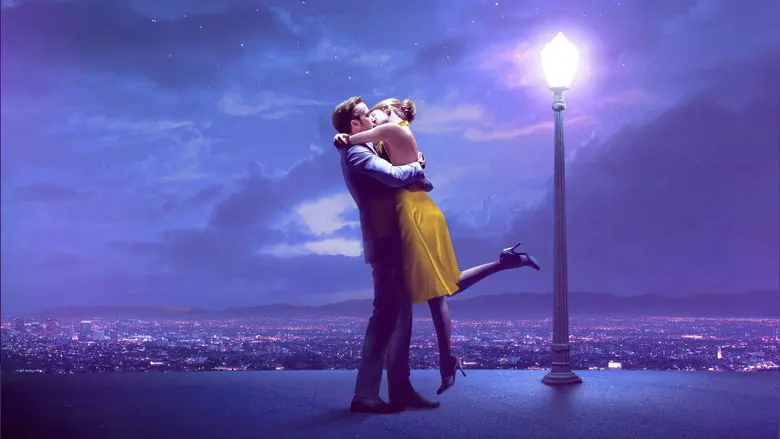
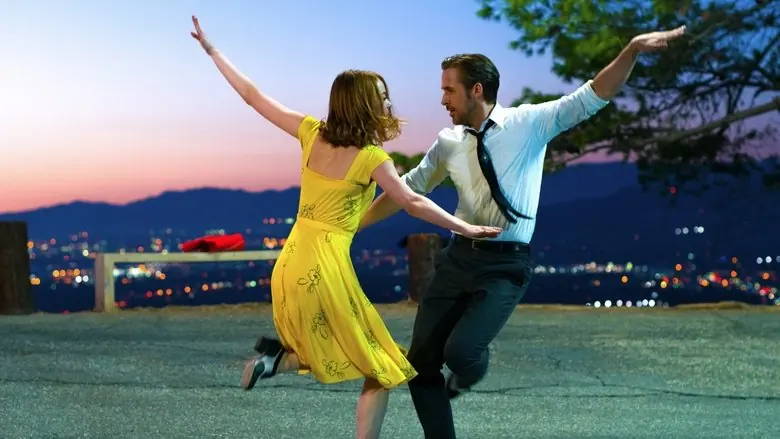

Trailer
Clicking loads the video from YouTube (privacy-enhanced mode). Open on YouTube
More films by Damien Chazelle
 Whiplash
 First Man
 Babylon
Original Cinematopedia text based on Wikipedia (es) and Wikipedia (en) and Wikidata.