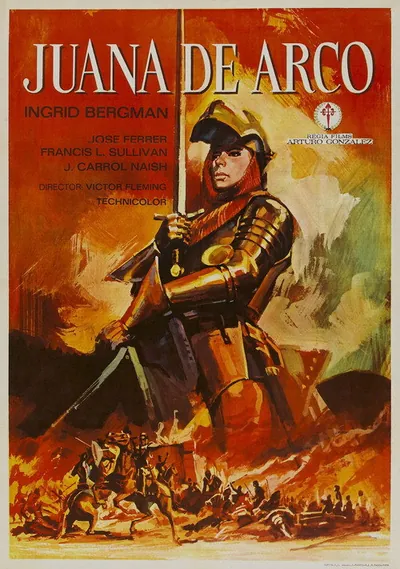
Joan of Arc
Juana de Arco
1948 · United States · 132 min
- Director
- Victor Fleming
- Screenplay
- Maxwell Anderson
- Producer
- Walter Wanger
- Music
- Hugo Friedhofer
- Cinematography
- Winton Hoch, Joseph A. Valentine, William V. Skall
- Editing
- Frank Sullivan
- Production company
- RKO Pictures
Awards: National Board of Review: Top Ten Films; Academy Award for Best Cinematography, Color; Academy Award for Best Costume Design, Color · 7 nominations
What the critics say
90 % Rotten Tomatoes positive reviewsCast
What it is about
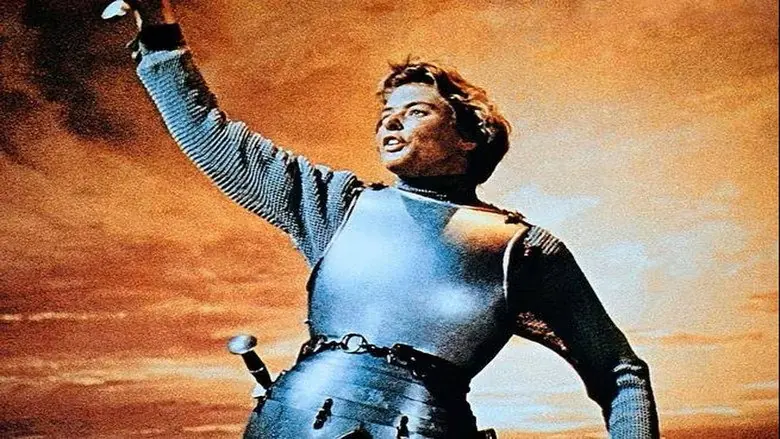
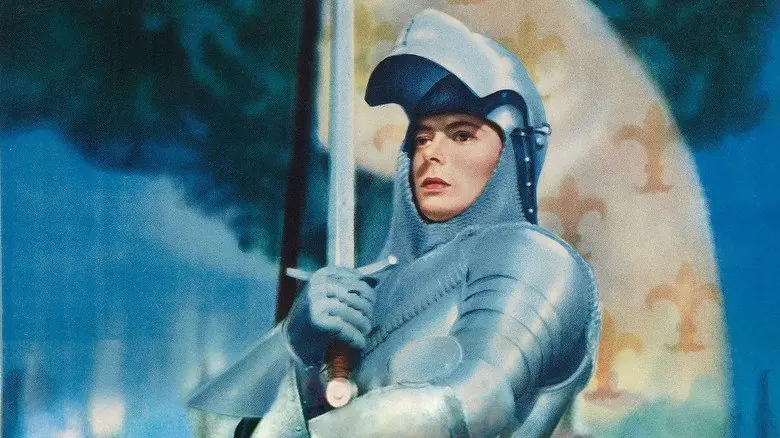
Fifteenth-century France. Joan, a young peasant from Domrémy, begins to hear voices she believes come from God. They urge her to help free the country from English occupation and to see the Dauphin Charles crowned as the rightful king. At seventeen she persuades the military commander of Vaucouleurs to provide an escort to Chinon, where she wins over the Dauphin and receives command of his armies. The film follows her military campaigns, from the siege of Orléans to her capture, the church trial in Rouen and the sentence that led to the stake.
How it was made
The project grew out of Maxwell Anderson's stage play Joan of Lorraine, a Broadway success for Ingrid Bergman. Anderson wrote the screenplay with Andrew Solt, and Victor Fleming directed, favoring a biography over an earlier idea to adapt the novel The Ballad and the Source. Bergman, Fleming and producer Walter Wanger set up an independent company, later renamed Sierra Pictures, created for this single production. Filming began on September 16, 1947, at the Hal Roach Studios with location work in the Los Angeles area, and wrapped in December. José Ferrer played the Dauphin, and the color cinematography, art direction and costumes earned Academy Award nominations or wins.
Reception and legacy
Critics were divided and box office fell short of expectations, though the film was not the outright financial disaster it is sometimes called. Bergman and Ferrer received Oscar nominations for their performances, and the picture won technical awards for color cinematography and costume design. Shortly after its premiere, the revelation of Bergman's affair with Roberto Rossellini temporarily halted her American career, and the film was drastically cut for general release; the full version was not restored until decades later. Fleming died soon after its release, and his view of the finished film has been debated. Today it is mainly remembered as part of Bergman's career rather than as a landmark of the biographical genre.
Stills

Trailer
Clicking loads the video from YouTube (privacy-enhanced mode). Open on YouTube
Trivia
A shortened version
The film was cut by about 45 minutes for its general release in 1950. The full-length version was not restored until nearly fifty years later.
A final film
It was the last film directed by Victor Fleming, who died two months after its release.
More films by Victor Fleming
 Gone with the Wind
 The Wizard of Oz
 The Good Earth
 Captains Courageous
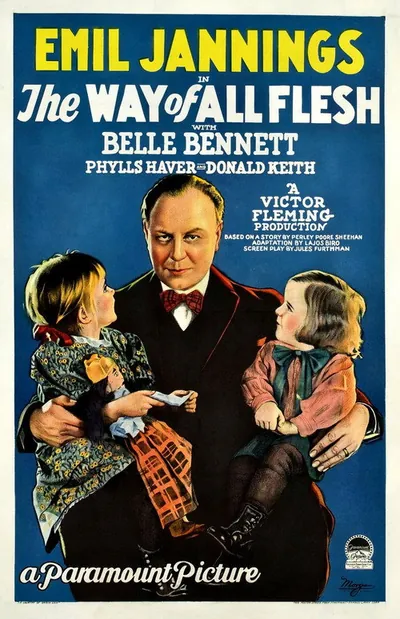 The Way of All Flesh
 The Great Waltz
Original Cinematopedia text based on Wikipedia (es) and Wikipedia (en) and Wikidata.