
Destroy All Monsters
Kaijū Sōshingeki
1968 · Japan · 89 min
- Director
- Ishirō Honda
- Screenplay
- Ishirō Honda
- Producer
- Tomoyuki Tanaka
- Music
- Akira Ifukube
- Production company
- Toho
What the critics say
82 % Rotten Tomatoes positive reviewsCast
What it is about
At the end of the twentieth century, the Earth's giant monsters have been gathered by the United Nations Science Committee and confined on an island in the Ogasawara chain, where a research center operates beneath the surface. When contact with the island is suddenly lost and the creatures begin attacking major cities around the world, Dr. Yoshida sends Captain Katsuo Yamabe and the crew of the spaceship Moonlight SY-3 to find out what happened. They discover that the island's scientists have been mind-controlled by an alien race calling itself the Kilaaks, who demand humanity's surrender. The story follows the human crews as they try to understand the threat and regain control of the monsters.
How it was made
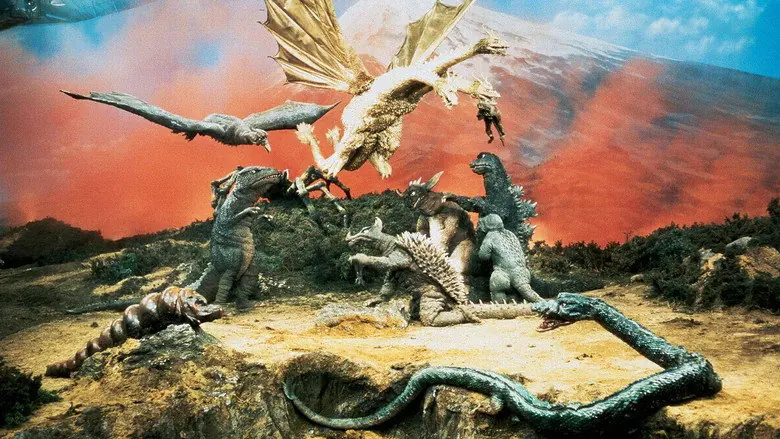
The project grew out of a 1967 screenplay by Takeshi Kimura, credited under the pen name Kaoru Mabuchi, titled Monster Chushingura, which aimed to gather nearly every monster from Toho's roster. Kimura and Ishirō Honda reworked that draft into the final script, which Honda co-wrote. Ideas such as lunar colonies and hybrid monsters were dropped for budget and planning reasons, and Honda's fascination with a monster farm ended up barely present on screen. Sadamasa Arikawa directed the special effects, with Eiji Tsuburaya credited as supervisor. Footage from Ghidorah, the Three-Headed Monster (1964) was reused for King Ghidorah's fiery birth. Haruo Nakajima returned as Godzilla.
Reception and legacy
The film premiered in Japan in August 1968 and reached American screens in 1969 in an English-language version released by American International Pictures. Contemporary American reviews were mixed, with praise mostly reserved for the climactic monster battle, and its reputation has grown since. Audience and critic scores on sites such as Rotten Tomatoes, IMDb and Letterboxd are generally favorable. Critics pointed to a weak plot and thin characterization but enjoyed the spectacle. Its legacy includes a three-episode arc in the animated series Godzilla: The Series, Monster Wars, inspired by the film, and Gareth Edwards has said he was interested in drawing on it for a sequel to his 2014 Godzilla.
Stills


Trailer
Clicking loads the video from YouTube (privacy-enhanced mode). Open on YouTube
Trivia
A script with every monster
The first 1967 draft aimed to include nearly all of Toho's monsters, even King Kong, though later versions cut the roster down.
A misstep
During the attack on Tokyo, Godzilla steps over a model construction crane, which Haruo Nakajima later said he did to avoid tripping and falling.
More films by Ishirō Honda
 Godzilla
 Dreams
 King Kong vs. Godzilla
 Invasion of Astro-Monster
 Mothra vs. Godzilla
 King Kong Escapes
Original Cinematopedia text based on Wikipedia (es) and Wikipedia (en) and Wikidata.