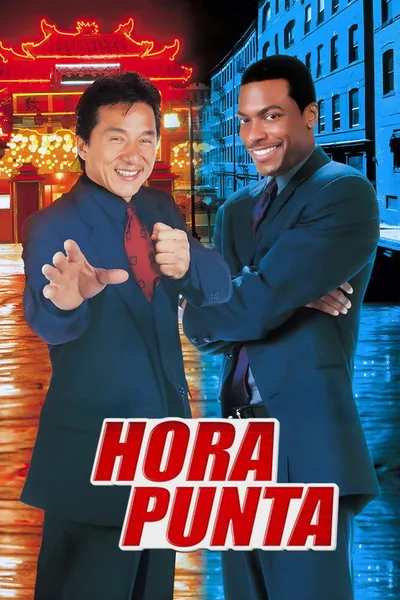
Rush Hour
1998 · United States · 98 min
- Director
- Brett Ratner
- Screenplay
- Jim Kouf
- Producer
- Roger Birnbaum, Jonathan Glickman
- Music
- Lalo Schifrin
- Cinematography
- Adam Greenberg
- Editing
- Mark Helfrich
- Production company
- New Line Cinema
Cast
What it is about
On the final days of British rule in Hong Kong, Inspector Lee leads a raid against a triad gang and recovers valuable Chinese artifacts. Soon after, in Los Angeles, the daughter of the Chinese consul, Soo Yung, is kidnapped on her first day at school. Fearful that Lee's involvement could spark a diplomatic incident, American authorities hand him over to the Los Angeles police, effectively keeping him out of the investigation. He is assigned to Detective James Carter, a brash officer whom his colleagues find hard to stomach and who sees the case as a chance to prove himself. The two are soon forced to work together, despite their clashing methods and language barrier, as the investigation grows more complicated.
How it was made
The project began with an original script by Ross LaManna, which was first sold to Hollywood Pictures with Brett Ratner and Jackie Chan attached. After a long stretch in development limbo, the film was picked up by New Line Cinema, which already had a working relationship with Ratner and Chris Tucker from Money Talks (1997). Tucker was among the last major casting decisions, and the cast was complete by early 1997. Principal photography ran from November 1997 to January 1998, with locations in California, Los Angeles and Hong Kong. The film pairs Tucker's rapid-fire comedy with Chan's action choreography, building its appeal on the contrast between the two leads. Lalo Schifrin composed the score and Adam Greenberg served as cinematographer.
Reception and legacy
Rush Hour opened in the United States on September 18, 1998, through New Line Cinema. Critics responded positively, praising the chemistry and performances of Chan and Tucker. It was a commercial hit, grossing about 245 million dollars worldwide, and spawned two sequels, Rush Hour 2 (2001) and Rush Hour 3 (2007). Its formula helped popularize the mismatched cop buddy comedy and the Hollywood star vehicle for Asian martial arts actors.
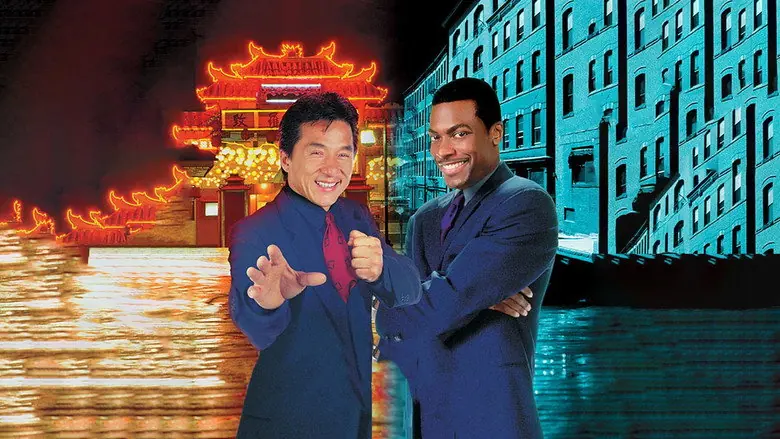
Stills


Trailer
Clicking loads the video from YouTube (privacy-enhanced mode). Open on YouTube
Trivia
A box office hit
The film became one of the year's biggest earners in the United States, taking in more than 140 million dollars domestically.
A project that waited years
The original script passed through several studios before New Line Cinema acquired it, delaying its arrival in theaters.
More films by Brett Ratner
 X-Men: The Last Stand
 Rush Hour 2
 Rush Hour 3
 Red Dragon
 Hercules
 After the Sunset
Original Cinematopedia text based on Wikipedia (es) and Wikipedia (en) and Wikidata.