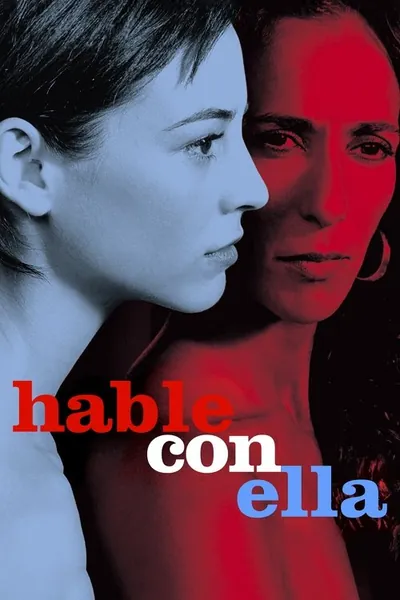
Talk to Her
Hable con ella
2002 · Spain · 112 min
- Director
- Pedro Almodóvar
- Screenplay
- Pedro Almodóvar
- Producer
- Agustín Almodóvar
- Music
- Alberto Iglesias
- Cinematography
- Javier Aguirresarobe
- Editing
- José Salcedo
- Production company
- El Deseo
Awards: Academy Award for Best Writing, Original Screenplay; Golden Globe Award for Best Non-English Language Film; European Film Award for Best Film; European Film Award for Best Director; European Film Award - People's Choice Award for Best Director; European Film Award for Best Screenwriter… · 9 nominations
Cast
What it is about
Benigno and Marco are two men who, for very different reasons, find themselves in the same waiting game. They first meet at a performance of Pina Bausch's Café Müller, where Marco's tears catch Benigno's attention. Months later their paths cross again at a private clinic, where Benigno works as a nurse and Marco keeps vigil over Lydia, a bullfighter left in a coma after being gored. There they also meet Alicia, a young dancer who is unconscious and under Benigno's care. The film follows how these two strangers, bound together by bedside vigils and loneliness, form an unusual friendship, while the four characters' stories интertwine through memories and shifts in time.
How it was made
Pedro Almodóvar wrote and directed the film, which was produced by Agustín Almodóvar through El Deseo; Agustín also appears in the cast, as a priest. Alberto Iglesias composed the score, Javier Aguirresarobe shot the film and José Salcedo Palomeque edited it. Filming took place in Madrid and Córdoba. The cast includes Javier Cámara, Darío Grandinetti, Leonor Watling, Rosario Flores and Geraldine Chaplin, and Pina Bausch appears as a dancer in the performance that opens the story. The narrative relies on flashbacks that reconstruct both relationships, and a fictional silent short, Amante menguante, offers a thematic counterpoint. Critics noted its calm handling of isolation, miscommunication and irrational passion.
Reception and legacy
Released in Spain in March 2002, the film was warmly received, especially abroad, where it won the Academy Award for Best Original Screenplay, making Almodóvar the first Spanish screenwriter to win that honour, and earned a nomination for Best Director along with the Golden Globe for Best Foreign Language Film. It also took two BAFTAs, for Best Film Not in the English Language and Best Original Screenplay. Its reception at home was more muted: the Spanish Academy did not submit it for the Oscars, and it won the Goya for Best Original Score. Over time it has come to be regarded as one of Almodóvar's finest works and one of the most important Spanish films of the twenty-first century.
Stills


Trailer
Clicking loads the video from YouTube (privacy-enhanced mode). Open on YouTube
Trivia
Caetano Veloso on screen
Brazilian singer Caetano Veloso appears as himself, performing "Cucurrucucú paloma" at a party.
A choreographer in her own role
Choreographer Pina Bausch, whose show Café Müller opens the story, also appears in the cast as a dancer.
More films by Pedro Almodóvar
 All About My Mother
 Volver
 The Room Next Door
 Bad Education
 Pain and Glory
 Women on the Verge of a Nervous Breakdown
Original Cinematopedia text based on Wikipedia (es) and Wikipedia (en) and Wikidata.