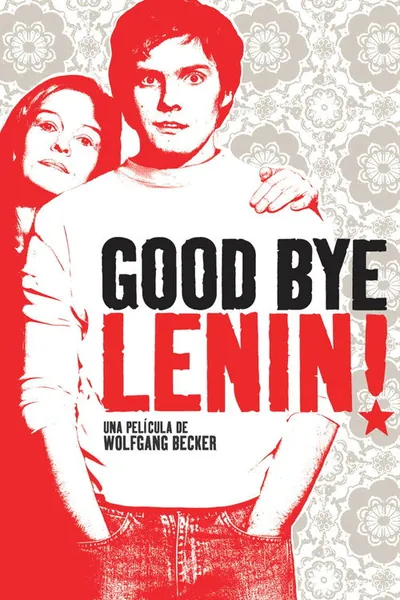
Good Bye, Lenin!
Good Bye
2003 · Germany · 125 min
- Director
- Wolfgang Becker
- Screenplay
- Wolfgang Becker, Bernd Lichtenberg
- Producer
- Stefan Arndt, Manuela Stehr, Andreas Schreitmüller, Katja De Bock
- Music
- Yann Tiersen
- Cinematography
- Martin Kukula
- Editing
- Peter R. Adam
- Production company
- X-Filme Creative Pool
Awards: César Award for Best Film from the European Union; European Film Award for Best Film; European Film Award for Best Actor; European Film Award for Best Director; European Film Award - People's Choice Award for Best Director; European Film Award for Best Screenwriter… · 9 nominations
Cast
What it is about
East Berlin, October 1989. Christiane Kerner is a devoted socialist whose son Alex is arrested during a protest. Shortly afterwards she suffers a heart attack and falls into a coma. When she wakes up eight months later, the Wall has fallen and the GDR no longer exists as a state. Her doctor warns the family that any shock could be fatal, so Alex decides to hide the changes and recreate, inside the flat, the world his mother knew. The comedy grows out of this domestic charade, which becomes more complicated with the neighbours, his sister and a friend who dreams of becoming a filmmaker, while Alex, torn between affection and rebellion, slowly reconstructs the story of his own family.
How it was made
The project came from screenwriter Bernd Lichtenberg, who had been carrying a story drawn from his own experience as a young West Berliner during reunification. The script sat in a drawer for some years until Lichtenberg saw Wolfgang Becker's Life Is All You Get and felt Becker could find the mix of sadness and humour he wanted. Becker and producer Stefan Arndt refined the script through six drafts and several interim versions. Denis, originally conceived as a main character, was reworked into a supporting role. Most of the shooting took place on the Karl-Marx-Allee and around prefabricated apartment blocks near Alexanderplatz. Yann Tiersen's score recalls his earlier work on Amélie, and the piano piece Comptine d'un autre été: L'après-midi appears in both films. Real East German songs also feature, including Unsere Heimat and Bau Auf!
Reception and legacy
The film was widely received in Germany and across Europe. It won the European Film Award for Best Film in 2003 and the César for Best European Union Film. It also took the German Film Award for Best Fiction Film, and it earned European Film Award recognition in the categories of director, actor and screenwriter. Its blend of comedy and melancholy about memories of the GDR made it a point of reference for looking at reunification through everyday life, and it is often cited as one of the most representative German titles of that outlook.
Stills


Trailer
Clicking loads the video from YouTube (privacy-enhanced mode). Open on YouTube
Trivia
A character who lost prominence
Denis was originally a main character, a young man of Turkish origin who was to be married against his will. After rewrites he became an aspiring filmmaker and moved into a supporting role.
Six drafts
Before it was finished, the script went through six drafts and several interim versions. Lichtenberg wrote the first ones alone, while Becker pushed for changes, mainly to the characters.
More films by Wolfgang Becker
 Schmetterlinge
 Me and Kaminski
Original Cinematopedia text based on Wikipedia (es) and Wikipedia (en) and Wikidata.