
Ordinary People
1980 · United States · 124 min
- Director
- Robert Redford
- Screenplay
- Alvin Sargent, Judith Guest, Nancy Dowd
- Producer
- Ronald L. Schwary
- Music
- Marvin Hamlisch
- Cinematography
- John Bailey
- Editing
- Jeff Kanew
- Production company
- Paramount Pictures
- Based on
- Ordinary People
Awards: Academy Award for Best Picture; Academy Award for Best Director; Academy Award for Best Supporting Actor; Academy Award for Best Writing, Adapted Screenplay; National Board of Review Award for Best Film; National Board of Review: Top Ten Films · 5 nominations
Cast
What it is about
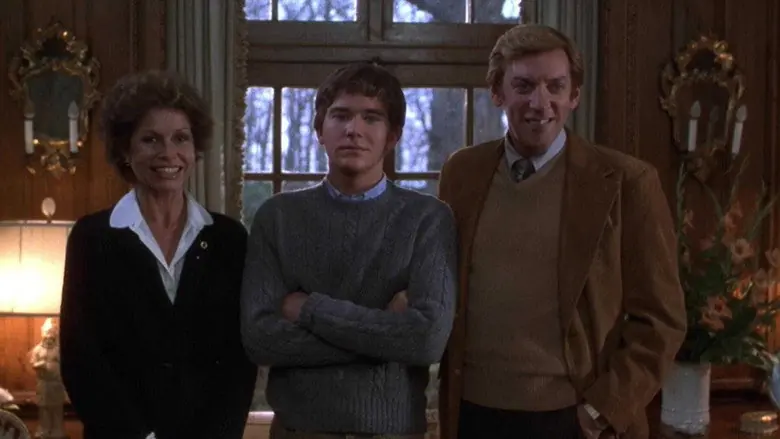
Ordinary People is a 1980 American family drama that follows the Jarretts, an affluent household in Lake Forest, a wealthy suburb north of Chicago. From the outside they look like a model family, but a recent tragedy has left its members without words for what happened and without a clear place for their grief. The younger son, Conrad, returns home after four months in a psychiatric hospital, and his return forces everyone to face what they have tried to bury under routine and appearances. The film watches each of them try to hold on to some version of normal life: the father, Calvin, who wants harmony at any cost; the mother, Beth, who seems to take refuge in order and composure; and Conrad, who struggles to make sense of his experience. Conrad begins treatment with a psychiatrist, Dr. Berger, and slowly tries to build new relationships outside the house, in a process that is halting and full of setbacks. The story relies on conversations, silences and small everyday clashes rather than on action, and it asks how a family can keep functioning when grief is not shared.
How it was made
The film marked the directing debut of Robert Redford, already a well-known actor when he stepped behind the camera. It is based on Judith Guest's 1976 novel of the same name, and the screenplay was written by Alvin Sargent, who adapted the book for the screen. The film was released by Paramount Pictures. The cast pairs Donald Sutherland and Mary Tyler Moore as the parents, with Timothy Hutton, then a relatively unknown young actor, as Conrad, who became the emotional center of the story. According to accounts of the production, Gene Hackman was at one point cast as Calvin but eventually left the project after he and the studio could not reach a financial agreement. Michael J. Fox, who had just moved to Los Angeles, auditioned for the role of Conrad but reportedly did not impress Redford. Natalie Wood was also considered for the part of Beth. The visual style is restrained: Redford keeps the staging calm, using spacious, bright suburban interiors that contrast with the tension building between the characters. The direction avoids underlining emotions and lets the actors carry scenes, especially the exchanges between mother and son and the arguments between the couple. The score makes prominent use of Pachelbel's Canon, a piece that had been relatively obscure for centuries and that became far more visible in mainstream culture after the film. The budget was modest, about 6.2 million dollars, and the shoot concentrated on performance rather than spectacle.
Reception and legacy
Ordinary People opened in American theaters on September 19, 1980, and achieved both commercial and critical success. It grossed about 90 million dollars worldwide, a strong result for a drama made on a restrained budget. Critics praised Redford's direction, Sargent's screenplay and the work of the cast. Roger Ebert gave it four stars and noted that the film does not treat its affluent setting as the source of its characters' problems, but lets those problems grow out of the people themselves. Rotten Tomatoes records a favorable rating of around ninety percent, and audiences polled by CinemaScore gave it a rare A+. During awards season it received six Academy Award nominations and won four: Best Picture, Best Director, Best Adapted Screenplay, and Best Supporting Actor for Timothy Hutton, who at twenty was the youngest winner in that category at the time. Mary Tyler Moore earned a Best Actress nomination, and Judd Hirsch was nominated as Best Supporting Actor, losing to Hutton. At the Golden Globes the film won five awards, including Best Motion Picture – Drama, Best Director, Best Actress for Moore, and Best Supporting Actor and New Star of the Year for Hutton. Sutherland, who received a Golden Globe nomination, was left out of the Oscar nominations, an omission many commentators have since regarded as a notable snub. The film also reshaped Moore's career, moving her away from the television roles that had made her famous, and it launched the career of Elizabeth McGovern. Psychiatrists praised the portrayal of Dr. Berger as a rare positive depiction of their profession on screen. Over the years the film has become a reference point for the family drama of the early 1980s, and its screenplay ranked 58th on the Writers Guild of America West list of the 101 greatest screenplays. In 2025, Pope Leo XIV said that it was one of his favorite films.
Stills


Trailer
Clicking loads the video from YouTube (privacy-enhanced mode). Open on YouTube
Trivia
A role that changed hands
Gene Hackman was first cast as Calvin, but he left the project after he and the studio could not agree on financial terms.
A forgettable audition
Michael J. Fox, who had just arrived in Los Angeles, auditioned for Conrad, a test that reportedly did not impress Redford.
Filming while studying
Elizabeth McGovern received special permission to film the movie while she was attending Juilliard.
More films by Robert Redford
 Quiz Show
 A River Runs Through It
 The Horse Whisperer
 Lions for Lambs
 The Legend of Bagger Vance
 The Company You Keep
Original Cinematopedia text based on Wikipedia (es) and Wikipedia (en) and Wikidata.