Faust
Fausto
1926 · Germany, Weimar Republic · 106 min
- Director
- F. W. Murnau
- Screenplay
- Gerhart Hauptmann, Hans Kyser
- Producer
- Erich Pommer
- Music
- Werner R. Heymann
- Cinematography
- Carl Hoffmann
- Production company
- UFA
Cast
What it is about
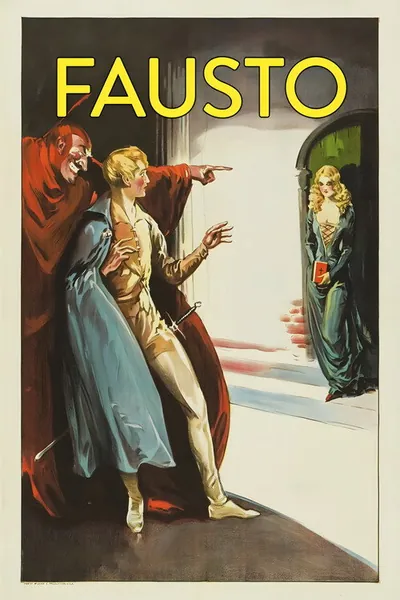
Mephisto makes a wager with an Archangel: if he can corrupt a righteous man's soul, the Devil will rule the earth. A plague strikes the village where Fausto, an elderly sage, lives. Desperate and disillusioned, he turns away from his books and calls upon the Devil. After a brief pact, he regains his youth in exchange for his soul and falls in love with Gretchen, an innocent young woman. The film follows the folk legend and Goethe's version, with a pace that recalls classic theatre, and explores the tension between desire, guilt and faith.
How it was made
Murnau pushed for the directing job, which Ufa had first considered giving to Ludwig Berger, and he gained the backing of Emil Jannings. It was the most ambitious and costly production of the studio until Metropolis surpassed it the following year, and shooting lasted about six months. Murnau used two cameras and filmed many scenes repeatedly; one sequence showing a contract written on parchment in fire took an entire day. The screenplay went through several hands. Hans Kyser first wrote the intertitles, but the studio later hired Gerhart Hauptmann, whose new titles were never used in the final release. Carl Hoffmann's cinematography relies on strong contrasts of light and shadow, and the special effects, such as Mephisto's winged appearance, are central to the film. It is associated with German Expressionism, though it also draws on Romantic painting.
Reception and legacy
It was a financial failure, recovering only half its cost, and German critics responded with hostility to its departures from Goethe and to Gösta Ekman's performance. Its reputation grew considerably over the following years, and it is now regarded as one of the canonical examples of German Expressionist cinema. Its influence can be seen above all in the special effects of later films. It was also Murnau's last German film, as he soon made Sunrise in the United States. According to the review aggregator Rotten Tomatoes, it holds a 91% approval rating.
Stills


Trailer
Clicking loads the video from YouTube (privacy-enhanced mode). Open on YouTube
Trivia
Swapped intertitles
Gerhart Hauptmann wrote new intertitles for twice Ufa's offer, which led to a bitter exchange of letters with Hans Kyser. In the end, the release used Kyser's titles.
Burning parchment scene
A short sequence showing the contract being written on burning parchment took an entire day to film.
More films by F. W. Murnau
 Sunrise: A Song of Two Humans
 Nosferatu
 Tabu: A Story of the South Seas
 The Last Laugh
 4 Devils
Original Cinematopedia text based on Wikipedia (es) and Wikipedia (en) and Wikidata.