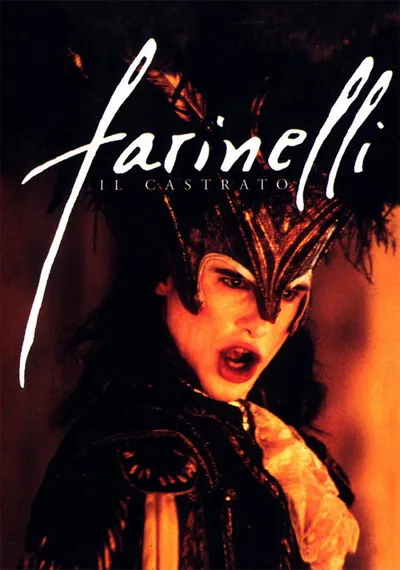
Farinelli
1994 · Belgium, Italy, France · 111 min
- Director
- Gérard Corbiau
- Screenplay
- Gérard Corbiau, Marcel Beaulieu
- Producer
- Véra Belmont
- Music
- Christophe Rousset
- Cinematography
- Walther van den Ende
- Editing
- Joëlle Hache
Awards: · 2 nominations
What the critics say
60 % Rotten Tomatoes positive reviewsCast
What it is about
The film opens in Madrid, at the palace of King Philip V of Spain, where Riccardo Broschi asks to see his brother Carlo, now known as Farinelli and a celebrated opera star. Carlo refuses, and the story then turns back to show his childhood as a singer in a church choir, his bond with an older brother who writes music for him, and the presence of his teacher Nicola Porpora. From there the film builds a drama of musical rivalries, loyalties and family wounds. It blends episodes from the singer's life with a highly personal view of his career and emotional ties, focusing on a man whose voice brought him fame at the cost of a mutilation that shaped his whole life.
How it was made
A co-production between Italy, Belgium and France, directed by Gérard Corbiau, who wrote the screenplay with Marcel Beaulieu. Stefano Dionisi takes the title role, while Jeroen Krabbé plays Handel, cast as an almost villainous rival. The singing voice was built by digitally merging recordings by the Polish soprano Ewa Malas-Godlewska and the American countertenor Derek Lee Ragin, in an effort to recreate the sound of a castrato. The musical direction was by harpsichordist Christophe Rousset, and the recording was made at the Arsenal concert hall in Metz with the orchestra Les Talens Lyriques. Some scenes were shot at the Margravial Opera House in Bayreuth. The film is loosely based on real events but takes many liberties: it overstates the role of the brother at the expense of Porpora, invents the origin of the stage name, and dramatises a psychological relationship that historians regard as largely speculative.
Reception and legacy
Farinelli was released in 1994 and won the Golden Globe for Best Foreign Language Film in 1995. It was also nominated for the Academy Award in the same category, with Belgium submitting it. On Rotten Tomatoes it holds a 60% approval rating from 25 reviews, with an average score of 6 out of 10. Critics praised the vocal work and the musical recreation, while its historical liberties drew debate. It is remembered today as one of the best-known European films about the world of the castrati and Baroque opera, and as an example of how a biographical film can reinvent a figure about whom relatively little is known.
Stills


Trailer
Clicking loads the video from YouTube (privacy-enhanced mode). Open on YouTube
Trivia
A composite voice
Farinelli's voice does not come from a single singer: recordings by a Polish soprano and an American countertenor were digitally merged.
Baroque setting
Part of the shoot took place at the Margravial Opera House in Bayreuth, one of Germany's best-known Baroque theatres.
More films by Gérard Corbiau
 The King Dances
 The Music Teacher
Original Cinematopedia text based on Wikipedia (es) and Wikipedia (en) and Wikidata.