Hard to Be a God
El poder de un dios
1989 · Switzerland, France, Germany · 135 min
- Director
- Peter Fleischmann
- Screenplay
- Boris Strugatsky, Arkady Strugatsky, Peter Fleischmann, Jean-Claude Carrière, Pierre Christin, Dal Orlov
- Music
- Jürgen Fritz
- Cinematography
- Pavel Lebeshev
- Production company
- Dovzhenko Film Studios
- Based on
- Hard to Be a God
Cast
What it is about
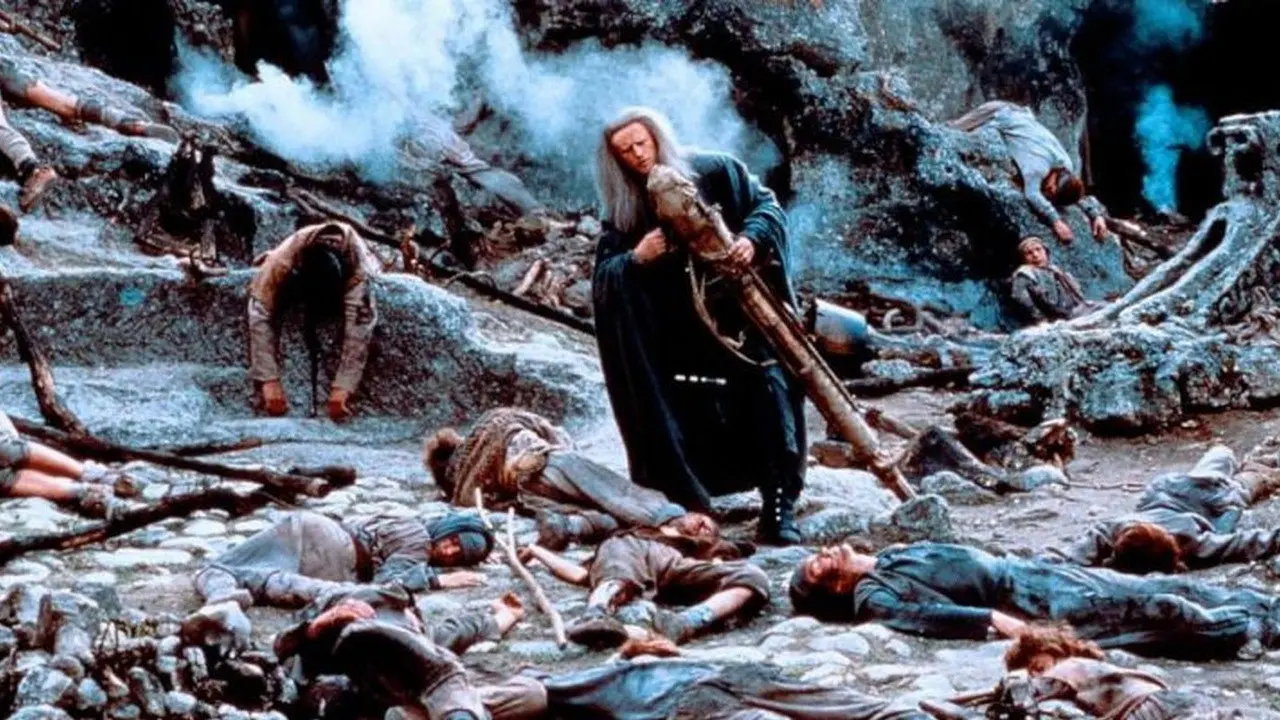
In the third millennium, humanity has achieved a peaceful existence built on reason and emotional control. When explorers discover a medieval human civilization on a distant planet, they decide to observe it to learn whether people there still carry barbaric instincts. An agent is sent to live in the city of Arkanar disguised as a wealthy nobleman, Don Rumata, with a camera implanted in his eye. Forbidden from interfering, he finds it increasingly hard to stand by as the townspeople suffer under oppression.
How it was made
Peter Fleischmann began developing the project in 1983, based on the novel by the Strugatsky brothers. In 1984 a deal was struck for the first co-production between West Germany and the Soviet Union, with Kyiv's Dovzhenko Film Studios as a partner. Financing came from West German public funds, broadcaster ZDF and the Bavarian government, plus private investors and distributors. Filming, planned near Kyiv for 1986, was delayed by the Chernobyl disaster and later by perestroika reforms. A large set was built in Yalta, with locations in Tajikistan. The crew mixed Western and Soviet professionals. Werner Herzog plays the observer Mita, and the score was composed by Jürgen Fritz, former keyboardist of the progressive rock band Triumvirat.
Reception and legacy
Directed by Fleischmann, the film is a co-production of West Germany, the Soviet Union, France and Switzerland, released in 1989. Adapting a 1964 novel, it stands among the notable science fiction films made from the Soviet bloc. Its 135-minute running time and bleak tone divided critics, who praised its visual ambition and its reflection on intervening in foreign societies. Historically, it is a singular production, emerging from the thaw between East and West.
Stills


Trailer
Clicking loads the video from YouTube (privacy-enhanced mode). Open on YouTube
Trivia
A pioneering co-production
It was the first co-production between West Germany and the Soviet Union, agreed in 1984.
Chernobyl and perestroika
The Chernobyl disaster delayed the shoot planned for 1986, and perestroika reforms pushed it back further.
More films by Peter Fleischmann
 Hunting Scenes from Bavaria
 The Hamburg Syndrome
Original Cinematopedia text based on Wikipedia (en) and Wikidata.