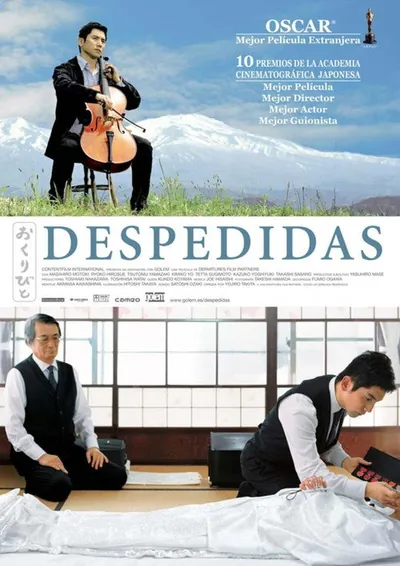
Departures
Okuribito
2008 · Japan · 131 min
- Director
- Yōjirō Takita
- Screenplay
- Aoki Shinmon, Kundō Koyama
- Music
- Joe Hisaishi
- Cinematography
- Takeshi Hamada
- Editing
- Akimasa Kawashima
- Production company
- TBS Television
Awards: Academy Award for Best International Feature Film; Japan Academy Prize for Picture of the Year; Japan Academy Prize for Director of the Year; Japan Academy Prize for Outstanding Performance by an Actor in a Leading Role; Japan Academy Prize for Screenplay of the Year; Asian Film Award for Best Actor… · 8 nominations
Cast
What it is about
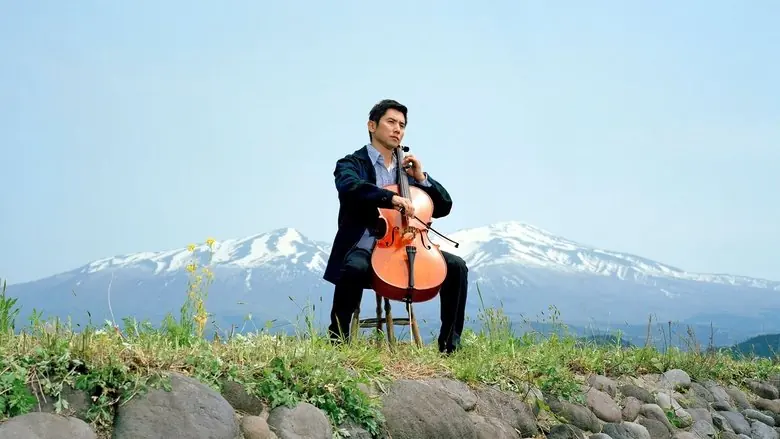
Daigo Kobayashi loses his job as a cellist when his orchestra is disbanded. He and his wife, Mika, move to his hometown of Yamagata, where they settle into the house he inherited after his mother's death. The place stirs up mixed memories, especially of the café his father once ran at the front of the building and of the family rupture that marked his childhood. An advertisement he takes for a travel agency leads him to an interview at the NK Agent office, where he learns the job involves preparing bodies within a traditional funeral ritual. Daigo accepts the position but keeps the true nature of the work from Mika. As the days pass, he faces rejection from people around him and a trade that few want to look at closely. The film is a drama about grief, professional pride and family ties, with moments of humour.
How it was made
The project grew out of Coffinman, a book by Aoki Shinmon, which caught the attention of Masahiro Motoki, who had been moved by a funeral he witnessed on the Ganges while travelling in India. Kundō Koyama wrote the screenplay based on that book. Financing proved difficult, and the shoot had to work around restrictions linked to the social prejudice against death, which many Japanese regard as a source of spiritual impurity. Yōjirō Takita directed, with music by Joe Hisaishi, cinematography by Takeshi Hamada and editing by Akimasa Kawashima. The encoffining rite, known as nōkan, is staged with care, although the sources note it is rarely practised today and mainly in rural areas. The production was backed by Tokyo Broadcasting System Television.
Reception and legacy
Distributors were initially reluctant to release the film because of its subject, until it won the Grand Prix of the Jury at the Montreal World Film Festival in August 2008. It opened in Japan the following month, where it became a major box-office hit, and it earned about 69.9 million dollars worldwide. Critics praised the performances, the direction and the blend of humour and drama, though some objected to its length, its predictability and its sentimentality. In February 2009 the Japan Academy named it the year's best picture, and it later won the Academy Award for Best Foreign Language Film, the first Japanese production to do so. Its success led to literary adaptations, a stage production and renewed interest in the ritual it depicts.
Stills


Trailer
Clicking loads the video from YouTube (privacy-enhanced mode). Open on YouTube
More films by Yōjirō Takita
 When the Last Sword Is Drawn
 Tenchi: The Samurai Astronomer
 Secret
 Onmyoji 2
Original Cinematopedia text based on Wikipedia (es) and Wikipedia (en) and Wikidata.