
Chronicle of a Disappearance
Crónica de una desaparición
1996 · 88 min
- Director
- Elia Suleiman
- Screenplay
- Elia Suleiman
- Producer
- Elia Suleiman
What the critics say
83 % Rotten Tomatoes positive reviewsCast
What it is about
The film is set during the tense stage of the Israeli-Palestinian peace process, shortly after the assassination of Yitzhak Rabin and the election of Benjamin Netanyahu, though these tensions remain largely implied rather than shown. It is organised into two main sections, loosely linked as the story of Elia Suleiman's return to the West Bank and Israel after a long absence. The protagonist, credited only as E.S., comes back from twelve years in New York and finds a land he barely recognises. There is no conventional plot or character arc; instead, a sequence of almost unconnected scenes builds up images and dialogue that convey the unease of living without a state.
How it was made
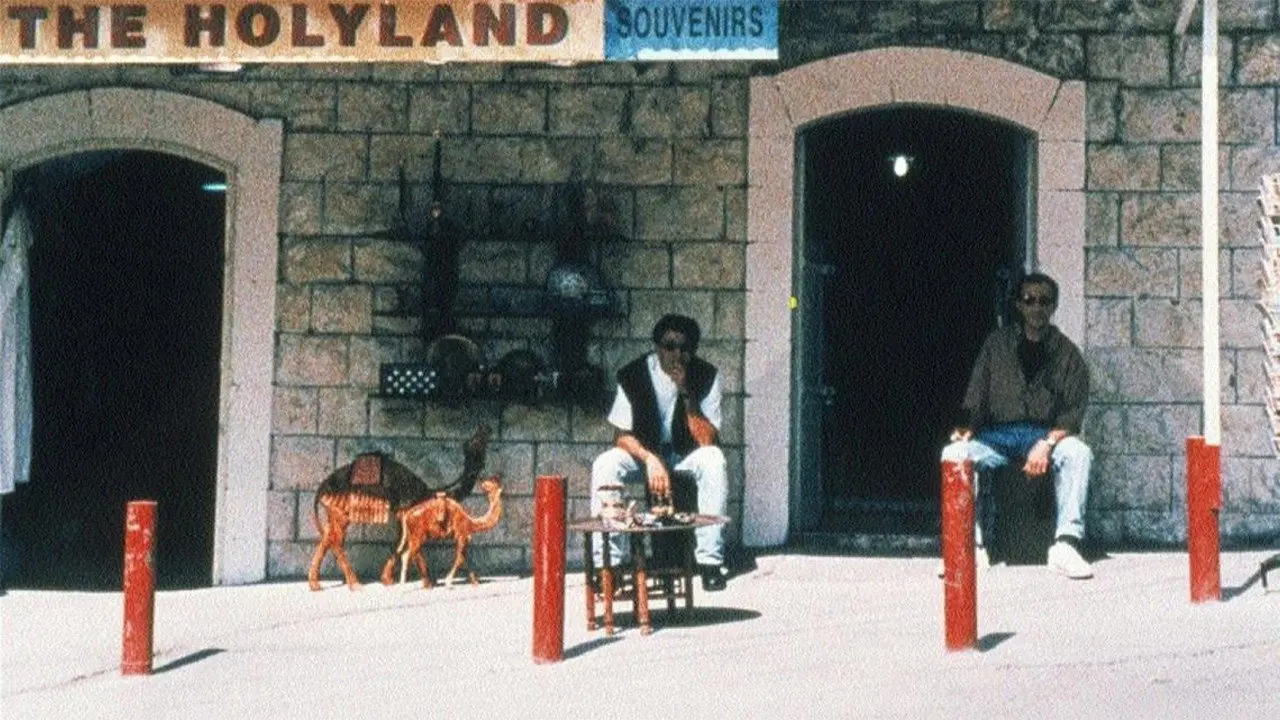
Suleiman, born in Nazareth, plays the lead and casts family members and friends, most of them non-professional actors, in the main roles. It is his first feature after two short films, and Dhat Productions produced it with support from several European and Israeli bodies. The script has no dramatic spine and is built from vignettes with different tones: the first section is light and domestic, while the last is more political and moves faster. The result is a style of static shots and dry humour, with dialogue in Arabic, Hebrew, English, French and Russian.
Reception and legacy
The film earned wide critical praise abroad. It was screened at Sundance and in the Museum of Modern Art's New Directors/New Films series, and at the 1996 Venice Film Festival it won the Best First Film prize. In 1999 a group of Israeli critics, cited by The New York Times, chose it as the best Israeli film of the year. It was also one of the few Palestinian films to receive a national release in the United States, in autumn 1997. Opinions were not uniform: some reviewers praised its minimalism and calm tone, while others found it distant and abstract.
Stills


Trivia
A shifting tone
The film is split into vignettes with different registers, from domestic scenes in Nazareth to a political segment in Jerusalem that leans toward farce.
Family in the cast
Suleiman cast relatives and friends in the roles, and he plays himself under the credit E.S.
More films by Elia Suleiman
 To Each His Own Cinema
 Divine Intervention
 7 Days in Havana
 The Time That Remains
 It Must Be Heaven
Original Cinematopedia text based on Wikipedia (es) and Wikipedia (en) and Wikidata.