
Crash
1996 · Canada, United Kingdom · 100 min
- Director
- David Cronenberg
- Screenplay
- David Cronenberg
- Producer
- Robert Lantos, Jeremy Thomas
- Music
- Howard Shore
- Cinematography
- Peter Suschitzky
- Editing
- Ronald Sanders
- Production company
- Crave, Telefilm Canada
- Based on
- Crash
Cast
What it is about
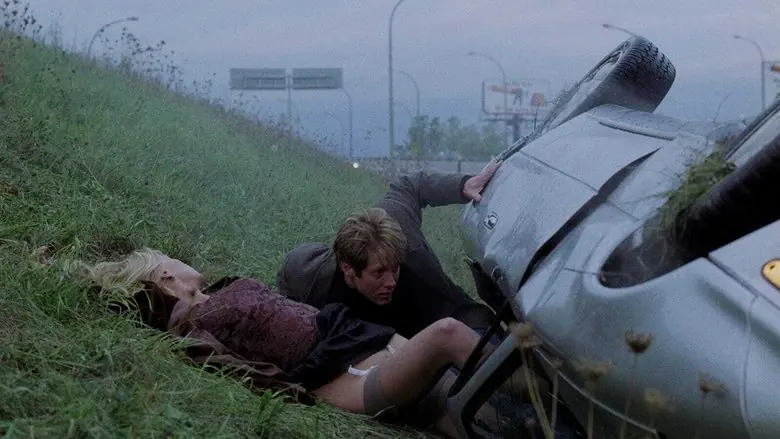
James Ballard, a film producer and advertising executive, is in an open marriage with his wife Catherine, and the two use the details of their outside encounters to fuel their own intimacy. One night, driving home from work, Ballard is involved in a head-on collision that kills the other driver. In hospital he meets again Dr. Helen Remington, the woman whose husband died in the crash, and the two start an affair built largely on their shared experience of the accident. Through Helen, Ballard is drawn into the orbit of Vaughan, a charismatic man who leads a circle of people fascinated by car crashes. Within that group, the characters' relationships grow more tangled, and the fascination with violence on the road becomes the film's central concern.
How it was made
The project began when producer Jeremy Thomas, who would later work with Cronenberg on Naked Lunch, urged him to read J. G. Ballard's 1973 novel. Cronenberg found it so disturbing that he could only get through half at first, before returning to it and recognising its strength. He wrote the screenplay himself, staying close to the book while inventing the ending and cutting some scenes. The setting moved from London to Toronto. Because of tight finances, the shooting script was kept deliberately short, around 77 pages, which allowed a slow, meticulous shoot. Howard Shore composed the score on a reduced budget, and Peter Suschitzky's cold, clinical photography suits the film's detached tone.
Reception and legacy
Crash caused intense controversy from its Cannes premiere, where it won a Special Jury Prize amid boos; Cronenberg later said that jury president Francis Ford Coppola had opposed it strongly. In Britain a tabloid campaign sought to ban it, but the board passed it uncut with an 18 certificate. In the United States, a delayed release and restrictions by some cinema chains fuelled further debate. Critics were divided, with some praising its daring and originality and others rejecting its violence and sexual content. Over time it has come to be regarded as one of Cronenberg's most singular and contested works, and it earned six Genie Awards in Canada.
Stills


Trailer
Clicking loads the video from YouTube (privacy-enhanced mode). Open on YouTube
Trivia
An unusual prize at Cannes
The Special Jury Prize it received is distinct from the regular Jury Prize and is not awarded every year, only at the official jury's request.
A very short script
The shooting script ran to about 77 pages, a length Cronenberg chose for budget reasons and to allow a slow, detail-focused shoot.
More films by David Cronenberg
 The Fly
 A History of Violence
 Eastern Promises
 A Dangerous Method
 The Dead Zone
 Dead Ringers
Original Cinematopedia text based on Wikipedia (es) and Wikipedia (en) and Wikidata.